Kampala
Uganda has a problem that most food-producing nations would consider a luxury: it is producing far more milk than it can drink. National output has climbed to roughly 5.4 billion litres a year, President Yoweri Museveni told an Egyptian investment delegation at State House Entebbe recently, against domestic consumption of only about 800 million litres. That leaves a surplus of some 4.6 billion litres annually — an ocean of milk that either needs a market or curdles into wasted farmer income. Into that gap has stepped the Arab Organization for Industrialization (AOI), a state-backed Egyptian industrial conglomerate, with a proposal that could reshape Uganda's dairy landscape: a mega-processing plant in Ngoma, Nakaseke District, reported by the Daily Monitor to carry a price tag of roughly Shs3 trillion and designed to process up to one million litres of milk a day.
THE MEETING THAT PUT NGOMA ON THE MAP
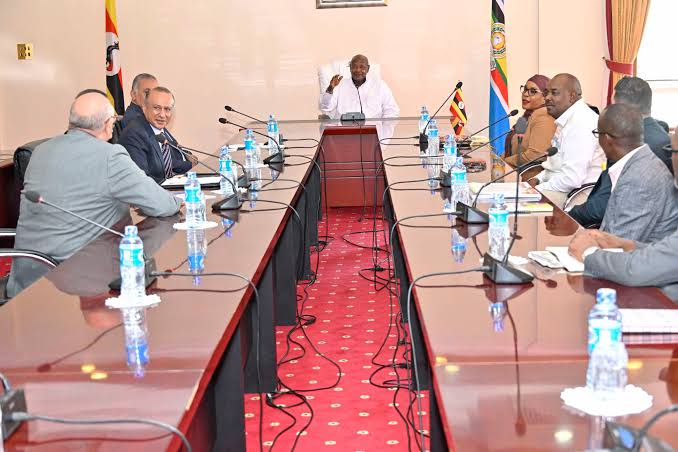
The proposal was laid out at a high-level meeting at State House Entebbe, where Museveni hosted a delegation led by Maj. Gen. Khaled Shokry Ghaith, consultant to the AOI chairman, alongside Egyptian investors Maj. Gen. Abdelkader Mohamed Nagy and Abdel Nasser Mohamed. AOI, established in 1975, is a heavyweight in Egyptian industrial policy with existing footprints in manufacturing, railway systems, renewable energy and electronics; a move into East African dairy processing would be a significant diversification for the conglomerate and a notable vote of confidence in Uganda's agricultural sector from North African capital.
Museveni was characteristically blunt about the scale of the ambition. "We are now producing 5.4 billion litres a year and we are going to overtake Holland," he told the delegation, a reference to the Netherlands' status as one of the world's dairy-export powerhouses despite its tiny landmass. He framed the investment as confirmation that Uganda's decades-long push to shift cattle-keeping from a subsistence and cultural practice — "we have been keeping cows for the last 7,000 years," he noted — into a commercial, export-oriented industry is finally bearing fruit.
WHY NGOMA, AND WHY NOW
The choice of Ngoma is not accidental. It sits within Uganda's cattle corridor, the vast arc of rangeland stretching from the country's south through its central districts into the drought-prone northeast, and local farmers there have been waiting for exactly this kind of investment for years. David Kato Muyambi, a dairy farmer from Ngoma who addressed the meeting, described the frustration that has defined milk production in the area: "After milking about 300 litres of milk, we did not have enough capacity for transportation. In 2021, we started looking for people who could help us establish a factory in Ngoma," he said, adding that he has personally offered land for the plant's construction and that the surrounding community is ready to support the project. Farmers in the area have also welcomed recent tarmacking of the Luweero–Butalangu Road, which has already improved their ability to move milk to market and made the district more attractive to processors scouting locations.
The timing also reflects mounting pressure on Uganda to diversify where its dairy exports go. The country's milk sector has faced intermittent trade blockades and quotas from Kenya, its traditional East African Community trading partner, pushing Ugandan processors and policymakers to look further afield — including to Nigeria, which opened its market to Ugandan milk after the Kenyan route narrowed. An Egyptian-anchored processing plant would give Uganda a foothold to convert raw milk into higher-value powders, cheese and butter aimed at the broader continental market opened up by the African Continental Free Trade Area (AfCFTA), rather than competing purely on bulk raw milk or basic pasteurised product.
Museveni also wove the investment into a wider — and distinctly geopolitical — narrative involving the Nile. "I told Field Marshal President Abdel Fattah el-Sisi that if you are talking about the Nile, there must be socio-economic transformation," he told the delegation, arguing that industrialising the tropical upstream nations, including through projects like the Ngoma dairy plant, reduces the pressure on natural resources such as forests that come from poverty and subsistence farming, and thereby serves Egypt's own long-term interest in a stable Nile basin. Egypt's ambassador to Uganda, H.E. Monzer Selim, confirmed that President Sisi had personally taken up the matter following a meeting with Museveni, calling the dairy proposal the start of "this journey" between the two governments.
THE PRODUCTIVITY PUZZLE BEHIND THE HEADLINE NUMBER
Museveni used the occasion to press a point he has made before: raw production volume is only half the story, because Uganda's dairy herd remains, on average, strikingly unproductive per animal and per acre. He argued that the free-range grazing system still practised by most Ugandan herders is fundamentally limited by land availability, whereas a shift to zero-grazing — cutting and carrying pasture to cattle kept in a shed — could let a single acre support up to eight cows rather than a fraction of that number under open grazing. He also flagged genetics as a frontier still largely untapped: the government's ambition is to raise average yields to at least 20 litres of milk per cow per day through improved breeding, a level that would put Ugandan dairy cattle far ahead of the current national average.
The Egyptian investors say their plant would attack this productivity gap directly, not just at the factory gate. Beyond building processing capacity, the delegation described plans to introduce automated, hygienic milking equipment to replace manual handling, along with refrigerated collection and transport networks linking individual farms to cooling centres and then to the Ngoma plant — infrastructure that, if delivered, would address one of the most persistent complaints of Uganda's dairy farmers: milk spoiling or losing value because of gaps in the cold chain between the cow and the factory.

A CROWDED FIELD, AND A CAPACITY QUESTION WORTH ASKING
The Ngoma proposal does not arrive in a vacuum. Uganda already has around 145 dairy processing facilities nationally, with combined installed capacity of roughly 3.4 million litres a day — yet those plants reportedly run at only about 68.7 percent of capacity, meaning the country's existing processing infrastructure is not yet fully utilised even before a new one-million-litre plant is added. Pearl Dairy, built up through earlier foreign investment, has become the dominant player and helped turn Uganda into East Africa's leading dairy exporter, with the value of milk and milk product exports climbing from around $92.4 million in the 2020/21 financial year to roughly $280 million by 2024/25.
That existing spare capacity raises a legitimate question for policymakers and investors alike: does Uganda's bottleneck really lie in processing capacity, or does it lie further upstream — in the cold-chain logistics, farm-level productivity and collection infrastructure that leave milk undelivered to the processors that already exist? The Egyptian proposal's emphasis on farm-to-factory logistics, rather than processing capacity alone, suggests AOI's own assessment may have reached a similar conclusion — that a shiny new factory means little without the collection network to keep it supplied, and that Uganda's real dairy opportunity lies in fixing the full value chain rather than only its final stage.
WHAT IT MEANS FOR FARMERS, MARKETS AND THE ECONOMY
If realised at anything close to the scale described, the Ngoma investment would be transformative for dairy farmers across the surrounding districts: a guaranteed, well-capitalised buyer for milk that today often goes to waste or is sold at distress prices when local demand is thin, plus modern milking and cooling equipment that could lift both milk quality and the prices farmers are paid for it. At a macro level, it would add to a dairy sector that is already edging toward becoming one of Uganda's top export earners alongside coffee, and would deepen an emerging economic and diplomatic relationship with Egypt that Museveni has explicitly tied to Nile basin cooperation.
The risks are the ordinary risks of any mega-project pledge: the meeting in Entebbe produced warm statements of intent and a presidential directive for the agriculture ministry to draft a technical logistics proposal, but no confirmed financial close, construction timeline or binding investment agreement has yet been reported. Uganda has, in the past, seen large announced agricultural investments take years to move from state-house photo opportunity to operating factory, if they arrive at all. For now, Ngoma's farmers, who have waited since 2021 for a processor to match their milk output, are watching to see whether this particular promise turns into concrete and machinery rather than another chapter in a familiar cycle of hopeful announcements.
Published By | Features Editor