Written By | Staff Writer
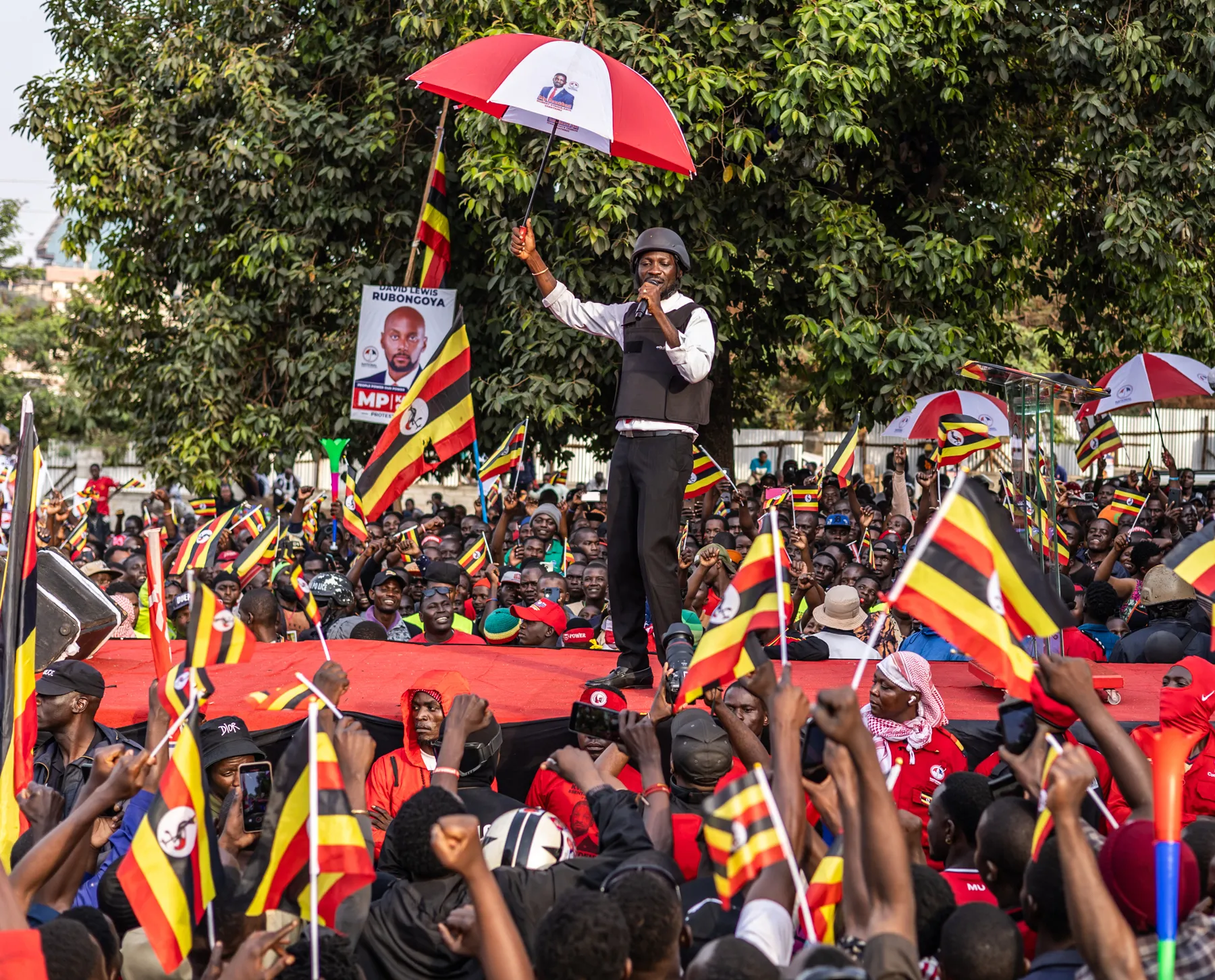
Kyagulanyi during his campaigns
Kampala
Nearly half a year after Uganda's most bitterly contested general election in a generation, the political temperature in Kampala has not cooled. President Yoweri Museveni, who has governed since 1986, was declared winner of the January 15, 2026 presidential vote with 71.65 percent, extending his rule into a seventh elected term. His main challenger, the musician-turned-politician Robert Kyagulanyi — better known as Bobi Wine — was recorded at 24.72 percent and immediately rejected the result, calling the process fraudulent. That rejection, and the state's response to it, remains the defining story of Ugandan politics in mid-2026.
What is happening
The election has not produced the closure that incumbents typically seek. Instead, the months since the vote have been marked by a sustained security clampdown on the opposition, continued detention of prominent figures, and a steady stream of allegations of abductions, rally disruptions and intimidation. Bobi Wine has said his polling agents were seized, that security forces raided his home in the days around the vote, and that he was forced to move to avoid arrest. He has urged supporters to protest peacefully against what he describes as an engineered outcome, while the authorities have moved to prevent gatherings from forming.
The rhetoric from within the ruling establishment has been unusually raw. General Muhoozi Kainerugaba — the president's son and the head of Uganda's defence forces, widely seen as a potential successor — used the social platform X to boast that the army had 'killed 22 NUP terrorists,' a reference to Bobi Wine's National Unity Platform, and to menace the opposition leader directly. Such statements from the country's top soldier have amplified fears among government critics that the machinery of the state is being turned against political rivals rather than kept neutral.
The key players
At the center stands Museveni himself, now one of the world's longest-serving leaders, whose National Resistance Movement continues to dominate Parliament and the security services. Around him, the rising influence of Muhoozi Kainerugaba has reshaped the politics of succession, injecting the military more openly into partisan contest. On the other side is Bobi Wine, whose National Unity Platform has become the principal vehicle for a younger, urban, largely disaffected electorate demanding change.
A third figure looms over the landscape from a prison cell. Kizza Besigye, the veteran opposition leader who challenged Museveni in four previous elections, remains jailed in Kampala on treason charges. Besigye, 68, was seized in neighbouring Kenya in late 2025 and returned to Uganda, a cross-border operation that drew condemnation from regional lawyers and rights groups. His prosecution — and the disruption of his legal team, including the reported denial of entry to Kenyan advocate Martha Karua and the detention of Kampala lord mayor Erias Lukwago — has become a symbol of the shrinking space for dissent.
Background and context
Uganda's electoral cycles have repeatedly followed a similar arc: a hard-fought campaign, a contested count, a crackdown, and a slow return to an uneasy status quo. The 2021 election that first pitted Museveni against Bobi Wine was accompanied by deadly violence and an internet shutdown. The 2026 contest, observers say, echoed that pattern, with hundreds of opposition supporters detained, rallies broken up, and injuries and deaths reported at multiple campaign events. International reaction has been pointed: elements in the United States Congress described the vote as a 'hollow exercise,' and Human Rights Watch, in its World Report 2026, characterized the election as marred by abuses. Notably, authorities did not publish a full polling-station tally, feeding suspicion about the announced margin.
The crackdown has extended beyond party politics into the press. Journalists and media managers have reported mounting pressure, including online harassment, as the military leans on independent outlets. For a country that has long presented itself as a pillar of stability in a turbulent region, the treatment of reporters and opposition figures has become an increasingly awkward counterpoint to that image.
Why it matters
The stakes reach well beyond the fate of individual politicians. Uganda is a linchpin of East African security, a major troop contributor to peace operations in Somalia, a host to one of the world's largest refugee populations, and — as of this year — a country on the cusp of becoming an oil producer. How the government manages its post-election legitimacy problem will shape investor confidence, donor relationships and regional diplomacy at a moment when the economic stakes are rising. A prolonged standoff, or an escalation in violence, could complicate the very industrial transformation the government is promising its citizens.
There is also a generational dimension. More than three-quarters of Ugandans are under 30, most having known no leader other than Museveni. The opposition's strength among young, urban voters points to a durable demand for political change that arrests and intimidation may suppress but are unlikely to dissolve. The unresolved question of succession — whether power eventually passes within the Museveni family, within the ruling movement, or to the opposition — hangs over every current dispute.
What to watch next
Several threads will determine whether the standoff eases or deepens in the second half of 2026. The first is the treatment of Besigye: any trial, verdict or release will be read as a signal of the government's intentions toward its critics. The second is whether Bobi Wine's calls for peaceful protest translate into sustained mobilization, and how the security forces respond if they do. The third is the international posture — whether Western partners and regional bodies apply meaningful pressure or accept the result as settled. Finally, the conduct of Muhoozi Kainerugaba, and the degree to which the army stays entangled in politics, will indicate how the succession question is evolving.
For now, Uganda sits in a familiar but tense holding pattern: an entrenched incumbent reaffirmed in office, an opposition that refuses to concede the legitimacy of that office, and a security apparatus positioned squarely between them. The election is over, but the contest it represents plainly is not.



