VENICE
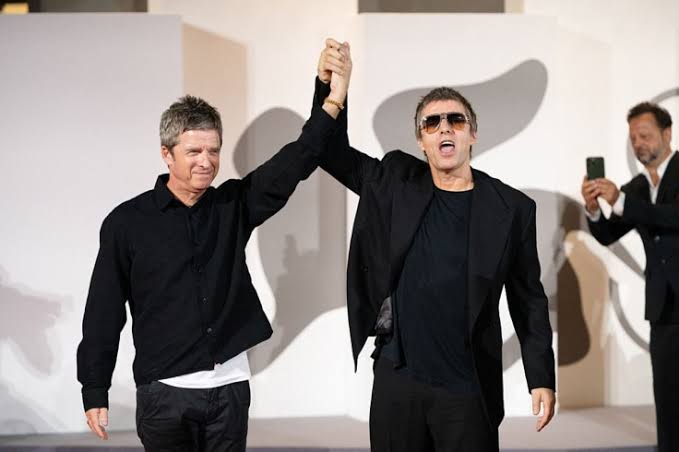
The image that travelled fastest out of the Sala Grande on Friday night was not from the film. It was from the moment afterwards: two brothers from Burnage, aged 59 and 53, standing in a Venetian cinema with their arms raised together while an audience refused to stop clapping for eight minutes.
For anyone who spent the 2010s reading the Gallaghers' insults to each other in headline form, that photograph does more narrative work than any documentary could. But there is a documentary, and it opens this week.
The film
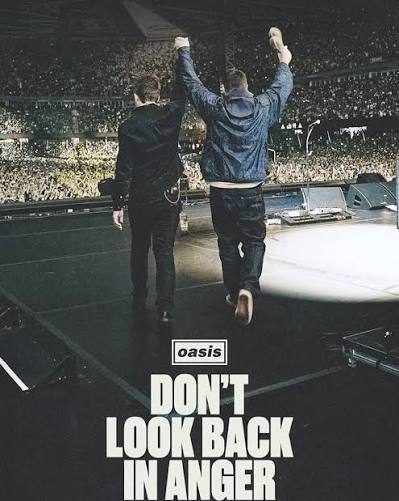
"Oasis: Don't Look Back in Anger" had its world premiere out of competition at the 83rd Venice International Film Festival on 5 September. It is directed by Will Lovelace and Dylan Southern — the pair behind music documentaries with a reputation for restraint rather than hagiography — and written by Steven Knight, the creator of "Peaky Blinders".
The subject is the 2025 reunion tour: the run of stadium shows that followed sixteen years of the band not existing, announced with a terseness that sent ticketing systems into meltdown across three continents. The film promises rehearsal, backstage and onstage footage, and its headline asset is the first joint interview Liam and Noel Gallagher have given in more than fifteen years.
Knight has been careful about how he frames it. The film, he has said, is about "reconciliation, redemption, and forgiveness" — which is either a statement of theme or a warning, depending on what you were hoping for.
What it is not
Early reviews are warm and slightly wary. The Hollywood Reporter called it a rich, poignant music documentary. Others have noted, more pointedly, that anyone arriving for forensic detail on the feud — the specific rows, the hotel-room incidents, the decade of interviews conducted largely through the press — will leave unsatisfied. This is a celebratory, water-under-the-bridge film. It does not interrogate its subjects so much as sit beside them.
That is a defensible choice and a commercially obvious one. A band that has just reunited is unlikely to authorise a film that relitigates why it broke up, and a documentary made with the cooperation of its subjects almost always trades access for edges. The interesting question is whether the joint interview carries enough weight to justify the omission.
On the evidence of the trailer, released in mid-August, it might. The two men are visibly older, visibly funnier about each other, and — in a detail that has been widely remarked on — sitting in the same frame, which for fifteen years was the one thing money could not buy.
How and when to see it
The release plan is unusually front-loaded on the big-screen experience. The film begins screening at selected UK cinemas from 9 September, including BFI IMAX in London, with limited IMAX early-access screenings across the US and Canada on the same day. The wider American cinema release follows on 11 September.
After that it moves to streaming: Disney+ internationally later in 2026, and both Disney+ and Hulu in the United States. An exact streaming date has not been confirmed, which is itself a signal — Disney appears to want this to be a cinema event first, and a catalogue title second.
That matters more than it usually would. This is a concert film as much as a documentary, built around stadium audio and stadium crowds. The difference between hearing 70,000 people sing the chorus of the title track through an IMAX system and hearing it through a television soundbar is not a small one.

Why the ovation was so long
Eight minutes is a substantial Venice ovation, though the festival's applause economy is famously inflated and should be read as enthusiasm rather than a verdict. Still, the length says something about who was in the room and what they were applauding.
The Oasis reunion is, for a certain cohort, the closest thing to a cultural reconciliation event in years — a story with a genuine antagonist structure that resolved. British guitar music has spent two decades being described as a heritage industry. A band whose defining public characteristic was that its two central members could not be in a room together got back in the room, sold out stadiums, and then let cameras record the process.
There is also the simple matter of scarcity. Documentaries with this level of access to a band mid-reunion barely exist, because bands mid-reunion are fragile and lawyers know it. That the Gallaghers signed off on it at all is part of the story the film is telling.
What this means for you
If you were an Oasis person, the practical advice is straightforward: see it in a cinema, ideally a large one, in the first fortnight. This is a film engineered for volume and for an audience that sings along, and the streaming version will be a different and lesser object.
If you were not an Oasis person, there is a more general reason to pay attention. Music documentaries have become the dominant format for legacy acts to manage their own history — and this is a high-profile test of whether an authorised, cooperative, non-confrontational version of a famously combative story can still be good. The reviews suggest it can be moving. Whether it is honest is a question you will have to answer in the seat.
And if you simply enjoy a redemption arc: two brothers who spent fifteen years refusing to be photographed together stood on a Venice stage on Friday and raised their hands at the same time. Whatever the film leaves out, that happened, and everyone saw it.
Published By | Entertainment Editor