TUNIS
There are two ways to read Tunisia in 2026, and both are correct. The first is a story of production: the largest olive harvest in the country’s history, dams fuller than at any point since the drought began, cereal collection up sharply, and tourism receipts climbing for a fourth consecutive year. The second is a story of financing: a government locked out of international capital markets, operating without an International Monetary Fund programme, and turning with increasing regularity to its own central bank to close the budget gap. Tunisia’s macroeconomic position in 2026 is the arithmetic of those two stories running against each other.
A narrow band of forecasts, and a real recovery beneath it
The headline numbers are unusually convergent for a middle-income economy under stress. The World Bank’s April 2026 Macro Poverty Outlook records real GDP growth of 2.5 percent in 2025, up from 1.6 percent in 2024, and projects the same 2.5 percent for 2026 before moderating to 2.3 percent in 2027 and 2028. The African Development Bank’s country outlook, updated on 8 June 2026, puts 2025 growth at the same 2.5 percent — measured against a lower 1.5 percent base for 2024 — but is more cautious about the current year, forecasting 2.1 percent in 2026 before a firmer 2.8 percent in 2027. The IMF has held its own 2026 projection at 2.1 percent, warning that the baseline assumes a gradual normalisation of global energy markets.
What is notable is the composition. Agriculture grew 10.3 percent in 2025 and is forecast by the World Bank to add a further 8.0 percent in 2026 — an extraordinary contribution for a sector of that size, and the single largest driver of the recovery. Industry, by contrast, grew 2.9 percent after contracting 2.2 percent the previous year, and services grew just 1.4 percent. This is a rain-fed rebound more than a structural one, and its persistence depends on weather rather than policy.
The olive oil year
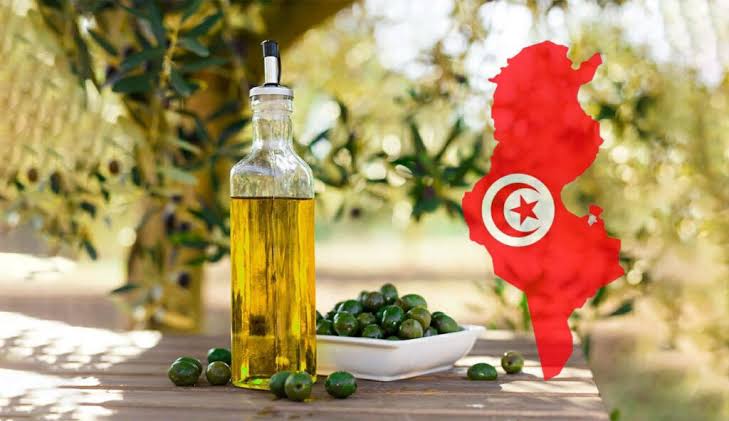
Nowhere is that clearer than in olive oil. In the first nine months of the 2025/26 season, which began in November, Tunisian olive oil exports rose 55.3 percent by volume to a record 368,000 tonnes, generating roughly $1.6 billion in revenue — a 44.4 percent increase year on year. Total production for the season came in at approximately 500,000 tonnes, placing Tunisia second in the world behind Spain. Extra virgin grades accounted for 83.6 percent of shipments, though 86 percent of the volume left the country in bulk rather than packaged form, which is where the margin sits.
The destination mix underlines Tunisia’s dependence on Europe: the European Union absorbed 56.8 percent of export volumes, with Spain alone taking 32.4 percent, Italy 19.7 percent and the United States 19.4 percent. North America accounted for 24.2 percent of volumes, Asia 11.3 percent and Africa just 3.9 percent — a reminder that for all the continental rhetoric around the African Continental Free Trade Area, Tunisia’s agri-food trade remains overwhelmingly north-facing.
Water: the constraint that eased, not the one that was solved
The harvest was possible because it rained. Dam filling rates, which had collapsed to roughly 31 percent in 2023 and 37 percent in 2024, reached 57 percent by 24 March 2026, 67 percent in early May and around 60 percent of total capacity by June, against 41 percent at the end of May 2025. Cereal output responded accordingly: authorities forecast wheat production of about 1.35 million tonnes and barley of 500,000 tonnes for the 2025/26 marketing year, increases of roughly 14 percent and 80 percent respectively, with soft-wheat collection nearly doubling from 600,000 quintals in 2025 to 1.1 million in 2026. The United States Department of Agriculture projects a more modest 1.2 million tonnes of wheat and 570,000 tonnes of barley for 2026/27.
None of this changes the underlying hydrology. Agriculture consumes close to 80 percent of Tunisia’s water resources, and the country’s measured water stress has hovered between 94 and 98 percent for a decade. Roughly six in ten years over the past seventy have been dry years. The 2026 harvest is a reprieve, and the agriculture ministry has been explicit that treated wastewater reuse and stricter allocation are the medium-term answer rather than better rainfall.

Phosphate: the sector that has not come back
If olives are the recovery’s success story, phosphate is its unfinished business. Phosphate exports were worth around 2.4 billion dinars in the first quarter of 2026, close to 15 percent of total exports of roughly 16 billion dinars — meaningful, but far below the sector’s pre-2011 weight. The state-owned Compagnie des Phosphates de Gafsa is working toward production capacity of about 4.5 million tonnes in 2026 and has set out a longer-term target of 9.4 million tonnes of commercial output by 2035, requiring investment of 2.7 billion dinars (roughly $930 million). The obstacles named by management are revealing: rail and road transport bottlenecks, and the shortage of water allocated to phosphate processing. The same constraint that governs the harvest also governs the mine.
Services, remittances and the external account
Tourism has been the most reliable earner. Receipts reached 3.35 billion dinars — about $1.15 billion — by the end of June 2026, up 8.3 percent year on year, and passed 5 billion dinars by the end of July, building on a 2025 season in which arrivals exceeded 11 million. Service exports grew 5.3 percent in 2025 and remittances 14.9 percent. Yet neither offset a 13.4 percent widening of the merchandise trade deficit, and the current account deficit moved from 1.5 percent of GDP in 2024 to 2.4 percent in 2025. The World Bank projects it widening to 3.7 percent of GDP in 2026 on higher energy imports; the AfDB, using a different perimeter, expects 5.3 percent. Reserves closed 2025 at 3.3 months of imports, or 106 days.
The financing corner
This is where the two stories collide. The 2026 draft budget puts total financing needs at about 27 billion dinars, roughly $9.2 billion and broadly in line with 2025. With Tunisia effectively absent from international bond markets — the government having declined an IMF programme rather than accept its conditionality on subsidy reform — that gap is being closed domestically. Parliament has authorised the Central Bank of Tunisia to finance the budget by up to 7 billion dinars at zero interest, the second consecutive year of exceptional direct monetary financing; press accounts of the draft budget have put the requested figure at as much as $3.7 billion. A 750 million euro Eurobond falls due in July 2026, to be settled from reserves, and the authorities have floated a first sovereign sukuk issuance to broaden the domestic investor base.
The fiscal path itself is not the problem. The deficit narrowed from 6.1 percent of GDP in 2024 to 5.2 percent in 2025 on better revenue collection and lower energy subsidies, and public debt fell from 84.9 percent to 82.2 percent of GDP (the AfDB records 82.1 percent). The World Bank expects the deficit to widen again to 6.1 percent in 2026 before consolidation resumes, with debt easing to 81 percent of GDP by 2028. The problem is the transmission mechanism. Heavy reliance on domestic banks and the central bank crowds out private credit — the AfDB notes near-zero growth in credit to the private sector alongside a non-performing loan ratio of 14.7 percent — and, over time, erodes the credibility of monetary policy. Inflation has in fact behaved: headline CPI fell to 5.0 percent in February 2026 from a February 2023 peak of 10.4 percent, core inflation to 4.9 percent, allowing the central bank to cut its policy rate from 8 percent to 7 percent in December 2025. Food inflation, at 5.9 percent, remains above headline and falls hardest on low-income households.
The social ledger
Unemployment fell to 15.2 percent in the fourth quarter of 2025 from 16.5 percent a year earlier — a genuine improvement that masks a deeply segmented labour market. Youth unemployment stands at 38.4 percent, unemployment among women at 22.4 percent, and among university graduates at 24.9 percent. The labour force participation rate of 45.9 percent conceals a gap of 64.8 percent for men against 27.7 percent for women, one of the widest in the Mediterranean. Poverty measured at the $8.30-a-day upper-middle-income line is nowcast to have fallen from 16.6 percent in 2024 to 16.0 percent in 2025 and is projected at 15.4 percent by 2027; the AfDB puts the share below the national poverty line at about 18 percent, with sharp regional disparities between the coast and the interior. The government has expanded the AMEN social protection programme and continued to stabilise staple prices, but an informal sector estimated at 40 percent of the economy limits both the reach of transfers and the tax base that funds them.
The external frame
Tunisia’s financing constraint has become entangled with European migration policy. Under the memorandum of understanding signed with the European Union on 16 July 2023, Tunisia received roughly 105 million euros for border and coastguard operations alongside a broader package of around one billion euros in macroeconomic and sectoral support; a further 675 million euros in migration support across several partner countries was set out for 2025 to 2027. The European Commission attributes an approximately 80 percent reduction in irregular arrivals from Tunisia to Italy to the arrangement. In July 2026, on the deal’s third anniversary, Amnesty International and Human Rights Watch both published assessments arguing that the cooperation has entrenched serious rights violations, and Tunis has itself proposed a revision of the terms. For a government short of external finance, migration cooperation has become one of the few reliable channels of it — which is precisely why it is contested.
What to watch
Three markers will define the rest of 2026. The first is the July Eurobond redemption and whether it is met without visible strain on reserves. The second is whether the sukuk issuance materialises and at what cost, since it would establish a new domestic funding channel that does not run through the central bank’s balance sheet. The third is rainfall: with agriculture carrying the recovery, a dry 2026/27 season would remove most of the growth Tunisia has recorded. The country has demonstrated it can produce. Whether it can fund itself while doing so is the open question.
Published By | Business News Editor