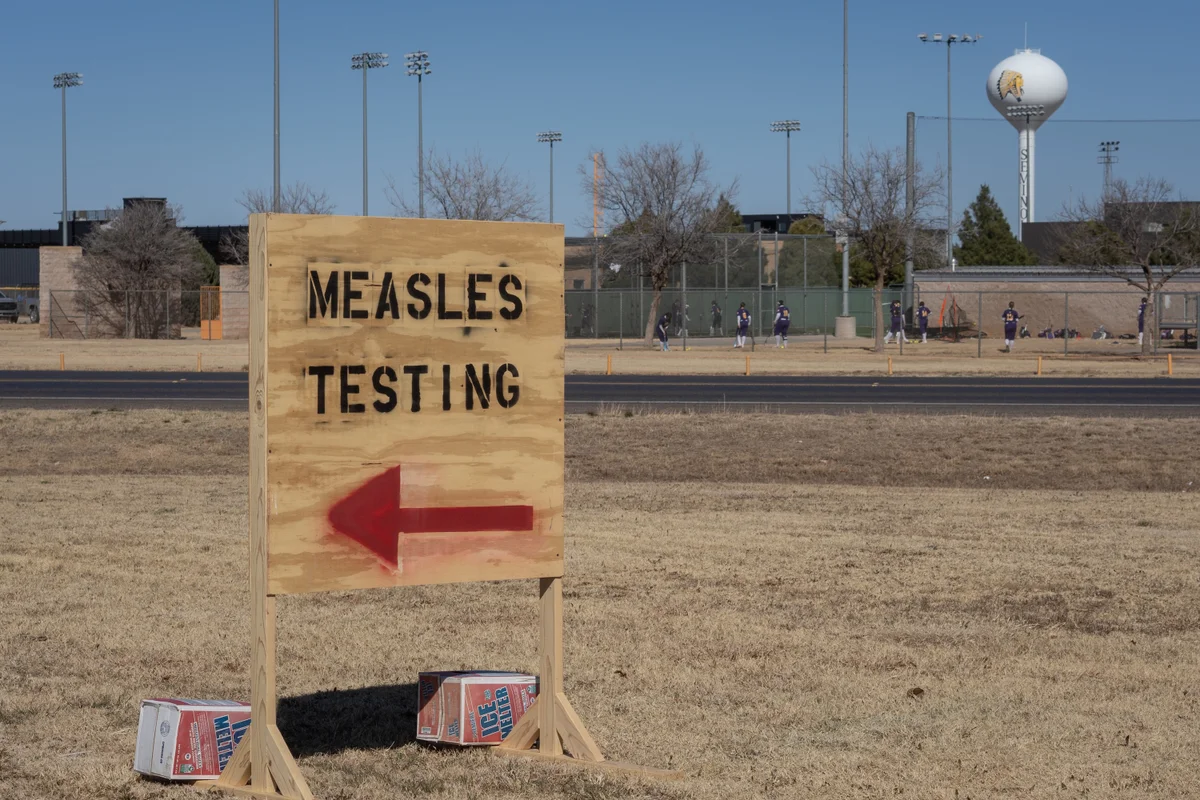
A disease this country officially wiped out a generation ago is now spreading, unbroken, coast to coast — and this November, international health authorities may make it official: the United States is no longer measles-free.
UNITED STATES
For 26 years, the phrase "measles elimination" sat quietly in American public health records as one of the country's proudest, least-discussed achievements — a hard-won status earned through decades of vaccination campaigns, declared by the CDC in 2000, and maintained through outbreak after outbreak that health workers stamped out before the virus could establish permanent, year-round residence in American communities.
That streak now appears to be over. As of the first week of July 2026, the CDC has confirmed more than 2,200 measles cases across 42 states and jurisdictions, spread across 32 separate outbreaks, with five and a half months of the year still left to run. The 2025 total — itself the worst in more than three decades — was 2,289 cases for the entire year. This year is on pace to blow past it, and blow past it early.
But the raw case count, brutal as it is, isn't actually the headline. The headline is what disease detectives have found buried in the virus's own genetic code: unbroken chains of transmission stretching back to a single outbreak that began in Texas in January 2025, with no clean 12-month break in between. That, under the technical definition used by international health authorities, is the precise dividing line between "elimination" and its opposite: endemic disease.
The Number That Matters Most Isn't The Case Count — It's The Calendar
Elimination, in the language of the Pan American Health Organization (PAHO), doesn't mean zero cases forever. It means no continuous, unbroken domestic transmission of the virus for 12 consecutive months, with any outbreaks that do occur traced back to a traveler bringing the virus in from abroad and then successfully contained.
The United States earned that designation in 2000, after decades of MMR vaccination campaigns drove the homegrown virus to extinction on American soil. It was one of the signature public health triumphs of the 20th century, a quiet coda to an earlier era when measles killed around 6,000 Americans a year and hospitalized tens of thousands more, mostly children.
This November, PAHO's Regional Verification Commission for the Elimination of Measles, Rubella, and Congenital Rubella Syndrome is scheduled to conduct its regular review — and infectious disease trackers at institutions like the University of Minnesota's CIDRAP say the writing is already on the wall. Genomic sequencing shows the current wave of cases connects back, link by unbroken link, to that January 2025 outbreak in Texas, indicating the virus never actually left — it just kept finding new, under-vaccinated pockets of the country to smolder in.
"Highly likely" is the phrase CIDRAP's analysis used to describe the odds the U.S. loses its measles-free status this fall. Neighboring Mexico faces the same review, and the same grim odds, in the same month.
Three Deaths, Dozens Of States, And A Very Familiar Pattern
Behind the statistics are three people who didn't survive this outbreak: two unvaccinated children in Texas and one unvaccinated adult in New Mexico. They were the first measles deaths recorded in the United States since 2015 — a chilling bookend to a disease many younger Americans have never seen a case of in their own lives, let alone watched take one.
The pattern in who's getting sick tells its own story. According to CDC data from mid-2026, roughly 92% of confirmed cases this year involved people who were unvaccinated or whose vaccination status was unknown. Break down the ages, and about a quarter of cases are in children under 5 — the age group most vulnerable to measles complications like pneumonia and encephalitis — with roughly half in school-age children and adolescents, and the remainder scattered among adults over 20, many of whom assumed a childhood shot or a long-ago bout of the disease had settled the matter for good.
Geographically, the outbreak reads like a map of the entire country rather than a single hot zone. Cases have been confirmed everywhere from Texas and New Mexico — ground zero for the original 2025 spread — to Utah, Michigan, Ohio, Pennsylvania, and even reliably high-vaccination states like Massachusetts, Vermont, and Connecticut. Thirteen cases were traced to international travelers arriving on U.S. soil, a reminder that in a globalized world, elimination was never a wall — it was a dam, and dams require constant maintenance.
Hospitals in some of the hardest-hit counties have quietly reopened protocols they haven't dusted off in years: negative-pressure isolation rooms, extended masking for anyone with a fever and rash walking into an ER, and rapid-notification chains to public health departments the moment a suspected case appears. Measles is so contagious that it can linger in the air of an empty room for up to two hours after an infected person has left it — a fact that has forced pediatric clinics in outbreak zones to rethink everything from waiting-room layouts to appointment scheduling for unvaccinated infants too young to be immunized.
Why Vaccination Rates Are The Real Villain Of This Story
Measles is, by a wide margin, one of the most contagious pathogens known to science. A single infected person can spread it to 12 to 18 unvaccinated people in a susceptible population — a reproduction number that dwarfs even the most infamous respiratory viruses of the past decade. Public health officials have long said that stopping it requires roughly 95% community vaccination coverage with the MMR vaccine to maintain what's called herd immunity, the invisible shield that protects infants too young to be vaccinated and the small number of people who can't receive the vaccine for medical reasons.
That coverage has been slipping. Childhood MMR vaccination rates have declined in communities across the country in recent years, driven by a mix of pandemic-era disruptions to routine pediatric care, growing vaccine hesitancy amplified on social media, and, in some states, looser exemption policies for school entry requirements. The result, epidemiologists say, is a patchwork of under-vaccinated pockets scattered across otherwise well-protected states — exactly the kind of tinder measles needs to catch and keep burning.
"The case distribution across age groups is particularly concerning," public health researchers tracking the outbreak have noted, pointing to the substantial share of cases now appearing in school-age children and adults — groups that, in a well-vaccinated population, should be seeing this disease essentially never.
Compounding the problem, some states have expanded non-medical exemptions for school vaccination requirements in recent years, making it easier for parents to opt out for personal or religious reasons without a doctor's involvement. Public health researchers have long warned that once exemption rates climb past a low single-digit percentage in a given school district, outbreaks stop being rare, isolated events and start becoming a mathematical inevitability — a threshold a growing number of U.S. counties have now quietly crossed.
What Losing Elimination Status Would Actually Mean
To be clear: losing elimination status is a symbolic and epidemiological marker, not an on/off switch for public health funding or policy. The sky will not fall on November 1st if PAHO's commission delivers the verdict experts expect. But the symbolism carries real weight.
It would mark the formal end of a 26-year American public health streak and place the United States in the company of countries that have struggled to control the disease through gaps in vaccination infrastructure — a reputational and public-health blow that stands in stark contrast to America's global image as a biomedical research superpower. It would also likely trigger renewed scrutiny of U.S. vaccination policy at exactly the moment vaccine confidence is already fraying in parts of the country, potentially becoming a political flashpoint as much as a medical one.
Perhaps most importantly, it would confirm what disease trackers have effectively been saying since June: that measles isn't just having a bad year in America. It's back, in the technical sense, as a homegrown, self-sustaining disease — something the country spent decades and billions of dollars specifically engineering out of existence.
What This Means For You
If you're a parent, the single most consequential thing you can do right now is confirm your child's MMR vaccination status with their pediatrician. The vaccine is roughly 97% effective after two doses, typically given at 12-15 months and 4-6 years of age, and remains one of the safest, most thoroughly studied vaccines in medical history.
If you're an adult who isn't sure whether you were vaccinated, or who only received one dose as a child (common before the two-dose schedule became standard), a blood test or a simple booster shot can close that gap — something worth discussing with a doctor, especially if you plan to travel internationally or live in a community with a known outbreak.
If you're planning travel this summer, be aware that measles doesn't respect state lines or, for that matter, national borders — thirteen cases this year alone arrived with international travelers. Airports, and the crowded, enclosed spaces of modern travel, are exactly the environment in which a single unvaccinated traveler can seed an outbreak thousands of miles from home.
And if you simply want to understand why this story matters beyond the numbers: measles was, for a generation of American parents, a disease you didn't have to think about. That is no longer guaranteed to be true for the next one.
The Bottom Line
A quarter-century of quiet public health success is on the verge of a very loud reversal. Whatever PAHO's commission decides this November, the underlying reality is already visible in the case counts, the genomic sequencing, and the three families who lost someone this year to a disease modern medicine solved decades ago. The virus didn't get more dangerous. The armor around it just got thinner — one skipped vaccination at a time.
Published By | Features Editor