Written By | Sports Desk
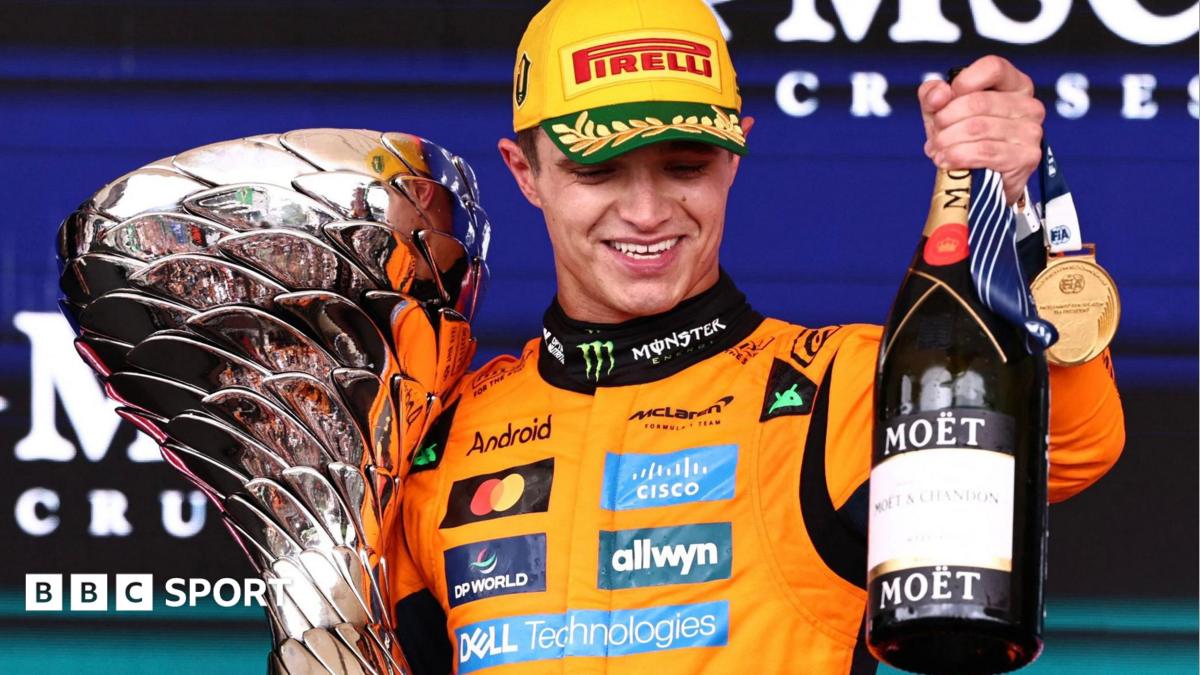
McLaren's title defender will start Sunday's Belgian Grand Prix ten places back — a calculated sacrifice in a season that has already slipped away from him
SPA-FRANCORCHAMPS, Belgium
There is a particular kind of quiet that settles over a paddock when a reigning world champion admits, out loud, that his title defense is no longer about winning. It settled over Spa-Francorchamps this week as McLaren confirmed that Lando Norris, the man who lifted the 2025 Drivers' Championship trophy, will start Sunday's Belgian Grand Prix from the back third of the grid — not because he did anything wrong on track, but because his car keeps breaking.
McLaren announced that Norris's Number 1 car will be fitted with a fourth power electronics unit this weekend, exceeding his permitted allocation under Formula 1's component rules and triggering an automatic ten-place grid penalty. It is the kind of announcement that, in isolation, might read as a minor technical footnote. In the context of Norris's 2026 season, it reads as something closer to a surrender flag.
A Season Undone by Reliability, Not Speed
To understand why McLaren is willing to sacrifice ten grid spots at one of the most demanding circuits on the calendar, you have to trace the unraveling of Norris's power unit allocation across the first nine rounds of the season. His first power electronics unit suffered a terminal failure in China, so severe that he was unable to even start the race. A second unit, fitted for the Japanese Grand Prix, ran into trouble during Free Practice and had to be pulled for remedial work. It seemed repaired — until it failed again in FP2 at Monaco, forcing McLaren to withdraw it from his allocation for good and move him onto a third and, they had hoped, final unit for the year.
That third unit has now also reached the end of its usable life within the rules, leaving McLaren with no legal option but to fit a fourth — and eat the penalty that comes with it. It is a mechanical horror story that stands in stark contrast to the experience of his own teammate. Oscar Piastri, sharing an ostensibly identical car, has needed only three power electronics units all season and will start Sunday's race with a clean grid slot, no penalty attached.
The numbers tell the rest of the story. Norris arrives in Belgium fifth in the Drivers' Championship, 82 points adrift of the man now leading it, Kimi Antonelli. His only win of the entire season came in the Miami sprint — a single bright spot in what has otherwise been a campaign defined by mechanical letdowns rather than driving errors. The title fight this year, by most reckonings, has narrowed to a contest between Antonelli, Lewis Hamilton, and George Russell — a trio that, twelve months ago, few would have predicted would push the reigning champion so far from contention.
Why Belgium, of All Places
The choice of circuit for this enforced penalty is not accidental. Spa-Francorchamps is one of the rare tracks on the calendar where overtaking is genuinely possible — the long Kemmel Straight into Les Combes, the sweeping run through Blanchimont, the sheer physical length of the lap all create opportunities that tighter, more processional circuits simply do not offer. McLaren's engineers made a deliberate bet: absorb the penalty now, at a track where a car with Norris's evident pace can claw back positions, rather than at the following two rounds in Hungary and Zandvoort, where the tight, twisting layouts of the Hungaroring and Circuit Zandvoort would turn ten lost grid spots into a near-insurmountable wall of traffic.
Norris himself has been candid about the calculation. Speaking to reporters ahead of the weekend, he explained the team's thinking plainly: better to take the hit somewhere a recovery drive is actually possible than to be handed the same penalty at a venue where it would effectively end his weekend before it began. It is the kind of pragmatic, unemotional reasoning that has defined McLaren's championship-winning operation over the past two seasons — even when the emotional cost, for a driver watching his title defense evaporate lap by lap, is clearly real.
What a Champion's Backslide Says About F1 in 2026
For fans, the Norris saga is a reminder of something Formula 1 rarely advertises: that in modern F1, reliability is as decisive a championship factor as raw pace. A driver can be quicker than everyone on the grid over a single lap and still lose a title to a component failure in a factory hundreds of miles from the circuit. Norris's Miami sprint win proved the speed is still there. The four burned-through power units prove that speed alone no longer guarantees anything.
There's also a broader lesson here about how modern title defenses actually unravel — not usually through one dramatic crash or one bad decision, but through an accumulation of small mechanical betrayals that compound race after race until a five-time podium contender is suddenly staring up at a championship table from fifth place. It's a less cinematic story than a rival's brilliance stealing the crown, but it may be the more honest account of how championships are actually lost.
The Weekend Ahead
Sunday's race offers Norris a chance, if not at the win, then at least at damage limitation and a reminder to the paddock that the pace hasn't gone anywhere. A strong recovery drive through the field at Spa — a circuit that rewards bravery as much as raw horsepower — would go some way to reassuring McLaren, and Norris himself, that this is a blip in an otherwise championship-caliber car, not a symptom of something more troubling.
For readers who tune into Formula 1 for the drama of wheel-to-wheel racing, the real spectacle this weekend won't be at the front of the grid, where the title contenders duke it out. It'll be watching a reigning world champion try to drive his way back from eleventh, fighting not for the trophy this year, but for the shape of next year's story.





