BISSAU, Guinea-Bissau
Election officials in Guinea-Bissau are counting ballots from a Sunday referendum that would hand the country's next president sweeping new powers, a vote the ruling military government says is the final building block toward restoring civilian rule and one the country's leading opposition party has denounced as "the continuation of the coup d'état" that put the junta in charge 10 months ago. Results are expected Tuesday, but the deeper question, whether Guinea-Bissau's return to democracy in December will be genuine or merely staged, will not be settled by a single tally.
The referendum caps a turbulent year for the small West African nation of roughly 2 million people, a country whose post-independence history has been repeatedly interrupted by coups and whose latest crisis began the moment officials were supposed to announce who had actually won the presidency.
What Happened Sunday
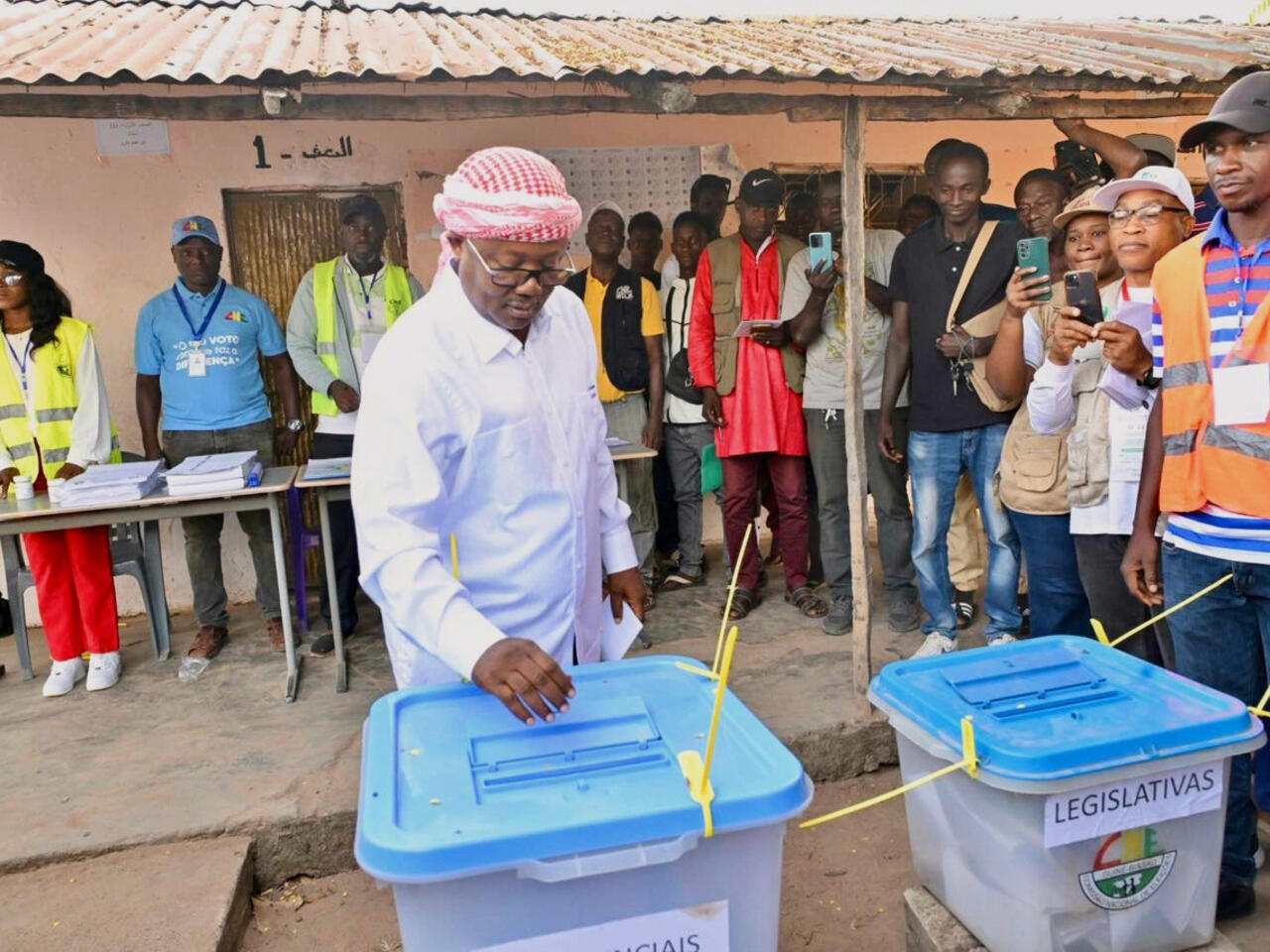
Voters answered a single yes-or-no question on Aug. 30: "Do you agree with the entry into force of the new constitution approved by the National Transitional Council?" Idrissa Djalo, executive secretary of Guinea-Bissau's National Electoral Commission, told reporters that turnout "exceeded" 55% and that the vote proceeded "without any incidents that would call into question the credibility of the vote." Counting began that evening, with official results expected Tuesday, Sept. 1.
The proposed constitution would convert Guinea-Bissau's political system from a parliamentary model, in which the prime minister comes from the parliamentary majority, to a presidential one. Under the new charter, the head of state would gain the power to appoint and dismiss the prime minister and cabinet ministers directly and to dissolve parliament outright, authorities that the current, weaker presidency does not hold.
General Horta Inta-A Na Man, the military officer serving as transitional president since the November coup, cast his ballot in Bissau and framed the referendum as an act of institutional housekeeping rather than a power grab for himself, telling reporters, "What we want after this referendum is to allow whoever wins the elections to see out their mandate without hindrance." Notably, Na Man is personally barred from running in the presidential and parliamentary elections scheduled for Dec. 6 under the transitional charter he currently upholds, a restriction his government has repeatedly cited as evidence the process is not designed to entrench him individually.

How Guinea-Bissau Got Here
The chain of events traces directly back to the country's Nov. 23, 2025, general election, in which incumbent President Umaro Sissoco Embaló sought re-election against a field that had already been thinned by legal maneuvering. Guinea-Bissau's Supreme Court had rejected the presidential candidacy of Domingos Simões Pereira, the veteran leader of the PAIGC, the African Party for the Independence of Guinea and Cape Verde, and the country's oldest political movement, and separately blocked the PAIGC from fielding parliamentary candidates altogether. Pereira responded by throwing his support behind Fernando Dias da Costa of the Party for Social Renewal, and independent tallies and civil-society observers suggested Dias da Costa was headed for a decisive victory over Embaló.
Official results were due to be announced Nov. 27. They never were. On Nov. 26, one day before that announcement, the military declared it had seized total control of the country, with both Embaló and Dias da Costa having separately claimed victory amid mutual accusations of electoral interference in the vote's final days. The coup installed a military government under a one-year transitional charter adopted the following month, with Na Man at its head.
Pereira, who had already been a thorn in the outgoing government's side, was detained on the day of the coup itself. He was moved to house arrest in February 2026, in what regional diplomats characterized as an apparent gesture to appease the West African regional bloc ECOWAS, only to be ordered back to prison on July 10 on accusations of economic crimes and involvement in an alleged coup attempt in October 2025, allegations he denies. The Community of West African States, at a summit of heads of state in Sierra Leone in late July, urged Guinea-Bissau's military-led government to unconditionally release all detained political figures, including Pereira, arguing that doing so "could bolster the credibility of the transition process." As of this writing, Pereira remains in detention.
The Opposition's Case
PAIGC has rejected the referendum root and branch. In the campaign leading up to Sunday's vote, the party called for a boycott, and Pereira, in an interview with Portuguese broadcaster RTP, described the exercise as an "absolute farce," insisting that "what will happen on 30 August is the continuation of the coup d'état carried out on 26 November." The party has characterized the vote as "a staging meant to give the appearance of legitimacy to the new constitution," arguing that the transitional institutions that organized it are "devoid of any democratic legitimacy" in the first place. PAIGC further alleged that authorities actively prevented the "no" campaign from operating freely, a claim consistent with what the party has described as "severe restrictions on public freedoms" and the suspension of ordinary political activity since the coup.
Two opposition coalitions had separately rejected the referendum process as early as July 22, accusing the transitional authorities of excluding civil society groups from the drafting of the new constitutional text altogether, a criticism that independent constitutional analysts, including those writing for the legal research platform ConstitutionNet, have echoed in describing the process as one imposed from above rather than negotiated among Guinea-Bissau's political and civic stakeholders.
The disconnect between the electoral commission's official account of Sunday's vote, orderly, credible, with turnout above 55%, and the opposition's account of a boycotted exercise marred by restrictions on campaigning is itself a preview of the dispute likely to follow whatever results are announced Tuesday. Civil society organizations issued an open letter ahead of the vote condemning the drafting of a new constitution under military authority, regardless of the referendum's ultimate outcome.
Where the Region Stands
ECOWAS has occupied an uneasy middle position throughout the crisis. The bloc reacted within 48 hours of the junta's initial announcement of its constitutional reform project in January 2026, calling for restraint and offering to deploy a mediation mission to Bissau while urging all state institutions to respect democratic principles. Yet the bloc has also drawn criticism from within Guinea-Bissau's opposition: members of the PAI-Terra Ranka coalition have accused ECOWAS and other regional bodies of failing to impose meaningful sanctions on the junta despite its interference with the constitutional order, arguing that statements of concern have not been backed by consequences. The bloc's engagement has also proven diplomatically delicate in the other direction; a Senegalese minister's public comments on the referendum process were criticized by figures aligned with the transitional government as "politically unacceptable" interference in Guinea-Bissau's internal affairs, illustrating how difficult it has been for outside powers to calibrate pressure without triggering charges of neocolonial meddling, an accusation independent commentators, including contributors to the online outlet Peoples Dispatch, have noted was leveled against Western and regional actors even before the coup.
Analysis
The core tension animating Guinea-Bissau's referendum is one familiar from other post-coup transitions across West Africa in recent years, most notably in Mali, Burkina Faso and Guinea: a military government presents constitutional and institutional changes as prerequisites for a credible return to civilian rule, while the opposition and much of civil society view the same process as the junta laundering its own authority through a plebiscite it controls from start to finish. Guinea-Bissau's specific twist is that the proposed changes would not personally benefit the man overseeing them, since Na Man is barred from the December ballot, which gives his government a genuine rhetorical advantage in arguing the reform is systemic rather than self-serving.
But that argument runs up against a harder problem: whoever inherits the empowered presidency the referendum is designed to create will do so under a constitutional order drafted and approved entirely under military tutelage, with the country's oldest and most organized opposition party boycotting the process and its leader sitting in prison. A presidency with the unilateral power to dismiss a sitting government and dissolve parliament is a significant expansion of executive authority under any circumstances; installing that architecture in the same stroke that transitions from military to civilian rule invites exactly the concern PAIGC has voiced, that the shape of Guinea-Bissau's next government is being decided before its voters choose who will lead it.
What to Watch
The immediate marker is Tuesday's official result. A comfortable "yes" margin, especially if turnout figures hold up to independent scrutiny, will let the junta claim a democratic mandate for the new constitutional order ahead of December. A closer or contested count, or credible allegations of irregularities beyond what the opposition has already alleged about campaign restrictions, would sharpen the legitimacy questions PAIGC has raised. Beyond the referendum itself, three things bear close watching: whether Pereira and other detained political figures are released before the December vote, a step ECOWAS has explicitly called for and one that would materially affect whether PAIGC can mount a genuine campaign; whether the December 6 elections proceed on schedule and with meaningful opposition participation; and whether ECOWAS moves beyond statements of concern toward more concrete diplomatic or economic pressure if the transition process continues to sideline the country's most established opposition party. For a country that has cycled through coups, transitional charters and disputed elections repeatedly since independence in 1974, the test this time is not whether Guinea-Bissau holds elections in December, but whether the rules governing them were written by anyone other than the soldiers who currently hold power.
Published By | News Editor