Written By | International News Agencies
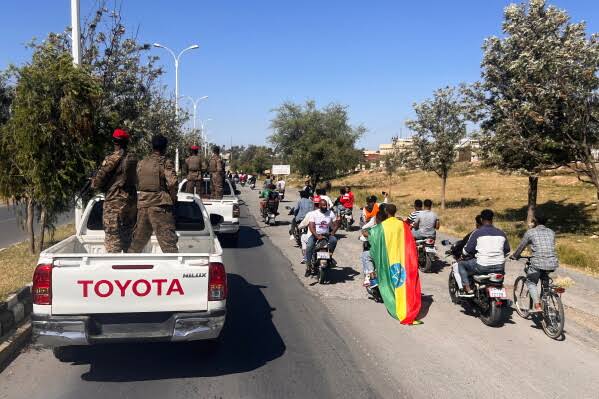
Addis Ababa and Asmara have cut diplomatic ties, traded accusations in letters to the UN Security Council, and accused each other of preparing for war.
WORLD POLITICS
Ethiopia's army has driven the Tigray People's Liberation Front (TPLF) out of the regional capital and several other towns in under two weeks. The victories are changing the question facing the Horn of Africa. It is no longer only whether Prime Minister Abiy Ahmed can end a rebellion that collapsed the 2022 Pretoria peace deal. It is whether the war will widen into a direct confrontation with neighbouring Eritrea.
Addis Ababa and Asmara have cut diplomatic ties, traded accusations in letters to the UN Security Council, and accused each other of preparing for war. Egypt, Sudan, Eritrea and Somalia have held a summit that implicitly targets Ethiopian positions. Ethiopia's gains on the battlefield may be real, but the reporting reviewed for this briefing runs through about Oct. 14, and the situation is moving quickly.
From a seven-group alliance to a fallen capital
The fighting traces to Sept. 20, when seven armed and political groups, including the TPLF, announced an alliance to remove Abiy's administration and install an inclusive transitional government, according to Al Jazeera. Responsible Statecraft names it the Ethiopian Peoples' Alliance for Survival. Fighting began on Sept. 23, when the alliance captured the airport at Mekelle, Tigray's capital, according to AFP. The African Union reported that Tigrayan forces seized airports in Mekelle, Axum and Shire and detained federal personnel.
Federal forces and the federally backed Tigray Peace Force (TPF) then advanced rapidly. The Critical Threats Project (CTP), a Washington research group, dates the capture of Mekelle to Oct. 3, while Al Jazeera and Responsible Statecraft say Oct. 4. The TPLF had withdrawn beforehand, saying it moved its regional administration "temporarily." CTP records the capture of Agula, Wukro and Hagere Selam over the following days, and witnesses told AFP that rebels subsequently lost Shire and Adigrat. Federal forces and an allied militia entered Adwa, about 24 miles (40 km) from Eritrea's border, on Oct. 11, a day after TPLF fighters withdrew, residents told AFP.
Normality is returning in some places, on federal terms. Ethiopian Airlines resumed flights from Addis Ababa to Mekelle on Oct. 11, the first since Sept. 23. At the airport, Getachew Reda, a former Tigray leader who now advises Abiy, appeared alongside intelligence chief Redwan Hussein and promised "visible change, a change beyond mere hope."
The TPLF says this is a retreat, not a defeat. Its leader, Debretsion Gebremichael, said: "We will confront the enemy on our terms and where we choose." That statement carries historical weight. Al Jazeera notes that in 2020 Abiy's government also declared victory after taking Mekelle, only for Tigrayan forces to regroup, retake the capital and prolong the war for nearly a year and a half.
The human cost
The battlefield toll is incompletely documented. CTP reports that airstrikes since Oct. 3 have hit Adigrat, Adwa, Axum and Shire, with strikes on Adwa on Oct. 4-5 killing nine people and strikes on Sheraro killing eight. ACLED, cited by AFP, said an Oct. 4 drone strike on a hotel in Adwa wounded between five and nine people, including security personnel, and that some sources said Debretsion and other senior officials were there. ACLED stressed that this was unverified.
Al Jazeera's Ethiopia bureau chief said that six to seven million people in the region have lived with electricity cuts, internet blackouts and a lack of communications, and that some civilians have fled to the Amhara and Afar regions. Residents of Adwa told AFP that shops were closed and that government institutions, including the hospital, had been looted the previous night. "The roads are deserted. People are very afraid of theft," one said. Because communications are restricted, casualty and displacement figures are hard to verify.
Eritrea: from partner to adversary
Eritrea fought alongside Ethiopia against the TPLF in the 2020-22 war, was not a party to the Pretoria agreement, and has since fallen out with Abiy. Ethiopia has lacked a coastline since Eritrea's de facto independence, formalised in 1993, and Abiy has pressed the case for Red Sea access since 2023. Eritrea reads that as a threat to its port of Assab. Abiy reiterated on Oct. 5 that Ethiopia will secure sea access, and Responsible Statecraft quotes him as saying of Assab that "that will be corrected tomorrow." He was sworn in for a new five-year term after his party won the June 1 election, Al Jazeera reports.
The diplomatic breakdown has been fast. On Sept. 25, the army chief of staff, Birhanu Jula, accused Eritrea of financing the TPLF and Egypt and Sudan of backing rebels, CTP records. On Oct. 1, Ethiopia closed its embassy in Asmara and expelled 10 Eritrean diplomats. Eritrea severed ties and called Ethiopia's conduct "a publicly pronounced declaration of war," per CTP. Ethiopia and Egypt expelled each other's diplomats the same day. Eritrea, Egypt and Sudan deny backing the alliance.
Eritrean troop movements are the most dangerous unknown. Reuters, AFP and ACLED reported on Oct. 7 that Eritrean troops were moving through Adigrat, and a senior Ethiopian official told Reuters that Eritrea had deployed one mechanised and three infantry divisions, which CTP puts at about 1,500 soldiers each. An unnamed security source told AFP that 5,000 to 8,000 Eritrean troops were in Tigray, Responsible Statecraft reports. Witnesses told AFP that Eritrean troops were seen in Adigrat before Ethiopian drone strikes hit them. On Oct. 8, AFP and ACLED reported that Eritrean forces in Adigrat had withdrawn northward. CTP assessed that Asmara more likely sought to shore up a buffer zone than launch an invasion, and said it found no large-scale buildup at the border. Eritrea has neither confirmed nor denied crossing.
War by letter
On Oct. 9, Foreign Minister Gedion Timothewos told the Security Council in a letter that Eritrea had launched an "all-out invasion," advancing up to 60 km (37 miles) into Tigray. He called it "a blatant act of aggression" and invoked Ethiopia's right of self-defence under Article 51 of the UN Charter. Information Minister Yemane Gebremeskel answered on X that Ethiopia was waging an "unprovoked war of aggression" and accused Addis Ababa of using the conflict to seize Assab.
On Oct. 10, Eritrean Foreign Minister Osman Saleh asked the Council to "forcefully condemn Ethiopia's deplorable declaration of war" and urged it to invoke Chapter VII, which allows measures from sanctions to military action. He said Ethiopia's actions would bring "huge devastation to the peoples of both countries." Faisal Roble, a Horn of Africa specialist in Nairobi, told Al Jazeera that both sides are "preparing for the last phase of an open conflict," but that the letters are "just posturing" to win international backing.
The regional ring
Ethiopia's rivals have been coordinating. Egyptian President Abdel Fattah el-Sisi met Eritrean President Isaias Afwerki in Egypt on Oct. 3. On Oct. 4, leaders of Egypt, Eritrea, Sudan and Somalia met in New Alamein and issued a declaration calling for respect for sovereignty and territorial integrity, noninterference and peaceful dispute resolution. It was not a formal military alliance. CTP judges that its language implicitly targets Ethiopia's positions on the Red Sea and the Grand Ethiopian Renaissance Dam. Analyst Hossamaldeen Ibrahim told Al Jazeera that Egypt sees any Ethiopian move toward the Red Sea as a strategic threat.
Gulf politics add a layer. The UAE publicly backs the federal government and has called for de-escalation, according to Al Jazeera, while Saudi Arabia has not commented publicly on the renewed war. Al Jazeera also noted a February Reuters investigation reporting that Ethiopia hosts a camp where thousands of fighters linked to Sudan's Rapid Support Forces were trained, which Reuters said was financed by the UAE; the UAE denied involvement and Reuters could not independently verify its role.
Washington's position is delicate. Responsible Statecraft's author writes that the U.S. dropped sanctions listings on Eritrean defence entities on Sept. 18 and eased arms-sale restrictions on Ethiopia, and notes a $5 billion Boeing deal with Ethiopian Airlines announced Sept. 30. That, the author says, leaves Washington well placed to mediate but apparently unprepared to do so. The African Union called for "maximum restraint" from Ethiopia, Eritrea and Egypt, but the same analysis calls the AU unconvincing as a mediator given its Addis Ababa headquarters.
Analysis: what to watch
Abiy's advantage is momentum, but his vulnerabilities are structural. The TPLF's command remains intact and, as Al Jazeera's bureau chief noted, it retains several towns and strong links with Eritrea along a frontier of more than 800 km. Other insurgencies continue: Amhara's Fano captured Wurgessa on Oct. 3 and Mehal Meda on Oct. 7 and attacked Dabat, disrupting federal supply lines, CTP reports, and CTP also reports fighting between the TPF and an Amhara militia near Alamata that reportedly killed more than 20 people. Ethiopia also faces an Oromia insurgency. Responsible Statecraft warns that a war with Eritrea would be a high-risk gamble because Ethiopia's imports depend on a single highway to Djibouti.
Three signals matter. The first is whether Eritrean forces are confirmed inside Tigray and, if so, whether Ethiopia strikes them again, which would turn rhetoric into interstate war. The second is whether the Security Council acts or stays silent, since neither letter has produced a visible response in the reporting reviewed. The third is political rather than military: whether Getachew Reda's promise of "visible change" translates into a credible Tigrayan administration, or whether the fall of Mekelle simply sets up another insurgency.
The Pretoria agreement left disarmament, disputed territory and the withdrawal of non-federal forces unresolved, as Responsible Statecraft's author notes, and that unfinished business is what drove September's collapse. Without a political settlement that includes Eritrea's security concerns and Ethiopia's access to the sea, the pattern of 2020 could repeat: a capital taken, a war not ended.



