Written By | News Agencies
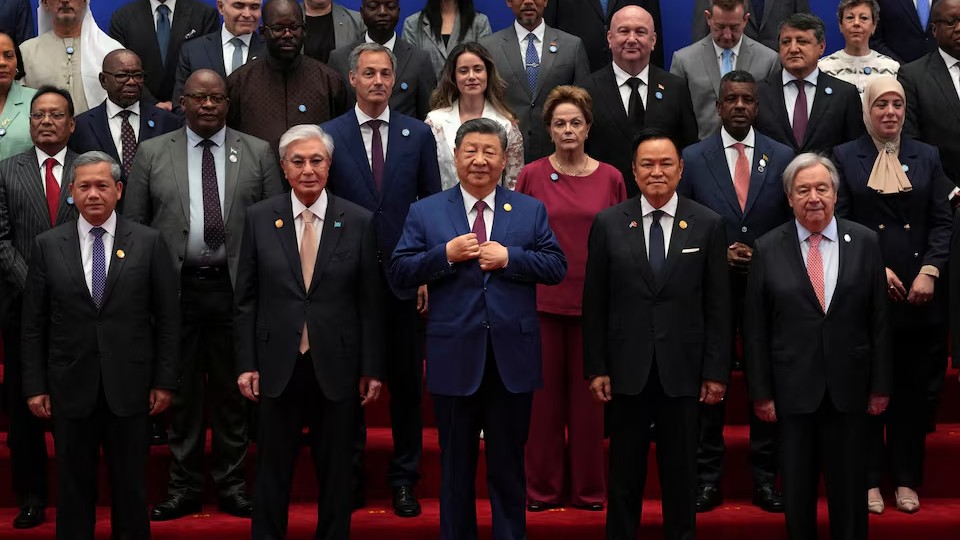
Xi paired the institutional launch with concrete resource commitments designed to appeal directly to developing nations
Background
Artificial intelligence has become one of the defining fault lines of great-power competition in 2026, and the past several weeks have made that divide institutional rather than merely rhetorical. Washington and Beijing have spent the year building rival coalitions meant to set the rules for how AI is developed, shared and governed globally, each explicitly positioning itself as the responsible alternative to the other. The U.S. approach has centered on Pax Silica, a State Department initiative launched in December 2025 under Under Secretary for Economic Affairs Jacob Helberg, built around AI, semiconductors, critical minerals and secure supply chains among trusted partners. It sits within the broader framework of the Trump administration's "Winning the AI Race: America's AI Action Plan," which emphasizes deregulation domestically and an "America First" posture in AI diplomacy — prioritizing exports of American AI technology and infrastructure to allied nations while resisting heavy multilateral regulation.
China's answer has been years in the making but crystallized this month. At last week's UN AI dialogue, Chinese and American officials publicly staked out opposing philosophies: U.S. representatives argued that extensive regulation would stifle innovation, while Chinese officials framed Beijing's low-cost, open-source AI models as a global public good capable of narrowing the gap between wealthy and developing nations. That framing has become the centerpiece of China's diplomatic pitch to the Global South throughout 2026, building on years of technology-focused outreach through the Belt and Road Initiative, BRICS and other multilateral vehicles Beijing has used to build influence outside the Western-led order.
Key Developments
That competition took concrete institutional form on July 16, when representatives of 29 countries signed an agreement in Shanghai establishing the World Artificial Intelligence Cooperation Organization, or WAICO — a new intergovernmental body that will be headquartered in Shanghai. The signing took place alongside the 2026 World Artificial Intelligence Conference and was attended by UN Secretary-General António Guterres, lending the launch a degree of international legitimacy beyond a purely China-led affair. President Xi Jinping used the occasion to deliver what analysts describe as his clearest articulation yet of China's ambitions in global AI governance, urging countries to cooperate on the technology and, in an implicit rebuke of the United States, stating that no single country should be allowed to dominate it.
WAICO's founding membership spans a wide geographic swath of the developing world and China's traditional diplomatic partners: Russia, Belarus and Serbia in Europe; Kazakhstan, Kyrgyzstan, Tajikistan and Uzbekistan in Central Asia; Oman in the Middle East; Algeria, Cameroon, the Republic of Congo, Ethiopia, Kenya, Lesotho, Mozambique, Senegal, South Africa and Zambia in Africa; Brazil, Cuba, Nicaragua and Venezuela in Latin America; and Cambodia, China, Indonesia, Laos, Malaysia, Myanmar and Pakistan in Asia. Six of the 29 founding members are full BRICS members and another five are BRICS partner countries, underscoring how heavily the new body overlaps with — and extends — existing China-anchored diplomatic architecture. Notably absent are the United States, the European Union as a bloc, Japan, and the United Kingdom, all of which have instead gravitated toward Washington's Pax Silica framework.
Xi paired the institutional launch with concrete resource commitments designed to appeal directly to developing nations. He pledged 5,000 training and seminar slots in AI-related fields for people from developing countries over the next five years, promised to establish AI application cooperation centers in partnership with ASEAN, the Arab League, the African Union and BRICS, and said China would extend access to its AI-powered weather-warning system — reportedly referred to internally as "Mazu" — to 30 countries. Officials described the goals of the new organization as promoting international cooperation on AI and developing cross-border regulatory approaches intended to keep the technology "beneficial and safe for humans," language that echoes, while diverging in substance from, similar commitments made by Western governments and companies.
The announcement arrived just weeks after the State Department's second Pax Silica summit in June, at which ten additional signatories — Argentina, Chile, Costa Rica, El Salvador, the European Union, Germany, Greece, Kazakhstan (which is also a WAICO founding member, illustrating that some countries are hedging between the two blocs), the Netherlands and Panama — joined the U.S.-led framework, bringing its total membership to 24. That summit also produced new initiatives including an AI supply-chain assistance project for Panama, a $50 million U.S. commitment to a program called PaxPass, and a workforce-development partnership with Stanford University branded Foundry School. Washington and Beijing are additionally said to be preparing their first formal bilateral AI talks under the Trump administration, though no date has been confirmed.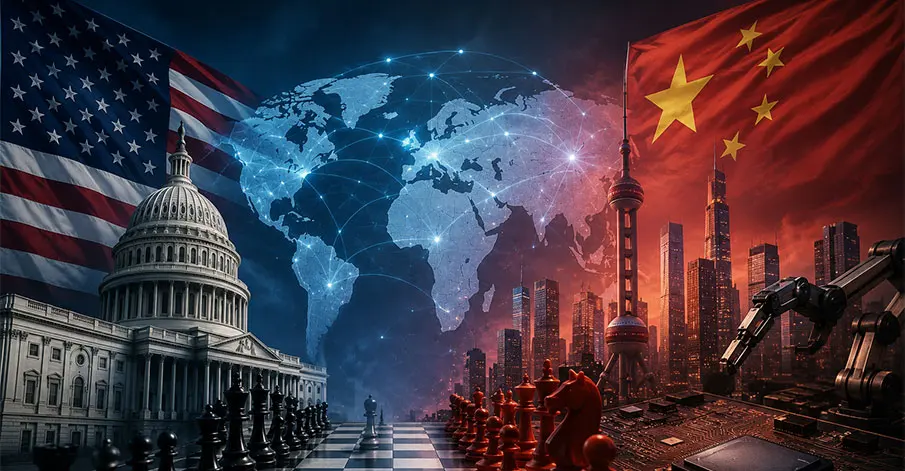
Reactions
Reaction to WAICO's launch has split along largely predictable lines. Beijing's state media and officials have presented the organization as evidence of China's commitment to multilateral, inclusive AI governance, contrasting it with what they describe as an exclusionary, export-control-driven American approach. Indonesian officials, among others, framed their participation as a pragmatic move to secure AI training resources and technology access without requiring alignment with Washington's stricter geopolitical conditions. Analysts covering the launch have generally agreed that Beijing intends to use WAICO as a vehicle to shape how AI governance is discussed and framed at the United Nations, giving China a bloc of votes and aligned positions to draw on in future multilateral negotiations over AI standards, safety frameworks and technology transfer rules.
Western commentary has focused heavily on the emerging bipolar structure this creates. Several analysts have described the current moment as a genuine fork in global AI governance — one pole anchored in Washington's Pax Silica coalition of wealthier, largely Western-aligned economies, and the other in Beijing's WAICO, drawing heavily from the Global South, BRICS members and China's traditional partners. Notably, some countries, including Kazakhstan, appear in both camps, suggesting that for many mid-sized economies the choice is not binary but transactional — a hedge to preserve access to technology and resources regardless of which bloc ultimately proves more influential. The United Kingdom's absence from WAICO while it continues to weigh its position relative to Pax Silica has been cited as an example of a government caught between the two poles without having fully committed to either.
What's Next
The most immediate test of WAICO's substance will be whether its stated commitments — the training slots, cooperation centers and weather-system access — translate into functioning programs, or remain largely symbolic gestures typical of a newly formed multilateral body. Analysts will also be watching how WAICO positions itself ahead of any UN-level negotiations on AI governance frameworks, given Beijing's evident intent to use the organization as a coordinating bloc in those forums. The scheduled but unconfirmed bilateral AI talks between Washington and Beijing under the Trump administration could offer an early signal of whether the two governments intend to manage this competition through direct diplomacy or allow it to harden into fully separate, incompatible technology ecosystems — a scenario often described as AI "bifurcation," with divergent standards, hardware ecosystems and data-governance rules emerging on either side.
For countries still undecided, the coming months are likely to bring pressure from both Washington and Beijing to formalize alignment, particularly as each coalition seeks to expand its membership and demonstrate momentum. The EU's own position bears watching, given that Brussels signed onto Pax Silica as a bloc during the June summit even as individual concerns persist about strategic dependency on both the United States and China for critical AI infrastructure. Ultimately, the durability of WAICO will depend less on its founding declarations than on whether China can deliver tangible technological and economic benefits to its Global South partners at a scale that rivals what Washington and its allies can offer — a competition that is likely to define AI diplomacy for years to come.



