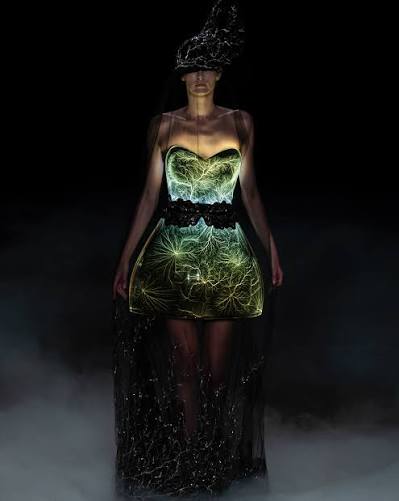
At Paris Couture Week, the Dutch designer unveiled Helix Nebula, a gown built from 8,000 hand-blown glass spheres and the world's first couture use of plasma — gas so charged it glows when the wearer moves
PARIS
Every couture season produces a handful of garments that get described, breathlessly, as "wearable art." Most of the time that's a compliment about craftsmanship. This season, at Iris van Herpen's Fall/Winter 2026-27 show during Paris Couture Week, it was closer to literal fact. The Dutch designer, long known for treating fashion as a laboratory for materials science as much as silhouette, unveiled a dress that doesn't just resemble energy — it contains it.
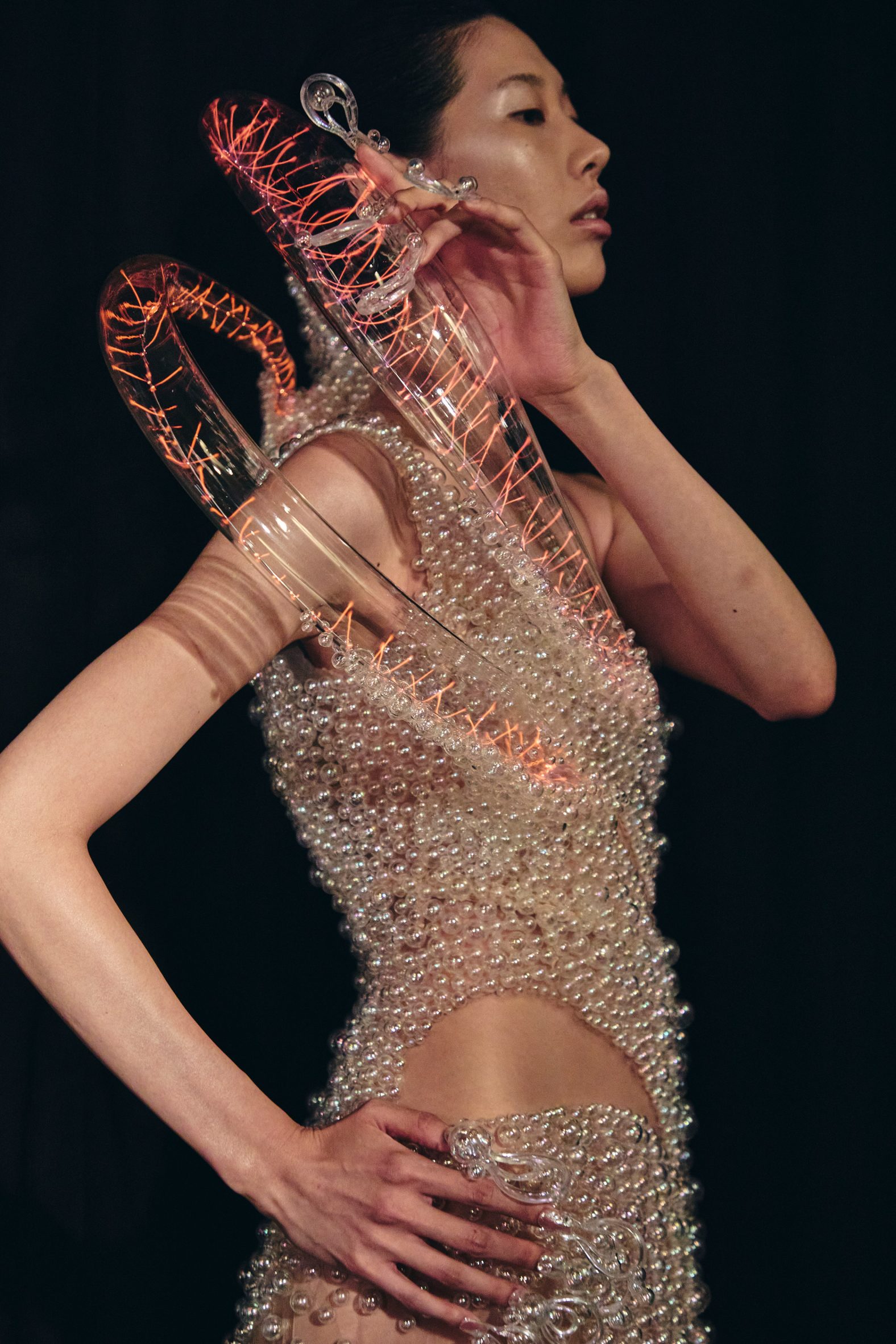
The piece, called Helix Nebula, is built around hand-shaped glass horns injected with plasma: gas that has been ionized so it carries an electrical charge, the same fourth state of matter that powers neon signage and appears naturally in lightning and the aurora borealis. Worn on the body, the dress uses the wearer's own electrical field as a conductor, causing the plasma's charged particles to move and release photons at specific wavelengths — resulting in bolts of glowing red light that streak through the glass as the model walks. Van Herpen, working with American plasma artist Mundy Hepburn, is billing it as the first couture garment ever constructed with plasma as a material in its own right.
Dressing the Frequencies of the Universe
Helix Nebula was the centerpiece of a 17-look collection titled Sonic Starquakes, which took as its conceptual starting point the largely invisible forces — electromagnetic, seismic, cosmic — that shape both the universe and the human body without ever being directly seen. It's a theme Van Herpen has circled for years, but rarely has she pursued it this literally.
"For years, I have been drawn to the idea of creating a garment woven from energy alone," Van Herpen said following the show. "This is the first time we have worked with the fourth state of matter, plasma. Glass and tulle still hold it to the earth, but we are one step closer to couture that exists as atmosphere alone."
Beyond Helix Nebula's glowing horns, the gown's remaining structure is built from translucent tulle studded with roughly 8,000 hand-blown glass spheres, each bonded to the fabric using UV light — a construction process that, by even couture's demanding standards, verges on the industrial. Elsewhere in the collection, a piece dubbed the Fractal Universe dress pushed the concept of relinquishing creative control even further: charged electrons within the garment were allowed to determine elements of its final form during construction, meaning no single hand fully dictated the finished silhouette.
"By escaping human control, the charged electrons within the garment determined its final expression," Van Herpen explained, "completing the creation through an invisible, universal force, [so that the] final gesture of its creation belonged not to the hand of the maker, but to an elemental force woven into the fabric of the cosmos itself."
Science as Silhouette
Van Herpen's entire design practice has always sat at the intersection of couture ateliers and research labs — she has previously collaborated with mathematicians, marine biologists, and 3D-printing engineers, and her past collections have referenced everything from magnetic fields to deep-sea bioluminescence. What makes Sonic Starquakes notable, even within that body of work, is the degree to which the collection treats invisible physical phenomena not as inspiration but as raw material.
"Around us, and within us, vast dimensions of reality remain undiscovered," Van Herpen said, describing the collection's broader intent. "From lightning to the charged environments of particle accelerators, this collection gives form to forces that rarely reveal themselves. I do not seek to explain them; instead, they heighten our awareness of the unknown, reminding us of the mysteries that lie within this multiverse."
That framing — energy and geometry as connective tissue between the cosmic and the biological — recurred throughout the show notes, with Van Herpen pointing to the same branching patterns appearing in lightning strikes, river deltas, and the neural networks and blood vessels inside the human body. "The universal flow of energy shapes branching geometries across all scales," she said, "from the microscopic to the planetary."
Why It Matters Beyond the Runway
It would be easy to file Helix Nebula away as a one-off spectacle piece, the kind of showstopper couture houses build purely to generate headlines and closing-look photographs — and to be fair, it will almost certainly never be worn outside a museum case or a red carpet moment engineered for maximum safety and stagecraft. But Van Herpen's plasma experiment sits within a broader, increasingly serious movement in high fashion toward genuinely new material science, rather than simply new applications of existing fabrics. Her past innovations — 3D-printed garments, water-based "magnetic" dresses — have had a track record of eventually filtering, in diluted form, into more wearable design languages and even into industrial and product design more broadly.
For the luxury industry, moments like this also serve a specific commercial function: couture, unlike ready-to-wear, isn't primarily meant to sell directly. Shows like Sonic Starquakes function as technical showcases and brand-building spectacle, generating the kind of global media attention that reinforces a house's positioning as more research lab than clothing manufacturer — a halo effect that, indirectly, supports sales across perfume, accessories, and licensed categories.
What This Means for Readers
For anyone outside the rarefied world of haute couture, Helix Nebula is unlikely to ever appear anywhere near an actual closet. But it's a useful signal of where the outer edge of fashion innovation is heading: toward materials science, energy, and interactivity, rather than simply cut and fabric. Expect to see plasma's glow, or some diluted echo of it, eventually surface in more accessible forms — festival wear, stage costuming, experiential retail displays — the way past Van Herpen innovations have trickled outward over time.
For now, though, Helix Nebula remains something rarer: a dress that is, quite literally, electric.
Published By | Features Editor