BISSAU
Nine months after soldiers overthrew Guinea-Bissau's elected government, the military-led transitional authorities are pressing ahead with a rapid, tightly choreographed return to constitutional rule that critics say is being engineered to entrench a stronger presidency before voters get a real say. A national referendum on rewriting the constitution is set for Aug. 30, followed by long-delayed presidential and legislative elections on Dec. 6 — even as the country's leading opposition figure remains in pretrial detention and the regional bloc overseeing Guinea-Bissau's reintegration convened this week in Timor-Leste to press for faster progress.
The timeline, confirmed in a government decree, gives Guinea-Bissau's roughly 2.2 million people just 11 days from today to weigh a proposal that would fundamentally alter how the country is governed, followed by barely three months to campaign for the first competitive national elections since the coup.
From Disputed Election to Military Takeover
Guinea-Bissau's crisis traces back to Nov. 26, 2025, when a faction calling itself the High Military Command for the Restoration of National Security and Public Order seized power just days after a presidential election whose results had not yet been certified. The military said it acted to prevent a "bloodbath" between supporters of rival candidates — then-President Umaro Sissoco Embaló, who was seeking a second term, and opposition candidate Fernando Dias da Costa, both of whom had claimed victory before the High Military Command suspended the electoral process entirely and voided the results.
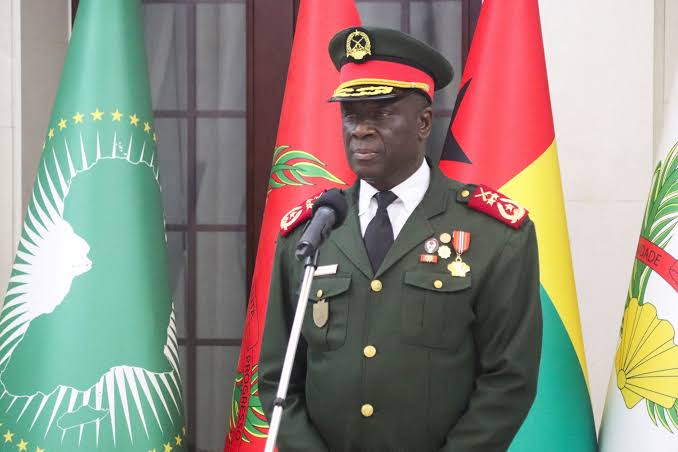
Embaló was deposed and flown to Senegal aboard a flight arranged with the help of West African mediators before relocating to the Republic of the Congo. The junta installed army chief of staff Maj. Gen. Horta Inta-A Na Man — widely referred to in regional media as N'Tam — as transitional president, tasked with overseeing a one-year transition. A transitional charter published in early December 2025 explicitly bars N'Tam, a close Embaló associate, from running in the elections he is charged with organizing. Domingos Simões Pereira, president of Guinea-Bissau's National People's Assembly and leader of the opposition African Party for the Independence of Guinea and Cape Verde (PAIGC), was detained on the day of the coup and remains in pretrial detention more than eight months later, according to the Community of Portuguese-Speaking Countries (CPLP).
The African Union demanded the unconditional release of Embaló and other detained officials in the coup's immediate aftermath, while the regional bloc ECOWAS suspended Guinea-Bissau from its decision-making bodies. U.N. Secretary-General António Guterres called the takeover an "unacceptable violation of democratic principles." A visiting ECOWAS delegation led by Sierra Leonean President and ECOWAS chair Julius Maada Bio and Senegalese President Bassirou Diomaye Faye pressed the junta in early December for a "short, structured and transparent transition" and demanded the release of political prisoners, including Pereira — a demand that, eight months on, has gone unmet.
A Referendum Timed Ahead of the Vote
On Jan. 22, N'Tam declared that "all the conditions for organizing free, fair and transparent elections have been met" and set Dec. 6 as the date for combined presidential and legislative elections. But the more immediate and, in the view of many observers, more consequential vote comes first: a government decree published in early July set Aug. 30 for a national referendum on a sweeping constitutional amendment.
The proposed changes would convert Guinea-Bissau from a parliamentary system — in which the prime minister has traditionally been drawn from the parliamentary majority, an arrangement that repeatedly produced fractious coalition governments, including under Embaló, who ruled by decree for roughly two years after dissolving an opposition-dominated parliament in December 2023 — into a presidential system. Under the proposed constitution, the head of state would gain the power to directly appoint the prime minister and cabinet members and to dissolve parliament, concentrating authority in the presidency at precisely the moment a newly elected president is set to take office. The transitional government has unanimously approved the amendment, and the decree setting the referendum date states that Guinea-Bissau's Supreme Court has issued a "favourable opinion" on the proposal.
The sequencing has drawn scrutiny: voters will decide in ten days' time whether to hand sweeping new powers to a presidency that will be filled just over three months later, in an election in which the architects of the transition — though barred from running themselves — will have overseen both the rules of the contest and the constitutional powers attached to the prize.
Suspended From the Family, Still Central to the Agenda
Guinea-Bissau's international standing remains in limbo. The CPLP, the community of Portuguese-speaking nations that includes Brazil, Portugal, Angola, Mozambique and Guinea-Bissau, suspended Bissau from all its activities in December 2025 under Article 7 of its statutes, which permits sanctions in cases of serious breaches of constitutional order. The suspension will remain in force until constitutional order is restored, and Guinea-Bissau's CPLP presidency responsibilities passed to Timor-Leste.
Guinea-Bissau's status was nonetheless a central topic this week at the CPLP's 31st Ordinary Meeting of the Council of Ministers, held Aug. 12–19 in Dili, Timor-Leste. "Guinea-Bissau is an indispensable member. It is a founding member," Joaquim Fernandes, coordinator-general of Timor-Leste's Pro Tempore Presidency Commission, told reporters ahead of the meeting, framing the suspension as a mechanism for continued engagement rather than punishment. Timor-Leste Prime Minister Xanana Gusmão struck a similar note on Wednesday at the meeting's opening, telling assembled ministers, including Portuguese Foreign Minister Paulo Rangel and CPLP Executive Secretary Maria de Fátima Jardim, that he "reaffirm[ed] my deep solidarity with the Guinean people and the firm commitment of Timor-Leste and the CPLP as a whole to supporting efforts towards dialogue, institutional stability and the restoration of the democratic rule of law." Gusmão called the crisis "a test of the CPLP's ability to uphold its principles of solidarity, dialogue and cooperation," urging member states to "act as the true family we aspire to be." In July, the CPLP had already called for the urgent restoration of constitutional order and renewed its demand for Pereira's release.
A Familiar Pattern in a Fragile State
Guinea-Bissau's crisis is not an isolated event but the latest chapter in a decades-long pattern of instability. The country, one of the world's poorest, has endured repeated coups and coup attempts since gaining independence from Portugal more than 50 years ago, including an attempted takeover in October 2025, weeks before the successful one. Analysts and Western officials have long linked the country's chronic political fragility to its role as a transit hub for cocaine trafficking between Latin America and Europe, with drug money widely believed to have penetrated the security services and political class. The November 2025 coup fits a broader West African pattern: military leaders have seized power since 2020 in Mali, Niger, Burkina Faso and, in 2021, Guinea, typically citing insecurity or bad governance as justification — a trend that has left ECOWAS's coup-response mechanisms strained and its deterrent credibility in question.
What to Watch
The Aug. 30 referendum is the immediate flashpoint. A "yes" vote would hand the winner of December's presidential election significantly expanded powers before that winner is even chosen, raising the stakes of a race in which the transitional authorities have already disqualified their own leader but have not clarified how competitive the field will otherwise be, or whether Pereira — still detained and barred from the political arena for now — could factor into the race at all should he be released. Turnout and the conduct of the referendum itself will be an early test of whether N'Tam's claim that "all conditions" for credible elections have been met withstands scrutiny from international observers. Also worth watching: whether ECOWAS and the CPLP, both of which have suspended Guinea-Bissau, use the run-up to December to extract concrete concessions — Pereira's release chief among them — or whether Bissau's transitional authorities are able to run out the clock on suspension by simply completing the electoral calendar they themselves designed. With just over three months separating the referendum from the vote that will determine who wields the presidency's newly expanded powers, Guinea-Bissau's window for a genuinely contested, broadly legitimate return to civilian rule is narrowing fast.
Published By | News Editor