Written By | International News Agencies
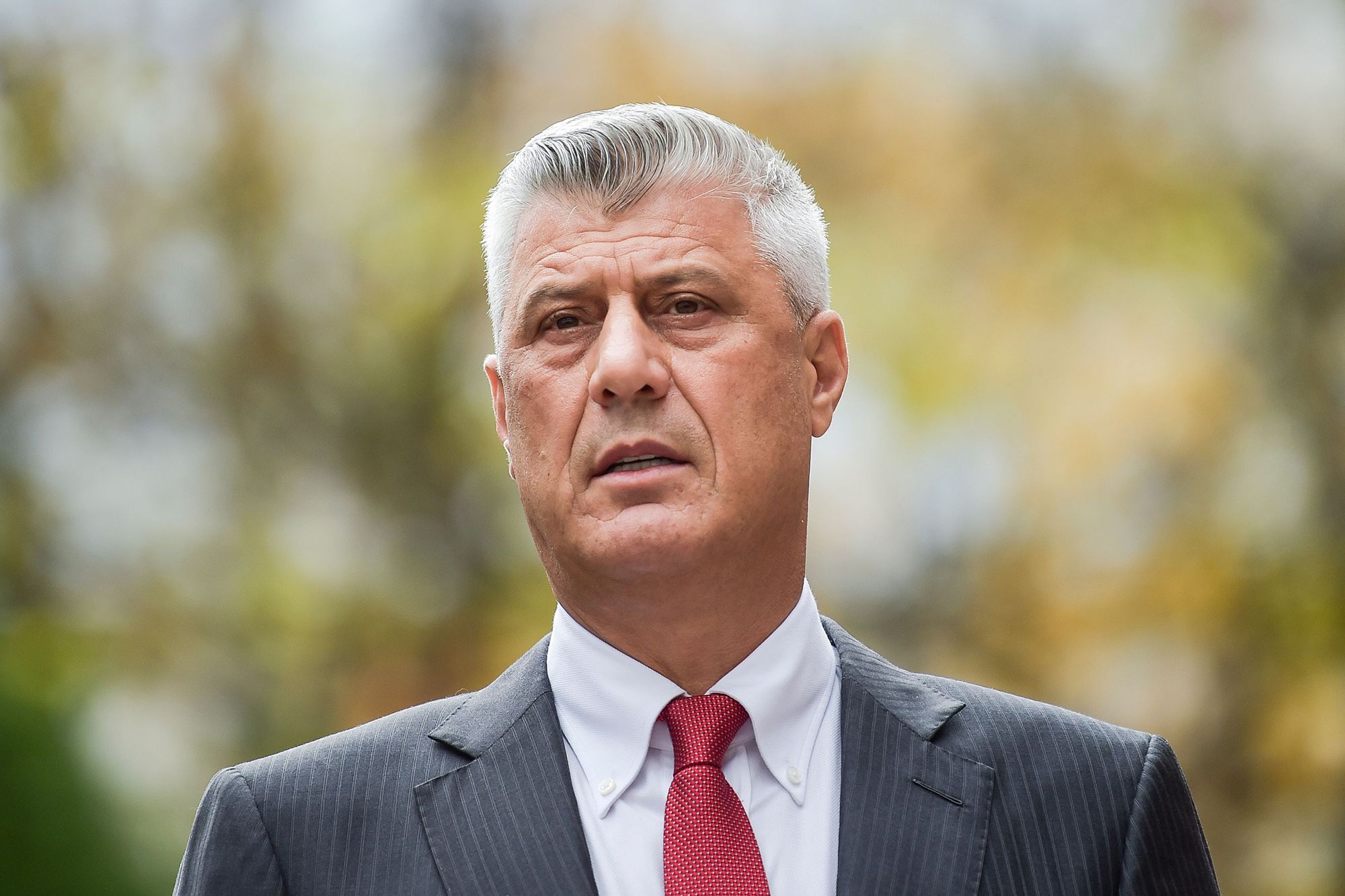
Thaçi was tried alongside three other former KLA leaders
The Hague / Pristina
Hashim Thaçi stood in silence, in a suit and tie, as the presiding judge read out the sentence. On Wednesday morning in The Hague, a panel of the Kosovo Specialist Chambers convicted the former president of Kosovo — guerrilla commander, negotiator at Rambouillet, prime minister, foreign minister, head of state — on four counts of war crimes, and sent him to prison for 25 years.
The counts were murder, torture, cruel treatment and arbitrary detention, committed while Thaçi was a senior figure in the Kosovo Liberation Army during the territory's violent separation from Serbia in 1998 and 1999. The court found the defendants criminally responsible for the murder of 96 people, the arbitrary detention of 385, the torture of 303 and the cruel treatment of roughly 49 more. Thaçi, 58, denies all the charges, and can appeal.
The Verdict
Thaçi was tried alongside three other former KLA leaders: Kadri Veseli, Rexhep Selimi and Jakup Krasniqi. Krasniqi, like Thaçi, received 25 years. Veseli was sentenced to 18 years and Selimi to 13, both including time already served. All four have been in pretrial detention since 2020. Prosecutors had asked for the maximum available term of 45 years for each man.
The verdict was not a clean sweep for the prosecution. All four defendants were acquitted on six counts of crimes against humanity, the judges finding that prosecutors had failed to prove the crimes were committed as part of a widespread or systematic attack directed against a civilian population. That distinction matters legally and politically: what the court found was a pattern of serious war crimes by an armed force, not a campaign of persecution amounting to crimes against humanity.
Presiding Judge Charles Smith, an American, said Thaçi had "used his position, leadership, authority and standing" to encourage the crimes. He also went out of his way to narrow the judgment's reach, stressing that the trial was "not about the legitimacy of the Kosovo Liberation Army" or about its ultimate goal of independence for what was then a province of Serbia. That caveat was aimed squarely at Pristina, and it did not land.
Background: A Court Built on Distrust
The KLA emerged in the mid-1990s out of the exhaustion of a decade of peaceful Albanian resistance to Slobodan Milošević's rule. It grew from scattered guerrilla cells into a force capable of fighting Serbian and Yugoslav troops, and the war it provoked killed or disappeared some 13,000 people — most of them ethnic Albanians — and drove around a million ethnic Albanian Kosovars from their homes. A 78-day NATO bombing campaign that began in March 1999 forced the withdrawal of Yugoslav forces. Kosovo declared independence in 2008; Serbia has never recognised it, and EU-mediated normalisation talks have been stalled for years.
Serbian commanders were prosecuted for crimes in Kosovo at the International Criminal Tribunal for the Former Yugoslavia. The Kosovo Specialist Chambers, by contrast, exists to try the other side. It was established in 2015 as a temporary tribunal applying Kosovo law but sitting in The Hague and staffed almost entirely by international personnel — an arrangement chosen because of fears for the safety of witnesses inside Kosovo. Those fears were not theoretical: in 2022 the court convicted two leaders of a Kosovo war veterans' association of intimidating witnesses by publicising leaked confidential documents.
The indictment covered the period from March 1998 to early September 1999. Prosecutors alleged that more than 50 KLA detention facilities were used to unlawfully hold, abuse and kill people the organisation regarded as opponents or collaborators — Albanians as well as Serbs, Roma and others. Hearings began in 2023 and the trial closed in February of this year, when Thaçi told the judges: "Throughout my life, I stood with the people of Kosovo defending freedom, life and dignity. I was always guided by the Western ideals of democracy, equality and justice."
The defence case turned on structure. Mark Ellis, executive director of the International Bar Association, described the argument to RFE/RL: the KLA was "very loosely organised," with no real hierarchy, and therefore no joint criminal enterprise through which its leaders could be held responsible for acts committed by others. The panel had to determine, defendant by defendant, whether a superior–subordinate relationship existed, whether each man had effective control, and whether he knew or had reason to know crimes were being committed and did nothing to stop them. On Wednesday it concluded, for all four, that he did.
Thaçi's own arc explains why the judgment carries the weight it does. A student who returned from what he described as political exile in Switzerland to join the independence struggle, he earned the nickname "the Snake" for his knack of slipping past Serbian forces. Western governments embraced him, inviting him to the 1999 peace talks in France as the KLA's political director and treating him as the man who could steer Kosovo to statehood. He rose to the presidency and resigned it, nearly six years ago, to answer these charges.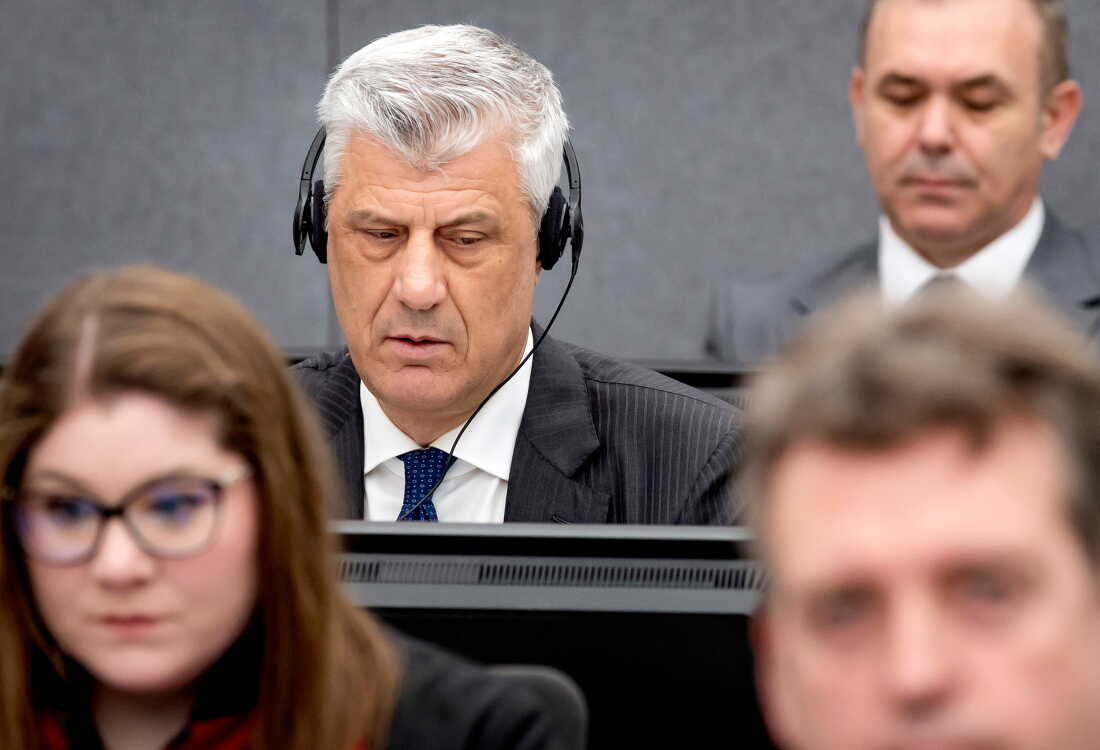
Reactions
In Pristina, thousands had gathered in the main square to watch the reading on a huge screen, beneath banners of the four defendants and a digital clock counting down to the verdict. The crowd was stunned. Some began shouting "UÇK," the Albanian acronym for the KLA. Once it was clear Thaçi would remain in detention, the square emptied within minutes. "A catastrophic decision," said one supporter, Bekim Fetahu. "They have put the victims together with the aggressors."
Kosovo's foreign minister, Glauk Konjufca, speaking outside the court, called it "a terrible judgment for Kosovo, for our people and for our liberation war — a sad, unjust, undeserved decision." Prime Minister Albin Kurti had set the government's position two days earlier, speaking on 14 September, the day after he was re-elected prime minister: "for us, everything is clear: the people of Kosovo, our resistance, and our war were just and liberating, against an occupier that committed war crimes, crimes against humanity, and genocide." Hundreds of supporters waited in a park near the courthouse in The Hague, where some briefly clashed with Dutch riot police.
Human rights organisations read it the other way. Esther Major, Amnesty International's deputy regional director for Europe, said the convictions "show that senior officials are not above the law." In Belgrade, President Aleksandar Vučić announced he would address the nation later on Wednesday about the verdicts and the "situation in the region."
Among Kosovo's Serbs, the mood before the verdict was less vindication than resignation. Jasmina Živković has spent 27 years trying to find out what happened to her father, one of roughly 1,600 people still missing from the war. He disappeared in late September 1999 — after the window covered by the indictment. "Unfortunately, many victims have been excluded from this process," she told RFE/RL, adding that she no longer expected the verdict to change anything for her, and that the trial had seemed to be about politics more than about victims.
Timothy Waters, a professor of international law at Indiana University, predicted before the ruling that responses would divide along ethnic lines, as they always have. Verdicts in the former Yugoslavia, he said, "all get read like an ethnic census. You can tell what side people belong to by their reaction to court processes in Croatia, in Serbia, in Bosnia." He pointed to the funeral of Ratko Mladić in Belgrade earlier this month, where thousands turned out for a man convicted of genocide at Srebrenica. "That tells you a lot more than anything that's happening in the court."
What's Next
Wednesday's ruling is a first-instance judgment, and all parties have the right to appeal; Thaçi's lawyers are expected to do so, and an appeals process will take years. Separately, Thaçi faces a second trial on charges of obstructing justice by intimidating witnesses, due to open later this month.
The political consequences inside Kosovo may be more immediate. The country has spent much of the past two years in institutional deadlock, with rival parties unable to form stable majorities and repeated elections producing little; Kurti was only re-elected prime minister on 13 September. Public sympathy for the defendants has been intense — thousands marched in Pristina on 12 September, and some opposition parties had floated re-electing Thaçi as president if he were acquitted. That option is now closed, and a government that has publicly rejected the verdict must nonetheless keep cooperating with the court that issued it, since that cooperation is written into Kosovo's own law and into its relationship with Brussels.
For the European Union, the judgment is awkward in a way that is easy to miss. The Specialist Chambers were the price the West asked Kosovo to pay for its statehood: a demonstration that the country would prosecute its own founders. Having paid it, Kosovo now finds its national narrative — a just war of liberation against an aggressor — formally qualified by a court its own parliament created, in the same month that Serbia buried a convicted génocidaire with honours. Judge Smith insisted the trial was not about the legitimacy of the KLA. In Pristina on Wednesday, almost nobody believed him.



