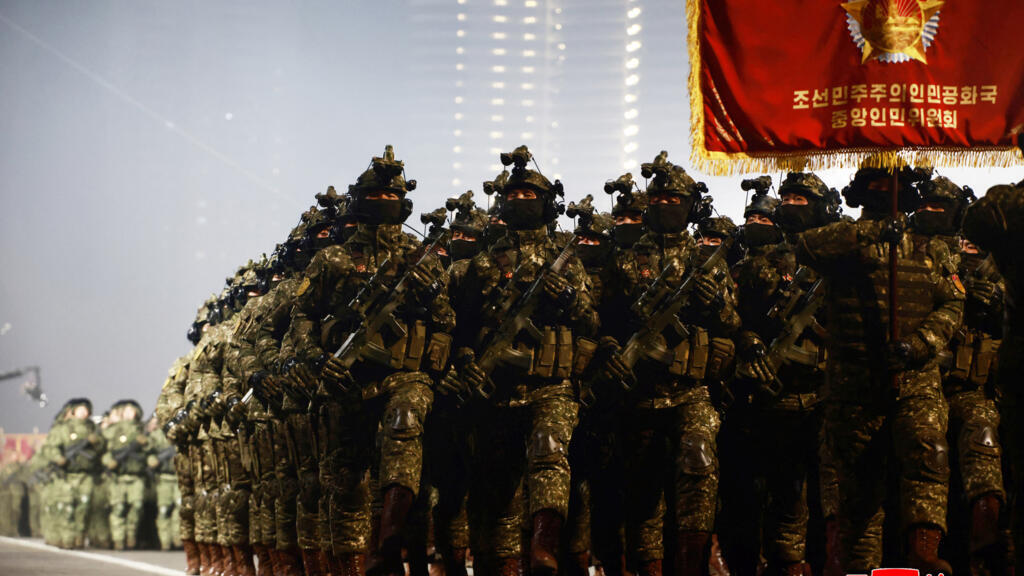
Ukrainian President Volodymyr Zelensky said this week that Russia has decided to bring in as many as 50,000 additional North Korean soldiers, a sharp escalation of a military partnership that has already sent thousands of Pyongyang's troops into combat and, according to Kyiv, North Korean-made ballistic missiles into Russian strikes on Ukrainian territory. The claim, still not independently confirmed by Western governments, would roughly triple the size of the North Korean force that fought to help Russia repel Ukraine's 2024 incursion into Kursk, and comes as South Korean and Ukrainian intelligence separately report that a dedicated North Korean missile unit has begun deploying inside Russia itself, positioned just 150 kilometers from the Ukrainian border.
Background
North Korea's involvement in Russia's war against Ukraine dates to late 2024, when Pyongyang dispatched an initial contingent, estimated by U.S. and South Korean officials at roughly 10,000 to 15,000 troops, to Russia's Kursk region to help push back a surprise Ukrainian ground incursion. That first deployment was formalized by the countries' 2024 mutual defense partnership treaty and marked the first time North Korean soldiers had fought in a foreign war in decades. According to South Korean intelligence cited by Yonhap earlier this year, roughly 11,000 North Korean troops remained in Kursk Oblast at the start of 2026, though Pyongyang's forces there had already suffered heavy losses — an estimated 6,000 killed or wounded, according to South Korea's National Intelligence Service.
Alongside troops, North Korea has steadily expanded weapons shipments to Russia, supplying an estimated 150 ballistic missiles between 2023 and 2025 along with millions of rounds of artillery ammunition, according to Ukrainian and Western assessments. The relationship has also had a diplomatic dimension: in July, North Korean Foreign Minister Choe Son Hui traveled to Moscow for a 'strategic dialogue' with Russian counterpart Sergei Lavrov and met separately with President Vladimir Putin, fueling ongoing speculation about a possible visit to Russia by Kim Jong Un later this year. Putin has publicly thanked Pyongyang for its troop contributions to the Kursk fighting, and each government has backed the other's territorial and 'sovereignty' claims — Russia over Ukraine, and implicitly North Korea over its own standing as a nuclear-armed state facing international sanctions.

Key Developments
Zelensky said on social media on Aug. 8 that 'a decision has been made for 30,000 to 50,000 North Koreans to be deployed on the territory of Russia,' raising his own prior estimate — offered just weeks earlier in July — of roughly 30,000. He did not disclose the intelligence basis for the claim, and it has not been independently corroborated by U.S., South Korean or NATO officials, who have offered more cautious language. Deputy U.S. Secretary of State Kurt Campbell, speaking in Seoul, said Washington and its allies remain 'alarmed' by the scale of North Korea's military support for Russia but stopped short of confirming Ukraine's specific troop figures. South Korea's government has said it is 'closely monitoring' the reports and has called on Pyongyang and Moscow to halt any military cooperation that violates United Nations Security Council resolutions barring North Korean arms exports and troop deployments abroad.
Separately, and more concretely documented, Ukrainian military intelligence reported this month that Russia plans to deploy a dedicated North Korean missile unit — equipped with six launchers and as many as 120 KN-23 and KN-24 short-range ballistic missiles — to Russia's Voronezh region, integrated into Russia's 112th Missile Brigade. The unit is expected to comprise roughly 90 North Korean personnel, giving Pyongyang's own crews hands-on experience operating the missiles in a live combat theater rather than simply supplying the hardware for Russian crews to fire. Ukrainian officials say an initial batch of roughly 40 of the missiles has already been shipped to Russia. Underscoring how far this cooperation has already progressed toward direct battlefield use, Ukraine's air force reported that Russia launched North Korean-supplied ballistic missiles at Ukrainian targets on the night of July 29-30 — one of the clearest indications yet that Pyongyang's weapons, and by extension its personnel training on them, are being folded directly into Russia's active strike campaigns rather than held in reserve.
Taken together, the reported new troop commitment and the missile unit's deployment mark a shift from North Korea's earlier role — chiefly replenishing depleted Russian infantry ranks in a single border region — toward a broader, more technically integrated partnership that could see North Korean forces and weapons systems distributed more widely across the Russian side of the front.

Reactions
Zelensky has repeatedly used the reports to press Ukraine's Western backers for more urgent support, warning that North Korea stands to gain valuable battlefield experience and exposure to modern missile and drone warfare that it could apply to its own military — and potentially transfer to other partners — regardless of how the Ukraine war ends. Kyiv has previously accused Western governments of responding too slowly and too quietly to North Korea's escalating role, a criticism Zelensky renewed in his Aug. 8 statement.
NATO has treated the broader North Korea-Russia military relationship as a serious escalation since it first emerged in late 2024, with the alliance's leadership warning at the time that deepening cooperation among Russia, North Korea, Iran and China threatens security not only in Europe but across the Indo-Pacific and North America. South Korea's response has been more measured but consistent: Seoul has repeatedly said it is monitoring the reports through its National Intelligence Service and has called for any cooperation that breaches U.N. Security Council resolutions to stop, while stopping short of independently confirming Zelensky's specific 30,000-to-50,000 figure. Washington's posture is complicated by the Pentagon's own recent strategic shift; a new National Defense Strategy released by Defense Secretary Pete Hegseth earlier this year signaled that the U.S. military would prioritize homeland and Indo-Pacific concerns over open-ended commitments to deter Russia in Europe, a recalibration that could shape how forcefully Washington responds to this latest reported escalation.
Neither Russia nor North Korea has publicly confirmed the scale of the reported new deployment. Moscow has generally declined to detail its military cooperation with Pyongyang beyond broad statements of partnership, while North Korean state media has previously framed troop deployments, when acknowledged at all, as consistent with the countries' 2024 mutual defense treaty rather than as direct intervention in the Ukraine war.
What's Next
If confirmed, a deployment approaching 50,000 troops would represent one of the largest foreign troop contributions to either side of the war since Russia's 2022 invasion, and would likely accelerate calls in Washington, Brussels and Seoul for a coordinated response, whether through new sanctions targeting the North Korea-Russia arms and personnel pipeline, expanded intelligence-sharing, or further military assistance to Ukraine. The integration of North Korean missile crews directly into Russian brigades, rather than simply the transfer of hardware, is also likely to draw close attention from nonproliferation analysts, who see it as a vehicle for North Korea to harvest real-world combat data on its ballistic missile programs — data that could feed back into its own weapons development and future exports.
For Ukraine, the practical battlefield impact will depend on how quickly any new North Korean forces are trained, equipped and moved to front-line sectors, and whether they are used in direct assault roles, as the initial Kursk contingent was, or in more specialized functions such as missile operations and rear-area security. Confirmation or denial of Zelensky's specific figures by U.S. or South Korean intelligence agencies in the coming days is likely to be the next concrete marker in a story that, for now, rests heavily on Kyiv's own intelligence assessments.
Published By | News Editor