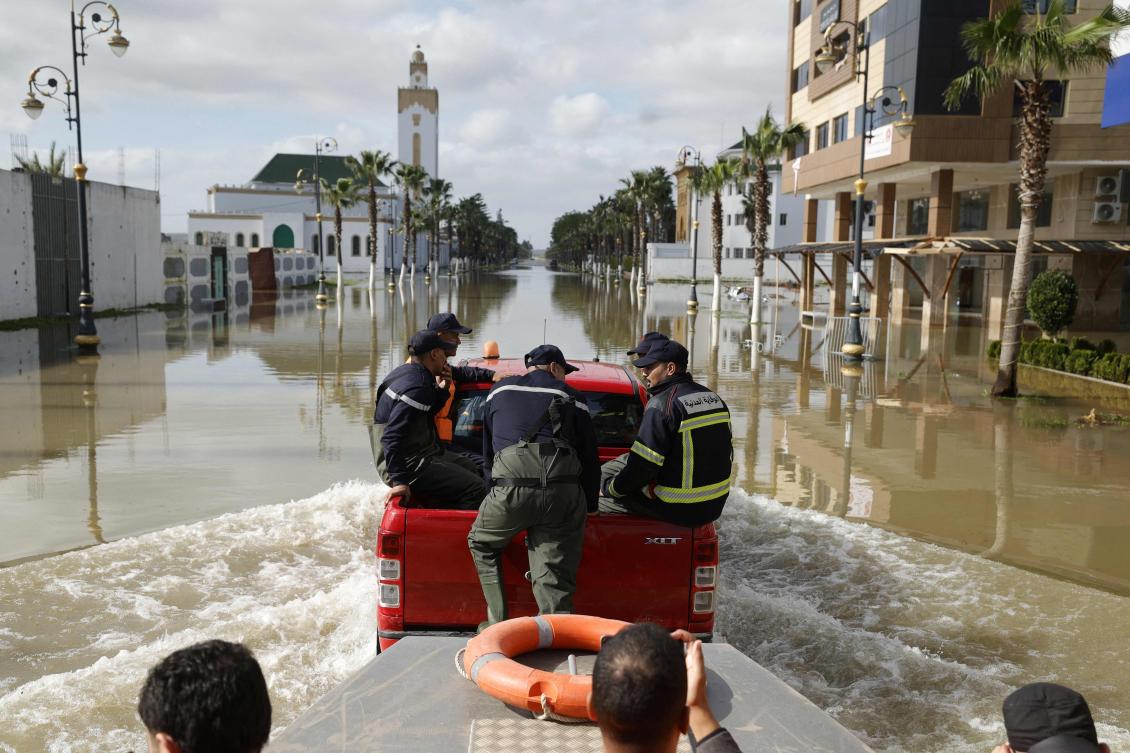
A wet 2026 has refilled the reservoirs and lifted growth. The harder question for Rabat's new government is whether pipes, desalination and transfers can stop the next drought from setting the economy's pace.
North Africa: Morocco
A Good Year That Proves the Point
For most of the past seven years, Morocco's economic story has been written by the sky. Rain-fed cereal harvests collapsed, reservoirs fell to historic lows and cities as large as Casablanca came within months of rationing. In 2026 the pattern broke. Heavy winter rains pushed the national dam filling rate to 61.3 percent in January, up from just 27.6 percent a year earlier, and by 1 June it stood at 75.7 percent, with more than 12.8 billion cubic metres in storage according to the Ministry of Equipment and Water's Maa Dialna platform as reported by Morocco World News. In parliament on 13 July, Water Minister Nizar Baraka put the country's total water reserves at 26 billion cubic metres, which he said was enough to cover about two years of drinking water and irrigation needs.
The economic effect was immediate. Bank Al-Maghrib now expects a cereal harvest of about 93 million quintals, more than double the roughly 44 million quintals of the previous season. Agricultural value added is projected to rise by about 16 percent, and provisional national accounts from the High Commission for Planning (HCP) show primary-sector value added up 17.3 percent in the first quarter of 2026. Yet the central bank's own projections contain the warning that frames this article. It sees GDP growth slowing from 4.9 percent in 2025 to 4.4 percent in 2026 and about 2.9 percent in 2027, mainly because farm output is expected to fall back toward normal. If cereal production returns to around 50 million quintals, agricultural value added would drop by about 7.6 percent. One good season does not change the underlying arithmetic. It shows how much of Moroccan growth still depends on rainfall.
That is why the more important story of 2026 is not the rain but what Morocco is building while the reservoirs are full: an attempt to turn water from a weather variable into managed national infrastructure.
The Structural Deficit Behind the Headlines
The underlying scarcity has not gone away. World Bank analysis shows renewable freshwater per person in Morocco falling from about 2,560 cubic metres a year in 1960 to roughly 620 cubic metres in 2020, and warns it could drop below 500 cubic metres, the threshold for severe scarcity, by around 2030. The Bank's Country Climate and Development Report estimates that water scarcity and falling crop yields could cut GDP by up to 6.5 percent over the long term.
The exposure falls heavily on rural households. Agriculture contributes roughly a tenth of GDP but employs more than a third of the active workforce, and the World Bank notes that rain-fed farming still covers about 80 percent of cultivated land. So drought is also a jobs shock, a migration pressure and a strain on public finances. This helps explain the social unrest of the past year, from the GenZ 212 protests over hospitals and schools to persistent rural-urban inequality. A strong harvest eases these pressures for a season. It does not remove them.
Building a National Water Grid
Morocco's response, set out in the National Programme for Drinking Water Supply and Irrigation (PNAEPI) 2020–2027, has been scaled up several times. Reported budgets range from more than MAD 130 billion to an updated MAD 143 billion, depending on the source. The programme rests on four elements: more dams, desalination, transfers between river basins, and wastewater reuse, alongside efforts to cut losses in distribution networks.
The inter-basin transfers have changed the most. The first 'water highway', a pipeline of about 67 kilometres linking the Sebou basin to the Sidi Mohammed Ben Abdellah dam near Rabat, began construction in December 2022 and started operating in August 2023. Its flow rose from 3 to 15 cubic metres per second, and it delivered more than 560 million cubic metres a year, well above the 350–400 million initially forecast. Cumulatively, nearly 950 million cubic metres moved between September 2023 and December 2025, protecting the Rabat–Casablanca corridor at the height of the drought.
The second link is far larger. A connection of nearly 300 kilometres toward the Oum Er-Rbia basin is designed to move up to 800 million cubic metres a year, supplying drinking water to Settat, Berrechid and southern Casablanca and serving about 176,000 hectares of irrigated land. A later extension to the Al Massira dam could raise capacity to about 1.2 billion cubic metres a year. Baraka told parliament that construction should begin toward the end of 2026. Meanwhile, 14 dams are under construction and eight have recently been completed.
Desalination: The Coastal Hedge
The second element is the sea. The government aims for desalinated water to supply about 60 percent of drinking water by 2030, compared with roughly a quarter today. Ministry figures reported by trade outlets put installed desalination capacity at around 410 million cubic metres a year across 17 plants in 2026, up from about 45 million cubic metres earlier in the decade. Separate industry estimates differ, so this figure should be read as an order of magnitude. An emergency programme of 203 mobile and decentralised units, co-financed by the state and the regions at about €218 million, targets smaller coastal and rural communities.
The flagship is the Casablanca plant, designed for 200 million cubic metres a year at first and 300 million by 2030. It was originally due in 2026, but Baraka now expects it to start operating in February 2027. A Veolia-built plant for Rabat is scheduled for late 2028 or early 2029, and a plant at Plage Blanche in Guelmim is planned for 2027. Desalination is the only source of new water that does not depend on rainfall. It does depend on energy, however, which is why Morocco's renewable build-out and its water strategy are closely tied. Bank Al-Maghrib's estimate that the 2026 energy import bill will rise by about 28 percent, after this year's oil-price shock, shows the exposure. Every cubic metre of desalinated water carries an energy cost that someone must pay.

The Economics: Who Pays, and for What Growth?
The economic case for this build-out is to reduce the volatility of growth rather than simply add to it. If transfers and desalination can guarantee urban supply and protect irrigated perimeters through dry years, the gap between Morocco's drought years and rain years should narrow. That would make the economy more predictable for investors in automotive, aerospace and agro-industry, which all need reliable water. Baraka's stated target is to secure 100 percent of drinking water demand and 80 percent of irrigation demand.
The costs are real, and they are mostly public. Large capital programmes have to be financed alongside social-protection commitments and pre-World Cup infrastructure. Pricing is politically sensitive: the government has just removed VAT on drinking water supplied by the national utility ONEE, a consumer-friendly move that narrows the room for cost-reflective tariffs. Baraka has also acknowledged structural problems that money spent on new supply cannot fix alone, including leaks in ageing distribution networks, now assigned to new regional multi-service utilities, and siltation that is steadily reducing reservoir capacity.
Then there is the allocation question. Agriculture remains by far the largest user of water. Moving water across the country makes it easier to keep irrigated, export-oriented farming going through droughts, but it also raises the question of which crops and regions should get priority. Unless water efficiency in irrigation, crop choices and groundwater governance improve, more supply risks being absorbed by more demand.
A New Government Inherits the Pipeline
The politics have shifted too. The 23 September legislative election produced a victory for the Authenticity and Modernity Party (PAM), with Fatima Zahra Mansouri positioned to lead the next government after the decline of Aziz Akhannouch's RNI. The incoming coalition inherits a water programme that is mid-construction and closely associated with the palace's strategic direction, so continuity is likely. What it will decide is pace and priority: how quickly the Oum Er-Rbia link and coastal desalination plants proceed, how they are financed, and whether tariff and irrigation reforms accompany them.
The temptation after a wet year is to slow down. Full reservoirs reduce political urgency, and the fiscal space can look better used elsewhere. That would be a mistake. Morocco's experience between 2018 and 2025 showed that the cost of being unprepared for drought arrives all at once: lost harvests, rural job losses, emergency spending and social strain. The 2026 harvest offers a breathing space to finish the work, not a reason to stop.
What to Watch
Four markers will show whether Morocco is turning a lucky year into lasting resilience. First, the Casablanca desalination plant's February 2027 start date, and whether it holds. Second, the start of construction on the Oum Er-Rbia transfer before the end of 2026. Third, the incoming government's first budget, and in particular whether water and irrigation efficiency spending is protected. Fourth, the 2027 agricultural season: if rains disappoint and urban supply holds steady, that would be the first real evidence that infrastructure, not weather, is starting to set the limits of Moroccan growth.
Published By | Business News Editor