HEALTH
Somewhere between a nicotine patch and a piece of science fiction sits NEUSLeeP — a soft, skin-attached device that its inventors say can reach into your brain, without a single needle, wire, or incision, and nudge you into deeper, faster, better sleep.
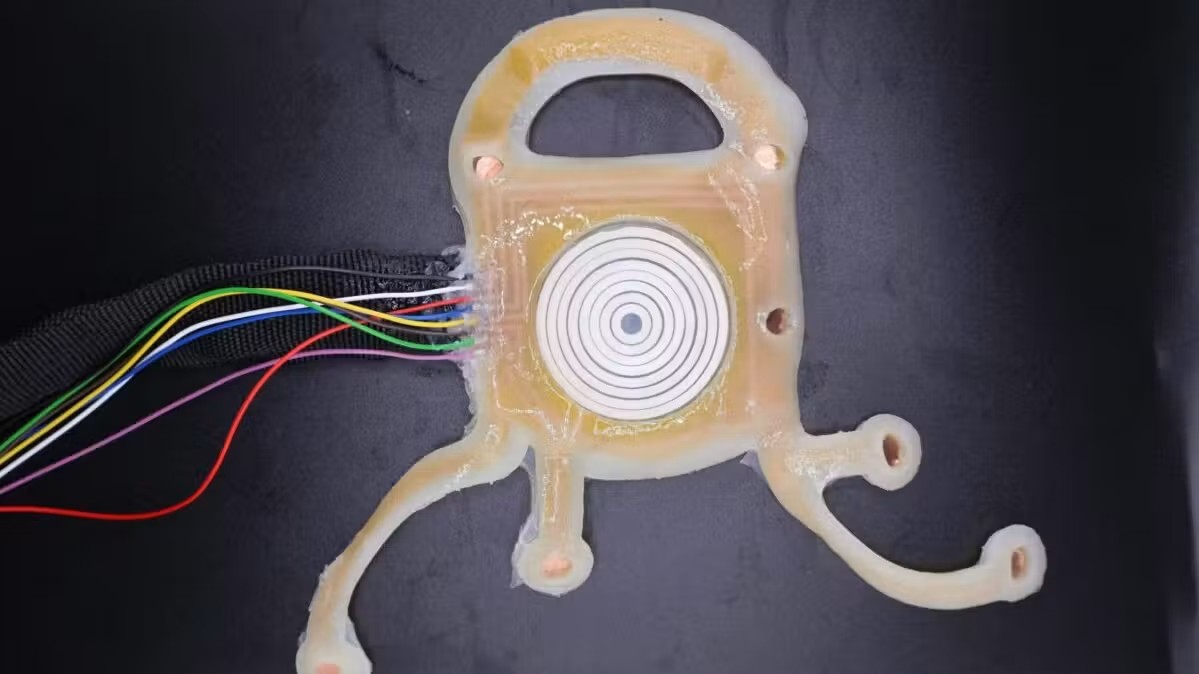
The device, developed by engineers at the University of Texas at Austin's Cockrell School of Engineering in partnership with UT Health San Antonio, combines gentle focused ultrasound stimulation with real-time brain-activity monitoring in a single bioadhesive patch worn on the skin. In a study published in Nature Communications this summer, 28 participants who wore the patch reached REM sleep — the dream-heavy stage tied to memory, emotional processing, and mental restoration — an average of 43 minutes faster than they otherwise would have. Once there, they stayed in REM roughly 16 minutes longer.
No pills. No anesthesia. No implanted electrodes. Just a patch, worn overnight, doing something researchers say has never been done non-invasively before: reaching deep brain regions responsible for regulating REM sleep and nudging them into action from the outside.
How Do You Reach Into Someone's Brain With A Sticker?
The science here hinges on focused ultrasound — sound waves aimed with enough precision to influence activity in specific, deep-seated brain structures without cutting, drilling, or implanting anything. NEUSLeeP pairs that stimulation with an electrode array baked into the same patch, which tracks brain activity in real time, essentially giving the device a feedback loop: sense what the brain is doing, nudge it gently, watch what happens, adjust.
“This is the first time we’ve been able to noninvasively target deep brain regions involved in REM sleep, while simultaneously monitoring brain activity,” said Kai Wing “Kevin” Tang, the UT Austin biomedical engineering Ph.D. graduate who led the research.
The lead investigator on the project, Huiliang “Evan” Wang, an assistant professor in UT Austin's Department of Biomedical Engineering, framed the achievement less as a finished product and more as a new doorway. “Our skin-attached NEUSLeeP patch opens up new possibilities for understanding sleep and treating sleep disorders in home settings,” Wang said — a pointed detail, since most serious sleep research currently requires an overnight stay in a lab wired up to a polysomnography rig.
Beyond Better Dreams: Mental Health In The Crosshairs
REM sleep isn't just about vivid dreams — it's the stage most closely tied to emotional regulation and memory consolidation, which is exactly why the research team is eyeing applications well beyond helping tired people feel less tired. Alongside the faster, longer REM cycles, researchers observed signs of improved stress regulation in participants and detected changes in brain circuits associated with emotional processing.

“Our vision is a future where patients with mental health disorders can optimize their sleep with a noninvasive and safe treatment,” said Vincent Mysliwiec, a professor at UT Health San Antonio and co-principal investigator on the project.
That vision points toward some of psychiatry's toughest customers: PTSD, depression, and chronic insomnia, three conditions in which disrupted or insufficient REM sleep is both a symptom and, researchers increasingly believe, a driver of worsening mental health. The research team says larger trials are already being planned to test the patch specifically in those populations, and the group is working on commercializing the technology — though it remains, for now, a research device rather than something you can buy.
The Crowded Field Of Sleep Tech — And Why This One's Different
Consumers are already drowning in sleep gadgets: rings that track heart-rate variability, mattress inserts that log movement, white-noise machines, weighted blankets, melatonin gummies stacked next to the checkout counter at every pharmacy in America. Almost all of them share the same fundamental limitation — they observe sleep or create conditions favorable to it, but they don't directly intervene in the neural circuitry that governs it.
NEUSLeeP is built differently. Rather than tracking sleep from the outside and hoping for the best, it's designed to actively modulate the brain regions that control the transition into REM. That distinction — passive monitoring versus active, closed-loop neuromodulation — is what has researchers in the sleep science community treating this as a meaningfully different category of device rather than just another entrant in a crowded wearables market. Focused ultrasound neuromodulation has been explored for years in research settings for conditions like tremor and chronic pain, but applying it, non-invasively, through a wearable skin patch, specifically to reshape sleep architecture, is new territory.
Why This Matters: America Is Not Sleeping Well
The backdrop to this research is a sleep crisis hiding in plain sight. Roughly a third of American adults do not get enough sleep on a regular basis, and estimates suggest that somewhere between 50 million and 70 million U.S. adults meet the clinical criteria for sleep deprivation at any given time. Insomnia alone — the most common sleep disorder — is now clinically diagnosed in close to 19 percent of American adults, translating to roughly 46 million people wrestling with it directly.
The downstream costs are not abstract. Poor sleep is linked to elevated risk of heart disease, type 2 diabetes, obesity, hypertension, and stroke, and it interacts destructively with mental health: depression frequently disrupts REM sleep specifically, and disrupted REM sleep, in turn, appears to make depression and anxiety harder to treat — a vicious cycle that has made “fix the sleep, help the mind” an increasingly central idea in psychiatric research.
Expert Perspective
It's worth being clear-eyed about where this technology actually stands: 28 participants is a small study, the kind that establishes a promising signal rather than a proven therapy. The research team itself frames this as an early, first-of-its-kind demonstration — proof that noninvasive deep-brain ultrasound stimulation for sleep is possible at all, not a finished clinical tool ready for your nightstand.
That said, the reaction from the sleep research community has been notably enthusiastic, largely because of what the device sidesteps. Existing options for people who want to manipulate their sleep architecture are limited to drugs, which carry dependency and side-effect risks, or invasive brain stimulation, which requires surgery and is reserved for severe, treatment-resistant cases. A wearable patch that can be applied at home, monitor its own effects, and require no medication at all would represent a genuinely new category — assuming it holds up in bigger trials across more diverse populations, ages, and existing health conditions.
What This Means For You
You can't buy NEUSLeeP. Not yet, and possibly not for years — devices that stimulate the brain, even non-invasively, face a rigorous path through larger trials and regulatory review before they reach consumers, and the research team has been explicit that this study is a first step, not a finish line.
What you can do in the meantime is the unglamorous stuff that still moves the needle on REM sleep and sleep quality generally: consistent sleep and wake times, limiting alcohol close to bedtime (alcohol is a notorious REM suppressor), managing stress before lights-out, and treating diagnosed insomnia or sleep apnea rather than pushing through it. If chronic poor sleep is affecting your mood, memory, or daily functioning, that's a conversation worth having with a doctor now — the ultrasound patch of the future doesn't help you tonight.
For anyone currently managing insomnia through medication, this research is also a signal worth watching rather than a reason to change anything today. Cognitive behavioral therapy for insomnia (CBT-I) remains the gold-standard, evidence-backed first-line treatment recommended by sleep physicians, and prescription sleep aids — while effective for many people short-term — carry well-documented risks around dependency and next-day grogginess that a device like NEUSLeeP is explicitly trying to design around. If future trials confirm what this pilot study suggests, the eventual competition won't just be against other gadgets; it'll be against the pill bottle itself.
There's also a commercial subtext worth noting: sleep technology has become one of the fastest-growing corners of consumer health, from oxygen-monitoring rings to AI-driven mattresses that adjust firmness overnight, with investors pouring money into anything that promises measurably better rest. A device that could plausibly graduate from a research tool into an at-home therapeutic — rather than just another data-collecting wearable — sits at a valuable intersection of medicine and consumer tech, which is likely part of why the UT Austin team is already working on paths to commercialize NEUSLeeP even at this early stage.
The Bottom Line
For decades, the only way to meaningfully influence deep brain activity was invasive: surgery, implants, general anesthesia. NEUSLeeP suggests that era may be ending. A patch you stick on your skin before bed, guided by real-time brain monitoring, coaxed 28 sleep-deprived study participants into faster, deeper, longer REM sleep — and hinted at benefits for stress and emotional regulation along the way. It's not a cure for America's sleep crisis yet. But for the tens of millions of people lying awake at 2 a.m., it's the most tangible glimpse yet of a future where better sleep doesn't come from a pill bottle.
This article covers early-stage research. The device described is not commercially available and has not been evaluated by regulatory agencies for consumer use.
Published By | Features Editor