Written By | Staff Writer
IFAD and Equity Group have put a bank’s own balance sheet behind climate adaptation lending. Whether it reaches a farmer in Kamwenge depends on the least glamorous line in the budget.
Kampala / Kigali
When the International Fund for Agricultural Development and Equity Group unveiled a US$200 million financing mechanism at the Africa Food Systems Forum in Kigali this month, the announcement landed in a week when Uganda’s Agriculture Minister was describing the country’s drought as unprecedented and the Ministry of Water and Environment was warning farmers that the coming rains would arrive late — and then, quite possibly, arrive all at once.
The Africa Rural Climate Adaptation Finance Mechanism, or ARCAFIM, will run for twelve years across Kenya, Uganda, Tanzania and Rwanda. Its stated target is roughly 260,000 smallholder producers and 500 rural micro, small and medium-sized enterprises, with at least half of intended beneficiaries women and 30 per cent youth. IFAD and Equity expect it to strengthen food security for about 1.2 million people and to benefit an estimated 1.5 million directly and indirectly.
Those are the headline numbers. The structure underneath them is the more interesting part, and it is what will determine whether any of this reaches a farmer in Kamwenge or Katakwi.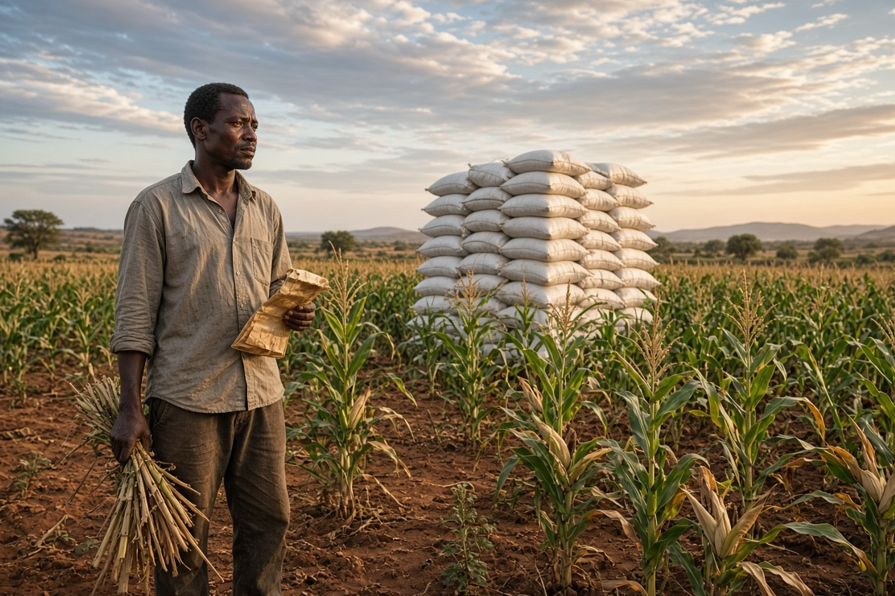
How the money is built
ARCAFIM splits into about US$180 million of lending capital and roughly US$20 million of technical assistance. Equity Group is providing US$90 million from its own balance sheet, matching the concessional contribution one-for-one — the distinction its executives were keenest to draw. The bank is not administering somebody else’s development money; it is taking the risk alongside them.
“Africa’s smallholder farmers are not waiting to be rescued,” Equity Group Managing Director and Chief Executive Dr James Mwangi said. “They are entrepreneurs operating in the most demanding risk environment on earth, and what they have lacked is a financial system built to back them.” By committing its own capital, he argued, Equity was trying to build a market in which financing climate resilience becomes ordinary banking business rather than an act of charity.
Because the lending capital is expected to revolve through roughly four investment cycles, the sponsors project about US$266 million in cumulative loans to smallholders and rural enterprises over the life of the facility. Risk is layered rather than pooled: international financing partners absorb a first-loss tranche, a mezzanine layer is shared with the bank, and Equity carries the senior risk. The concessional backers are the Green Climate Fund, contributing US$55 million; the Finnish Ministry for Foreign Affairs, with a US$30 million returnable capital contribution; the Nordic Development Fund; Denmark; and the European Union.
That architecture is a deliberate answer to a specific complaint — that climate finance accumulates in global funds and national budget lines and rarely converts into a loan a farmer can actually draw. “ARCAFIM’s ambition is to make rural climate adaptation a recognizable, viable and sustainable business line for African financial institutions,” IFAD Vice President Dr Gérardine Mukeshimana said.
Why Uganda’s timing makes this more than a press release
The Ministry of Water and Environment’s outlook for September to December 2026, released at the start of this month, expects near-normal to above-normal rainfall across most of the country, with the season potentially extending into early January 2027. Permanent Secretary Dr Alfred Okot Okidi attributed the outlook to an El Niño episode expected to intensify through the season, reinforced by an anticipated shift of the Indian Ocean Dipole into a positive phase around October. Above-normal rain is forecast for much of the central region and Lake Victoria basin, the east, the Mount Elgon slopes, West Nile and parts of western Uganda including Hoima, Kikuube, Masindi, Kibaale, Kagadi, Kamwenge and Kyenjojo.
But the same forecast carries two warnings that matter more to a farmer than the seasonal average. The onset is late — steady rains were not expected to establish in most areas until mid-to-late September, with the Madden-Julian Oscillation moving into a dry phase and suppressing early-September rainfall. And the peak is compressed into the end of October and November.
Late, then heavy, is the worst combination for a rain-fed system. It shortens the window for land preparation and planting, then concentrates the water into a period when soils are least able to absorb it and when standing crops are most vulnerable to lodging, waterlogging and disease. Uganda has already spent this year absorbing the other half of that cycle. On 9 September, Agriculture Minister Frank Tumwebaze said the government was in discussions with Finance Minister Henry Musasizi and Permanent Secretary Ramadhan Ggoobi over a large national irrigation programme, describing the current drought as unprecedented and warning that it threatened a severe food crisis.
Against all of that, Uganda irrigates under 2 per cent of its farmland.
This is precisely the gap ARCAFIM claims to address. Its eligible investments read like a list of what Ugandan farms have been unable to finance: irrigation and water harvesting, more resilient dairy and livestock production, post-harvest storage, renewable energy and climate-resilient agro-processing. Each is capital expenditure with a multi-season payback — exactly the profile that commercial lenders, pricing off a central bank rate that has sat at 9.75 per cent, have historically declined to fund for smallholders without registered land titles.
The intermediation problem
The design detail most likely to determine ARCAFIM’s Ugandan footprint is not the headline capital but the technical assistance — and, tellingly, that component is built into the financial architecture rather than bolted on as a side programme.
The money is meant to help microfinance institutions and savings and credit cooperative societies develop the capacity to originate adaptation lending: to teach a SACCO loan officer how to appraise a water-harvesting tank or a solar irrigation pump as a productive, bankable asset rather than a consumption loan against a borrower’s salary. The mechanism also introduces a climate adaptation taxonomy intended to help participating financial institutions and rural businesses identify which investments genuinely qualify as adaptation — a technical-sounding provision that in practice decides what gets financed.
In Uganda that lands in the middle of an unsettled sector. Large SACCOs are working against a 30 September deadline to obtain Bank of Uganda licences under the migration of Tier Four institutions to central bank supervision, and only a small minority of eligible societies had completed the process as of late August. A facility designed to strengthen SACCO lending capacity therefore arrives at exactly the moment when SACCO supervision is being rebuilt. That is either fortunate sequencing or an additional compliance burden on institutions already stretched, depending on how the two processes are coordinated.
Equity Bank Kenya Managing Director Moses Nyabanda said the bank would finance farmers and agricultural producers directly as well as through microfinance institutions, SACCOs and value-chain companies, while extending financing to rural MSMEs. Equity already carries an established agricultural book in Uganda, which makes the country a plausible early market rather than a later one.
What to watch — and what to be sceptical about
Three caveats are worth stating plainly.
First, this is debt. ARCAFIM is not a grant window, and a farmer who borrows to build a water-harvesting system still owes the money if the season fails anyway. Adaptation lending works where the investment reliably reduces yield volatility — which is true of storage and irrigation, and considerably less true of replanting into the same rainfall regime with better-marketed inputs.
Second, the beneficiary numbers are regional. Roughly 260,000 smallholders across four countries over twelve years works out, on an even split, to something in the order of 5,000 to 6,000 producers per country per year. Uganda has several million farming households. This is a demonstration of a model rather than a sector-wide solution, and its sponsors present it as such — IFAD and Equity have already named Southern and West Africa as candidate regions for replication.
Third, blended structures live or die on origination. First-loss capital removes a lender’s excuse for not lending; it does not by itself create loan officers in Nebbi or Kanungu who can appraise a drip-irrigation proposal, or extension staff who can tell a farmer which adaptation investment is worth borrowing against. The technical assistance line is the part to watch, and historically the part most likely to be underfunded relative to need.
For Uganda, then, the significance is less the US$200 million than the proposition behind it: that lending against climate resilience can be an ordinary banking business rather than a donor project. If that holds, the private capital that follows the demonstration will matter far more than the demonstration itself. If it does not, ARCAFIM will join a long list of facilities announced in Kigali that never quite arrived in Kamwenge.



