Written By | Entertainment Desk

Practical Magic 2" opened to roughly $28 million and ended a six-week reign at No. 1 — proof that a 1998 box-office disappointment can quietly become the most bankable thing a studio owns
LOS ANGELES
In October 1998, Warner Bros. released a film about two witch sisters in a New England town, watched it open to $13.1 million, absorbed a round of witheringly bad reviews, and moved on. "Practical Magic" was, by every metric the industry cared about at the time, a miss.
This weekend, its sequel took the No. 1 spot at the North American box office with an opening in the region of $28 million, ending the six-week run at the top by "Spider-Man: Brand New Day" — a film that has grossed more than $920 million domestically and crossed $2 billion worldwide. The Owens sisters did not beat Spider-Man on quality, scale, or spectacle. They beat him because a generation grew up rewatching a flop every October, and the studio finally noticed.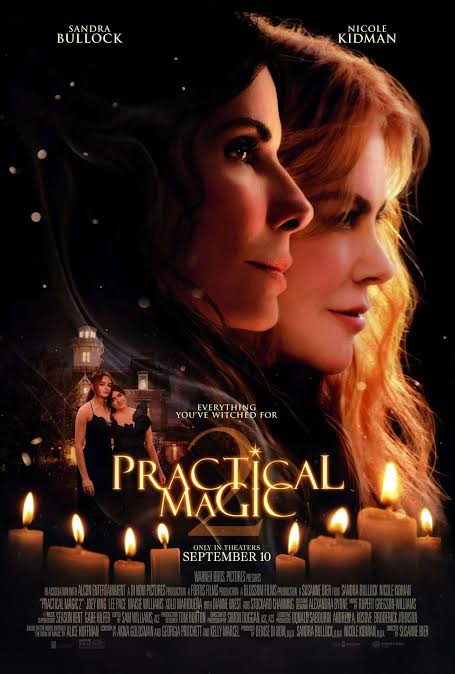
The numbers, and why they are stranger than they look
"Practical Magic 2" grossed $4.7 million in Thursday previews and opened across 4,146 North American locations. Pre-weekend tracking had suggested a debut as high as $40 million; the studio's own projection settled into the $30-35 million range, and the actual number landed a little under that as the post-summer corridor did what the post-summer corridor tends to do. Against a reported $75 million production budget, that is a solid rather than spectacular start — but it is more than double the original film's entire opening weekend, unadjusted, and roughly comparable even after inflation.
The more telling figures are the audience ones. The film earned a B+ CinemaScore and, more strikingly, a 92% audience score on Rotten Tomatoes — a spread that tells you almost everything about who bought tickets. This was not a general-interest crowd being persuaded. It was a pre-existing congregation showing up on the first weekend, in groups, on purpose.
And the streak it broke matters. "Spider-Man: Brand New Day" had held No. 1 for six consecutive weekends, becoming the fastest film to $900 million domestically — 36 days — and the eighth title in history to reach $2 billion globally, overtaking "No Way Home" as Sony's highest-grossing release ever. Dethroning it required only that a different audience turn up. That audience did.
The long, slow manufacture of a cult classic
The path from 1998 to now is a case study in how value accrues to intellectual property that nobody was originally protecting. "Practical Magic" found its afterlife on cable, then DVD, then streaming, then — decisively — on social platforms where its aesthetic vocabulary of herb-strewn kitchens, midnight margaritas and sisterly grief became a seasonal ritual. Every autumn for roughly fifteen years, the film has been rediscovered by a new cohort. Studios spend nine figures trying to build that kind of relationship. Warner Bros. got it by accident and then waited nearly three decades to monetise it.
The sequel, directed by Susanne Bier, is drawn from "The Book of Magic," Alice Hoffman's own follow-up to the novel that produced the first film. Sandra Bullock and Nicole Kidman return as Sally and Gillian Owens. Dianne Wiest and Stockard Channing return as Aunt Jet and Aunt Frances, which for a certain viewer is the entire pitch. Joey King and Maisie Williams play Sally's grown daughters, Kylie and Antonia, and Lee Pace, Xolo Maridueña and Solly McLeod fill out a cast that skews younger and broader than the original's.
The story remains the family curse: a multigenerational line of witches doomed to lose the men they love, and a new attempt to break it that requires excavating what the previous generation buried.
The critical split
Reviews have been mixed in a very particular way. Several critics have flagged the same tension — that the sequel's substantially larger budget occasionally works against Bier, sanding away the handmade, slightly shabby texture that made the 1998 film durable in the first place. A cult object is often cult precisely because of its imperfections; polishing it is a genuine risk, not a courtesy.
Against that, the reunion itself has been widely described as disarming, and the returning cast members are doing work that reviewers have found more affecting than the plot mechanics around them. It is the familiar sequel problem: audiences came for the feeling, and the feeling is largely intact, even where the filmmaking is glossier than the thing being remembered.
What it signals about the next two years of moviegoing
There is a strategic reading here that studios will absolutely take. The industry has spent the decade mining recognisable franchises; what "Practical Magic 2" suggests is that the most under-exploited category is not the hit that spawned four sequels, but the commercial disappointment that became beloved afterwards. Those titles carry deep affection, low expectations, cheap rights and — crucially — an audience that is demographically underserved by the current release calendar.
Expect the mining operation to begin. The risk, as ever, is that affection does not survive contact with a corporate release strategy, and that a second wave of these revivals arrives with none of the original's accidental charm.
What this means for you
If you loved the original: go, but go with the people you originally watched it with, because the film is engineered for that and much less interesting alone. If you have never seen it, watch the 1998 film first — the sequel assumes not just plot knowledge but emotional familiarity, and it will play as a pleasant, slightly overproduced fantasy without it.
And if you are simply tracking the state of cinemas: this weekend is a small, useful data point. The autumn corridor between blockbuster season and awards season has been sluggish for years. A $28 million opening for a 28-year-old property is not a rescue. But it is evidence that the audience nobody schedules for — adults, largely women, who want something atmospheric in September and October — is still there, still organised, and still waiting to be asked.



