Share
OPINION
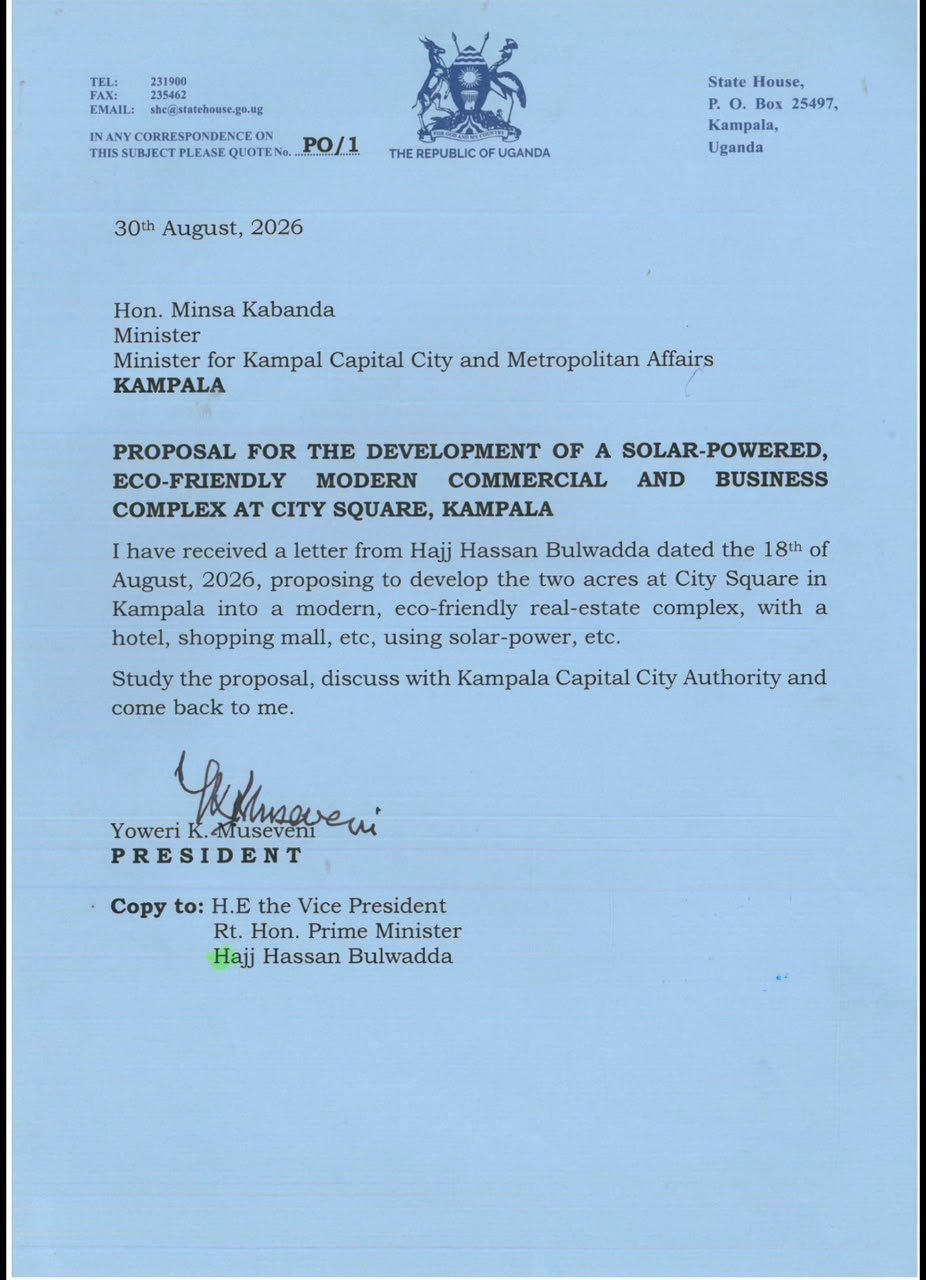
A letter from President Yoweri Museveni to Minister Minsa Kabanda, written on August 30, 2026, has quietly ignited a debate that deserves far more public attention than it has received. In the letter, the President asks the Minister for Kampala and Metropolitan Affairs to review a proposal from investor Hajj Hassan Bulwadda, who wants to develop two acres at City Square into a modern, eco-friendly hotel and shopping mall complex, powered by solar energy. The President wants the Minister's suggestions.
I am a Ugandan and a stakeholder in this country, and I have suggestions of my own.
We have seen this story before. An investor presents an attractive proposal — sleek graphics, green spaces, eco-friendly language, promises of modernity. The renderings show open courtyards where people sit and breathe. What eventually gets built is an overcrowded arcade of shops with rents so high that the very traders it was meant to serve cannot afford to break even. The recently completed complex on Nakivubo Channel followed precisely this script. The open, human-friendly spaces in the original proposal gave way to hundreds of congested stalls. There is little reason to believe this proposal will be different. The language changes; the outcome does not.
But my deeper concern is not about this particular investor. It is about what the existence of this proposal — and the serious consideration it appears to be receiving — reveals about how our leaders understand the city and the people who live in it.
Every election cycle, a portion of taxpayers' money funds trips for our leaders to visit developed countries, ostensibly to benchmark ideas for urban development. They go. They spend days in cities with well-maintained parks, public squares, green corridors, and pedestrian spaces designed for human rest and connection. They return. And nothing changes. The parks they walked through abroad remain abroad. The benches they sat on remain someone else's infrastructure.
What makes this particularly striking is that these same leaders send their children to study in those very countries. They have clearly seen something there worth investing in — worth paying for. The question that deserves an honest answer is why it is good enough for their children but not worth replicating for the rest of us.
The term "developed country" is not decorative. Cities earn that designation partly because they have made a deliberate choice to preserve spaces that serve no commercial purpose — spaces where no transaction is required, where entry is free, where a person can simply exist for a few minutes without spending money. Parks. Squares. Benches under trees. Green corridors in the middle of concrete.
Consider the ordinary Kampala resident. He lives in a cramped apartment in Kololo, Bukoto, or Najeera. He goes to work in the city centre — a stressful job, a difficult supervisor, a pile of bills waiting at home. His wife is frustrated. His health is under pressure. His finances are stretched. At lunchtime, he has thirty minutes. He does not want to spend money he does not have. He does not want another mall. He wants to sit somewhere quiet, away from his desk and his screen, breathe for a moment, and return to work with enough composure to finish the day. City Square, as a free public space, serves exactly that function. Once it becomes a hotel complex, that function disappears — and it will not be replaced. No new square will be built. The city will simply have one fewer place where an ordinary person can exist without paying for the privilege.
The Song I love by Counting Crows, "Big Yellow Taxi" has a line that feels written for this moment: "They paved paradise and put up a parking lot." The songwriter understood what planners and investors sometimes forget — that paradise is not always a forest or a beach. Sometimes it is simply a square in the middle of a city where a tired person can sit down for free.
There is a broader public health dimension to this that the Ministry of Health has itself acknowledged. Recent research and publications, including reporting in the New Vision, suggest that millions of Ugandans are experiencing significant mental health challenges — stress, anxiety, and related conditions driven by the pressures of daily urban life. Public green spaces are not luxuries. They are infrastructure for mental health. The research supporting this is abundant, consistent, and increasingly difficult to ignore.
To the President and to Minister Kabanda: we understand that investors create jobs and generate revenue, and we are not against development. But development that destroys the only free breathing space left in the city centre is not development for Ugandans. It is development for the few who can afford to check into the hotel.
The city belongs to all of us. City Square should remain proof of that.
Please do not pave away our paradise.
About the Writer
Mwine Bejuura is a Ugandan citizen and public affairs commentator writing on urban development, governance, and quality of life.