Written By | Sports Desk
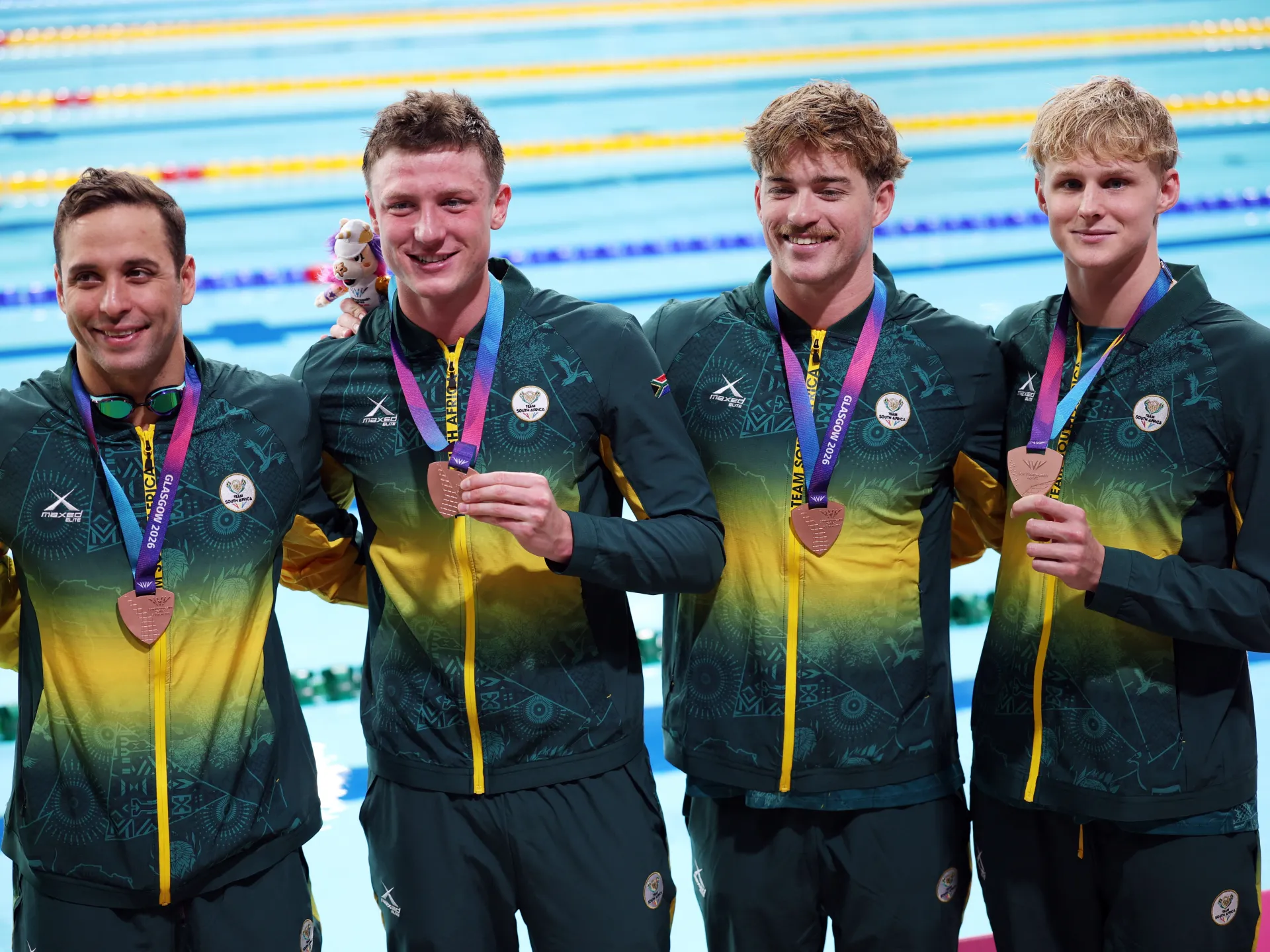
At 34, the South African swimmer added a 21st medal in Glasgow to surpass Emma McKeon’s record — and he is already plotting a fifth Olympic Games in Los Angeles.
Glasgow, Scotland
For most swimmers, twenty years in the pool is a career. For Chad le Clos, it is barely the preamble. On a soggy Wednesday night at the Scotstoun Sports Campus, the South African touched the wall alongside his relay teammates in the men’s 4x100m medley, and with that bronze medal — his 21st across five editions of the Commonwealth Games — he quietly rewrote a page of Games history that many assumed had already been closed for good.
The medal pushed le Clos past Australian swimming great Emma McKeon’s total of 20, making him the outright, undisputed most decorated athlete in the 96-year history of the Commonwealth Games. His haul now reads seven gold, five silver and nine bronze, assembled across Delhi 2010, Glasgow 2014, Gold Coast 2018, Birmingham 2022 and, finally, Glasgow 2026 — a Games staged, fittingly, in the city where his legend first truly took shape twelve years ago.
A Record Two Decades in the Making
Le Clos was a teenager when he first appeared on a Commonwealth Games podium in Delhi, still several years from the performance that would make him a household name: out-touching Michael Phelps in the 200m butterfly final at the London 2012 Olympics by five-hundredths of a second. That victory made him a star. What has followed since — four more Commonwealth Games, an Olympic silver in Rio, a World Championship title, and, above all, remarkable longevity in a sport that chews up careers by the athlete’s mid-twenties — has made him something closer to a fixture.
"I’ve been coming to these Games since I was 18 years old," le Clos told reporters pool-side after the relay, his voice hoarse from the crowd noise still ringing in the natatorium. "To still be standing here, still adding medals, still competitive against guys half my age — I don’t take one second of that for granted."
The numbers underline just how unusual that longevity is. Of the seven fastest men ever to swim the 100m butterfly, le Clos is the only one still racing at an elite level more than a decade after his Olympic breakthrough. Where most of his rivals from the London and Rio eras have long since retired into coaching, broadcasting or ordinary life, le Clos has kept climbing onto Commonwealth podiums, year after Games after Games, building a medal count that outpaces swimmers who arguably had more explosive peak seasons but far shorter windows of dominance.
Overcoming More Than Just the Clock
What makes the record resonate beyond the medal table is the story behind le Clos’s comeback ahead of the Birmingham 2022 Games, when he returned to major competition roughly eighteen months after what he has described only as a period of personal trauma. He has never fully detailed the incident publicly, but he has spoken candidly about the toll it took and the slow process of seeking professional support to work through it — "it took me about seven or eight months to speak to somebody," he has said in past interviews — before rebuilding himself into a competitor capable of standing on a Commonwealth podium again.
That comeback, capped by a silver medal in the 200m butterfly at Birmingham, is part of why Glasgow 2026 carries extra emotional weight for him. It is not simply a record extended; it is a record extended by an athlete who, by his own account, was not guaranteed to still be racing at all. South African team officials have pointed to le Clos as a locker-room anchor for a younger generation of swimmers navigating the same pressures — of expectation, of scrutiny, of a sport that offers little room for public vulnerability — that nearly ended his own career prematurely.
"Unfortunately, I’m delusional enough to think I can still do this at a fifth Olympics. But that delusion has carried me through some very dark places, so I’m going to keep leaning on it." — Chad le Clos, after his 21st Commonwealth Games medal
Glasgow 2026: A Games Reborn
Le Clos’s record arrived on the closing days of a Commonwealth Games that organizers had, only a few years ago, feared might not survive in its current form. Glasgow stepped in as a late replacement host after Victoria, Australia, withdrew from its 2026 hosting commitment in 2023 over ballooning costs, and the Scottish city — already a two-time host — delivered a leaner, more compact edition built largely around existing venues. Games organizers used the closing ceremony on August 2 to frame the event as proof that the Commonwealth Games can survive its cost crisis by scaling down rather than shutting down, a "blueprint for the future" that several smaller Commonwealth nations have already signaled interest in following for 2030.
Le Clos’s milestone became one of the signature storylines of that reborn Games, alongside home swimmer Kara Evans completing a Scottish sweep in the women’s 200m breaststroke and a broader medal table that saw several island and mid-sized Commonwealth nations post some of their best results in Games history. For a competition perpetually fighting to justify its place on an increasingly crowded global sports calendar, having an athlete rewrite the record books in its marquee pool discipline was a welcome piece of theater.
What Comes Next
Le Clos has been characteristically unsubtle about his ambitions beyond Glasgow: a fifth Olympic Games, in Los Angeles in 2028, at what would be age 36 — an age at which almost no elite sprint or middle-distance swimmer remains competitive on the world stage. Sports scientists who study athletic longevity point to a combination of factors behind cases like his: meticulous injury management, a training program that has shifted heavily toward recovery and load management rather than pure volume, and, harder to quantify, the kind of motivation that comes from having already faced the possibility of walking away entirely.
For readers who follow swimming only once every four years around the Olympics, le Clos’s Commonwealth record is a reminder that the sport’s most compelling stories often play out in the quieter years between the biggest stages — in a mid-size arena in Glasgow, in a relay final that will not make many highlight reels, in a swimmer whose greatest achievement now may not be a single blistering time but simply refusing to stop showing up.
Whether or not Los Angeles adds an unlikely final chapter, Chad le Clos has already secured his place as the most durable, most decorated competitor the Commonwealth Games has ever produced — a title earned not in one extraordinary race, but in twenty years of extraordinary consistency.



