Agriculture
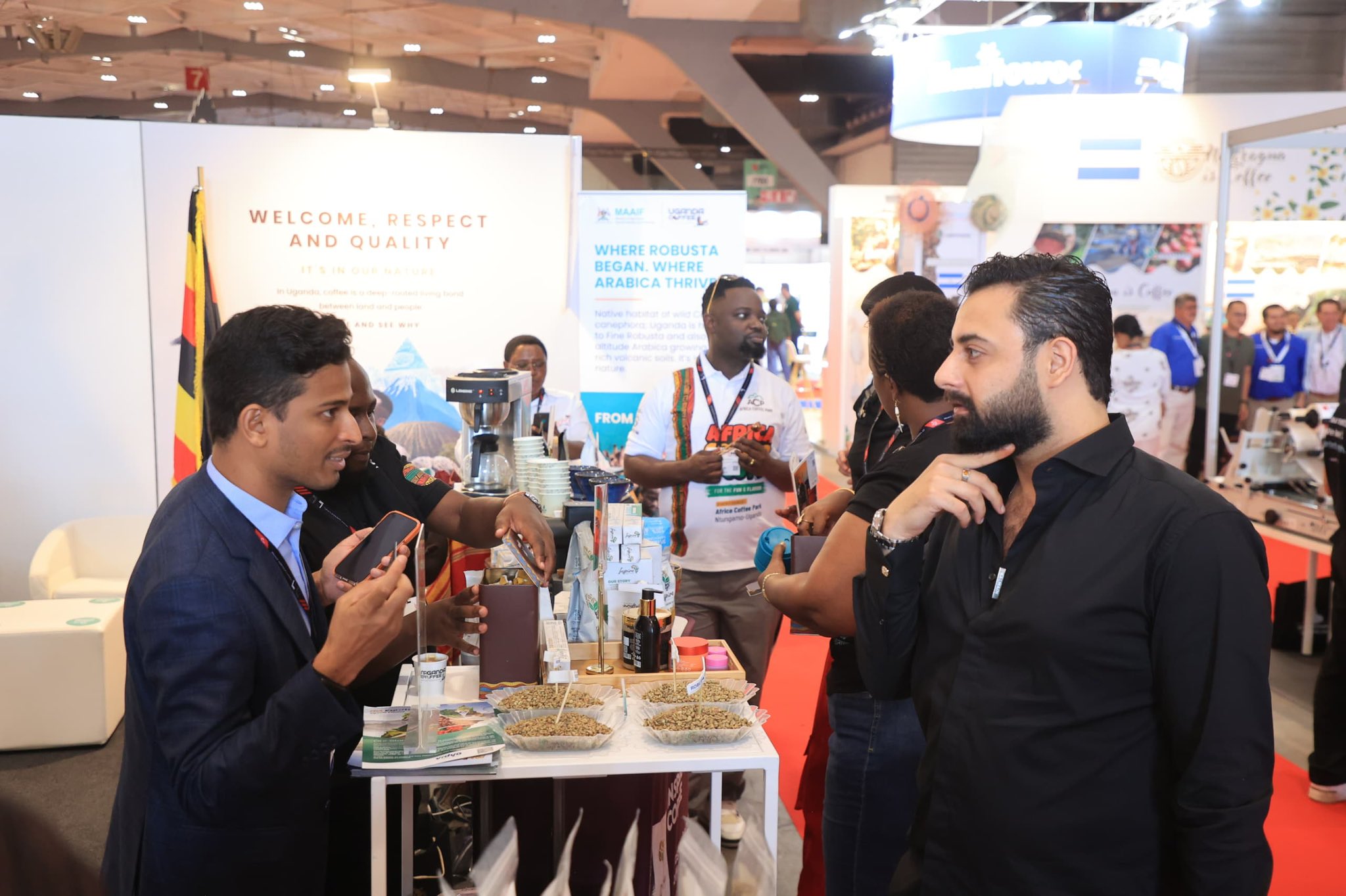
For three days this week, the Katonga Hall of the Kampala Serena Hotel has smelled like the inside of a roastery. Farmers in gumboots have rubbed shoulders with cupping judges in blazers, and men in gorilla-conservation T-shirts have queued behind bankers for the same cappuccino machine. The occasion is the first-ever Uganda Coffee and Cocoa Expo, running August 13-15, and organisers say it will draw more than 1,000 delegates from 78 countries before it closes on Saturday.
It is a fitting moment for the spectacle. Uganda's coffee sector has just closed its strongest year on record, and the country is now preparing to carry that momentum to Europe, where it has been named the official "Portrait Country" for the 2026 World of Coffee Expo in Brussels — a showcase that will put Ugandan coffee at the centre of the continent's largest speciality coffee trade fair.
Together, the two events mark a turning point in how Uganda talks about its oldest cash crop: not simply as a commodity to be shipped out in bulk, but as a story to be told, branded and sold directly to the people who drink it.
A record year, by the numbers
According to figures from the Ministry of Agriculture, Animal Industry and Fisheries (MAAIF) and the Coffee Department, Uganda exported 8.6 million 60-kilogram bags of coffee worth roughly $2.3 billion in the twelve months to May 2026, up from 7.4 million bags worth about $2.1 billion the previous year — a 16 percent rise in volume and an 11 percent rise in value. Some MAAIF officials have cited a slightly higher year-end figure of 8.4 million bags worth approximately $2.4 billion as the harvest year closed, reflecting the usual revisions that come with final-quarter data.
Whichever figure holds, the headline is the same: Uganda has overtaken Ethiopia to become Africa's leading coffee exporter by volume, a milestone officials have been eager to publicise. Part of the explanation is structural rather than purely a Ugandan success story — Ethiopia consumes roughly half of what it grows domestically, leaving less for export, while Uganda exports the overwhelming majority of its crop. But the growth trajectory is real: export earnings have climbed for five consecutive years, driven by expanding acreage, improved on-farm husbandry, and sustained global demand for robusta, which makes up the bulk of Uganda's output, alongside a smaller but fast-growing specialty arabica segment grown on the slopes of Mount Elgon and the Rwenzoris.
Farm-gate prices have followed international benchmarks upward. Early in 2026, the Ministry's own price bulletins put Drugar (a premium dried-cherry robusta grade) at UGX 16,000-16,500 per kilogram and Arabica Parchment at UGX 15,000-16,000 per kilogram, with FAQ robusta trailing at UGX 12,000-13,000. For a smallholder farming half an acre to two acres — the typical unit size in Uganda's coffee belt — those prices translate into meaningfully higher household incomes than the depressed levels of the early 2020s, even after accounting for the rising cost of fertiliser and transport.
Coffee remains Uganda's single largest agricultural export earner and a critical source of foreign exchange, supporting an estimated 1.7 to 2 million farming households across the country, from Buganda and Busoga in the centre and east to Bugisu in the shadow of Mount Elgon and the Rwenzori foothills in the west.

Two stages, one message
The Kampala expo, organised under the theme "Empowering Uganda's Coffee and Cocoa Industry: Innovation, Sustainability, and Global Reach," has been built explicitly around the idea of shortening the distance between farmer and buyer. Its programme includes cupping rooms where roasters can taste and score lots on site, a "Roaster Village" for direct trade conversations, green-coffee sessions aimed at exporters, and a business lounge where banks — Stanbic and Citi among them — are pitching trade finance and investment products to processors. Speakers range from MAAIF's Commissioner for Crop Inspection and Certification, Dr Paul Mwambu, to Dr Gladys Kalema-Zikusoka, the wildlife veterinarian behind Gorilla Conservation Coffee, whose brand ties premium arabica sales to mountain-gorilla conservation funding in Kanungu district. The pairing is deliberate: organisers are pitching Uganda not just as a low-cost bulk supplier but as a source of traceable, sustainably grown coffee with a conservation and smallholder story attached — the kind of narrative that commands a premium in specialty markets in Europe, North America and increasingly Asia.
That same narrative is what Uganda now intends to carry to Brussels. The World of Coffee Expo, run by the Specialty Coffee Association, is one of the industry's most influential annual gatherings of producers, roasters, traders and specialty buyers. Uganda's selection as Portrait Country — announced by the Ministry of Foreign Affairs and to be led jointly by the Ugandan Embassy in the Benelux region and MAAIF — gives it enhanced visibility throughout the event: dedicated exhibition space, promotional programming, and priority access to buyers from what remains the world's largest coffee-consuming region. "The World of Coffee in Brussels offers a unique platform for Uganda to present its coffee story directly to the European market," the Ugandan Embassy in the Benelux region said in a statement announcing the selection. MAAIF, for its part, framed the timing as no accident: "Uganda's coffee sector has never been stronger. With record exports, improving quality standards, and growing global recognition, the World of Coffee Brussels is the perfect stage to demonstrate why Uganda is the future of African coffee."
Why the branding push matters
The push for direct market access and stronger branding is not simply about prestige. Uganda's coffee has historically moved through long export chains — smallholder to local buying agent to processor to exporter to overseas trader to roaster — with much of the value captured well outside the country. Government policy in recent years, including the construction of large processing parks such as the $200 million Nonda Coffee Park now being built in Luwero district, has been oriented around capturing more of that value domestically by processing green coffee into export-ready or even roasted product before it leaves Uganda. Events like the Kampala expo and the Brussels showcase are the marketing counterpart to that industrial strategy: they exist to connect Ugandan processors and cooperatives directly with the roasters and importers who would otherwise only encounter Ugandan coffee as an anonymous line item from a trading house.
For farmers, the practical stakes are more immediate than trade diplomacy. Direct trade relationships and specialty certification typically pay significant premiums over commodity-grade robusta — sometimes multiples of the farm-gate price — but only for farmers and cooperatives organised enough to meet the traceability, quality and volume requirements that international buyers demand. Uganda's coffee extension services, cooperative unions and NGOs such as the Uganda Coffee Federation have spent recent years trying to close that gap, training farmers in post-harvest handling, drying and grading. The Kampala expo's inclusion of farm tours and lecture sessions aimed specifically at production-side practice, alongside the trade-facing programming, suggests organisers are trying to keep smallholders inside the same conversation as the exporters and international buyers who will ultimately decide how much of this year's record harvest translates into real income gains.
Risks on the horizon
None of this erases the volatility that has long shaped Uganda's coffee economy. International robusta and arabica prices move on decisions made in London and New York futures markets, exposing farmers to swings well outside their control. Climate stress — Uganda's meteorological authorities have warned of above-normal rainfall between August and December this year, raising flood and landslide risk in coffee-growing highland areas — adds a further layer of uncertainty to a crop that is highly sensitive to both drought and excess moisture. And competition is intensifying: Kenya has just shipped its first coffee consignment directly to Italy, a sign that neighbouring producers are pursuing the same direct-trade strategy Uganda is now championing.
Still, for a sector that has weathered decades of boom-and-bust pricing, this week's back-to-back milestones — a home-grown expo drawing exhibitors from 78 countries, and a marquee slot on Europe's biggest coffee stage still to come — represent a rare moment when Uganda's coffee story is being told on its own terms, rather than through the anonymity of a shipping manifest.
Published By | Features Editor