Written By |

Site 5 of 20 in our rotation through Uganda's landmark destinations: Kibale National Park
Tourism Feature
The forest wakes before the light does. Long before the sun clears the canopy of Kibale National Park in western Uganda, a low, rising hoot ripples through the mahogany and fig trees — one voice, then a dozen, then what sounds like the whole forest erupting into whoops and drumming as unseen hands slap buttress roots like timpani. It is the sound of chimpanzees greeting the day, and for the trackers, guides and travelers gathering at the misty Kanyanchu trailhead, it is the signal that the search is about to begin.
Kibale is Uganda's chimpanzee capital, a 795-square-kilometer block of moist evergreen and semi-deciduous forest that shelters an estimated 1,500 chimpanzees spread across a dozen or more communities — one of the densest populations of our closest living relatives found anywhere in Africa. But Kibale has never been only about chimpanzees. It is a forest of thirteen primate species, a wetland alive with birdsong, and, increasingly, a proving ground for the kind of community-anchored tourism that Uganda's conservation planners are betting will define the country's next decade.
A Forest Rebuilt Around Its Chimpanzees
Gazetted as a national park in 1993 after decades as a logged and lightly protected forest reserve, Kibale sits in the shadow of the Rwenzori Mountains between the crater lakes of Fort Portal and the open savanna of Queen Elizabeth National Park, with which it shares a wildlife corridor. That corridor matters: elephants, buffalo and occasionally lion still move between the two protected areas, even as Kibale's own identity has become inseparable from the primates in its canopy. Jane Goodall's decades of chimpanzee research at Gombe in Tanzania gave the species its global fame, but it was Kibale's Kanyanchu chimpanzee community, habituated to human observers beginning in the 1990s, that turned this particular forest into one of the most reliable places on Earth to watch wild chimpanzees behave as chimpanzees do — nesting, foraging on figs, hunting colobus monkeys in coordinated raiding parties, and squabbling over rank in scenes that feel uncomfortably, wonderfully familiar.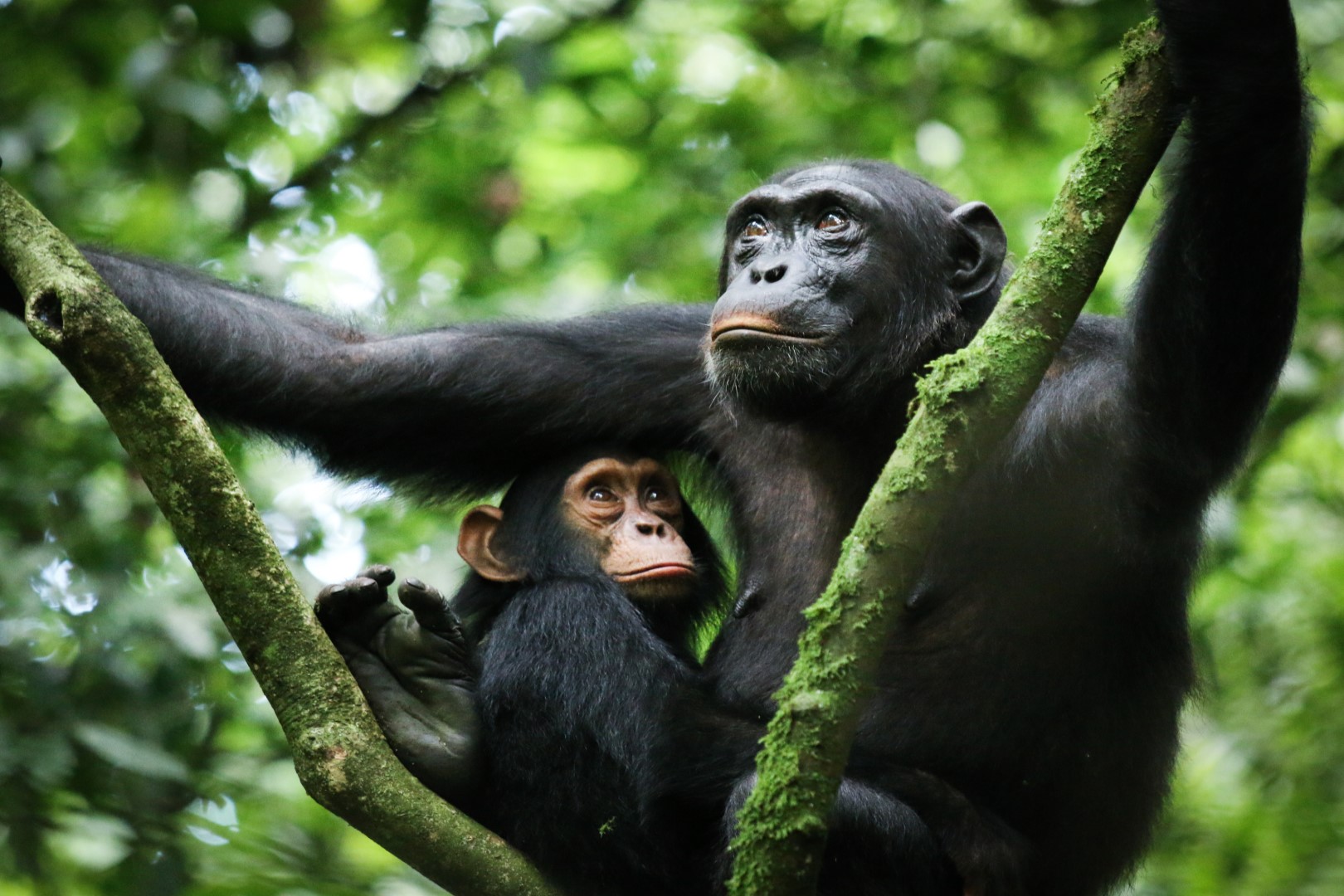
Thirteen Primates, One Wetland, and a Community's Stake
Beyond the chimpanzees, Kibale's primate roll call reads like a checklist for a serious naturalist: red colobus, black-and-white colobus, L'Hoest's monkey, blue monkey, grey-cheeked mangabey, and the diminutive, wide-eyed potto that emerges only after dark. More than 370 bird species have been recorded in the park's mix of forest and swamp, from the elusive green-breasted pitta to a long list of forest hornbills, malachite kingfishers and turacos that reward patient birders with flashes of impossible color against the green.
Just outside the park's southern boundary, the Bigodi Wetland Sanctuary offers a quieter counterpoint to the chimpanzee frenzy. Run by the community-based Kibale Association for Rural and Environmental Development, its 4.5-kilometer boardwalk trail through papyrus swamp delivers sightings of eight primate species, striking birdlife including the great blue turaco, and — just as importantly — a direct, transparent channel for tourist dollars to reach local schools and health projects. It is one of the older and more durable examples of community ecotourism in East Africa, and it is often the stop that visitors remember as vividly as the chimp trek itself.
What There Is to Do
Standard chimpanzee tracking departs from the Kanyanchu Visitor Centre three times a day and typically runs two to five hours round trip, depending on how far the chimps have ranged overnight; success rates run above 90 percent, and once trackers locate a community, visitors are permitted one hour of observation. For travelers who want more than an hour, the Chimpanzee Habituation Experience allows small groups to join researchers for a full morning or day as they work with a community still being acclimatized to human presence — a slower, more intimate, and less crowded alternative that many repeat visitors and photographers now prefer. Night walks in search of pottos and bushbabies, guided nature walks through Bigodi, and cultural visits to nearby Batooro and Bakiga communities round out a typical two- or three-night stay.
Getting There, Staying There, and What It Costs
Kibale sits roughly 25 to 35 kilometers southeast of Fort Portal town in western Uganda, about a five- to six-hour drive from Kampala or Entebbe, and is commonly combined with Queen Elizabeth National Park to the south or the Rwenzori foothills to the west. Park entry fees run USD 40 per day for foreign non-residents, USD 30 for foreign residents, and UGX 20,000 for East African citizens. Chimpanzee tracking permits are booked separately through the Uganda Wildlife Authority, ideally months in advance through a licensed tour operator, since only 36 tracking slots are released each morning and another 36 each afternoon. Under UWA's 2026–2027 tariff structure, standard chimpanzee tracking permits are discounted to USD 200 during the low-season months of April, May and November, with the rate rising to USD 300 from January 2027; the more immersive Habituation Experience permit costs more and is capped at smaller group sizes. The long dry seasons — roughly December to February and June to September — offer the driest trails and the most predictable trekking conditions, though Kibale's forest canopy means rain is possible in any month. Accommodation spans the full range, from the luxury Primate Lodge inside the park and Ndali Lodge on a crater rim overlooking the Rwenzoris, to mid-range options like Kibale Forest Camp, down to community guesthouses near Bigodi for budget travelers.
This Week in Ugandan Tourism
UWA launches Kidepo landscape conservation project (Aug. 9, 2026)
The Uganda Wildlife Authority formally launched the Kidepo Landscape Integrated Conservation and Development Project, a multi-year initiative aimed at strengthening habitat connectivity and community livelihoods around Kidepo Valley National Park in Uganda's rugged northeast — the latest sign that conservation investment is expanding well beyond the traditional gorilla and chimpanzee circuits.
Karenga District backs electric fencing for Kidepo Valley
Local leaders and residents in Karenga District have endorsed plans to construct an electric fence along sections of Kidepo Valley National Park, a move intended to reduce human-wildlife conflict as elephant and predator populations in the park continue to recover.
UWA Open Park Days set for September 25–27, 2026
The Uganda Wildlife Authority has confirmed its Open Park Days initiative will run September 25 through 27, temporarily waiving entrance fees at selected protected areas nationwide in a push to boost domestic tourism and get more Ugandans into their own national parks.
New UWA tariff structure took effect July 1, 2026
Standard gorilla trekking permits in Bwindi Impenetrable and Mgahinga Gorilla National Parks now stand at USD 800 for foreign non-residents and USD 700 for foreign residents, with low-season discounted permits at USD 600 available in April, May and November. UWA has also eliminated the old seven-day reservation hold as of March 1, 2026, meaning permits now require full payment at the time of booking — a change tour operators are urging travelers to plan around carefully.
Wildlife numbers cited as conservation success story
Uganda's 2026 wildlife resources reporting shows the national elephant population has grown from roughly 6,000 to nearly 8,000 animals, while the country's rhino population — reduced to just six individuals by the year 2000 — has climbed to 59 today, figures the government and conservation partners are citing as evidence that anti-poaching and habitat investment are paying off across the park system.
For a country whose tourism identity has long been built on the singular, expensive thrill of gorilla trekking, Kibale offers something adjacent but distinct: a forest where the primates are just as compelling, the permits considerably more affordable, and the surrounding community projects mature enough to have become part of the draw rather than an afterthought. As Uganda's tourism authorities push to spread visitor traffic — and the revenue that follows it — beyond a handful of marquee parks, the green cathedral of Kibale looks less like a secondary stop on the itinerary and more like a rehearsal for where the country's tourism strategy is headed next.