Written By | Torch Media Africa
Scientists Just Blew Up a 60-Year-Old Theory of How the Mind Works — And Silicon Valley Is Paying Attention
URBANA-CHAMPAIGN, ILLINOIS
Every neuroscience textbook on the planet tells the same story about how your brain makes a decision. Information comes in through your senses. It travels up a chain of command, region by region, getting more "refined" and abstract at each stop, until it finally reaches the frontal lobes — the brain's supposed executive suite — where the actual choice gets made. Sense first, think later, decide last. Clean, orderly, hierarchical.
A team of engineers and neuroscientists at the University of Illinois Urbana-Champaign just proved that story is wrong. And they didn't just tweak it — they found that your brain starts making decisions almost immediately, in a region long dismissed as a passive relay station for raw sensory data, using feedback loops that fire back and forth in ways that look nothing like the neat one-way pipeline neuroscience has assumed for six decades.
The findings, published in the Proceedings of the National Academy of Sciences and gaining major traction this month, are being described by researchers as a discovery that "redefines the architecture of thought" — and the ripple effects are already reaching well beyond neuroscience labs, into the offices of the engineers trying to build the next generation of artificial intelligence.
The Experiment: Mice, Whiskers, and a Virtual Reality Corridor
The breakthrough came from an unlikely setup: mice running through a tactile virtual reality corridor, using their whiskers to feel their way through a perceptual decision-making task, while researchers recorded dense electrophysiological activity across their brains in real time.
The team, led by electrical and computer engineering professor Yurii Vlasov alongside researcher Alex G. Armstrong, was specifically watching the primary somatosensory cortex — abbreviated S1, the brain's first stop for processing touch. For decades, S1 has been treated in neuroscience as essentially a sensory switchboard: it receives raw touch data and forwards it along to "higher" brain regions where actual cognition — planning, evaluating, deciding — supposedly happens.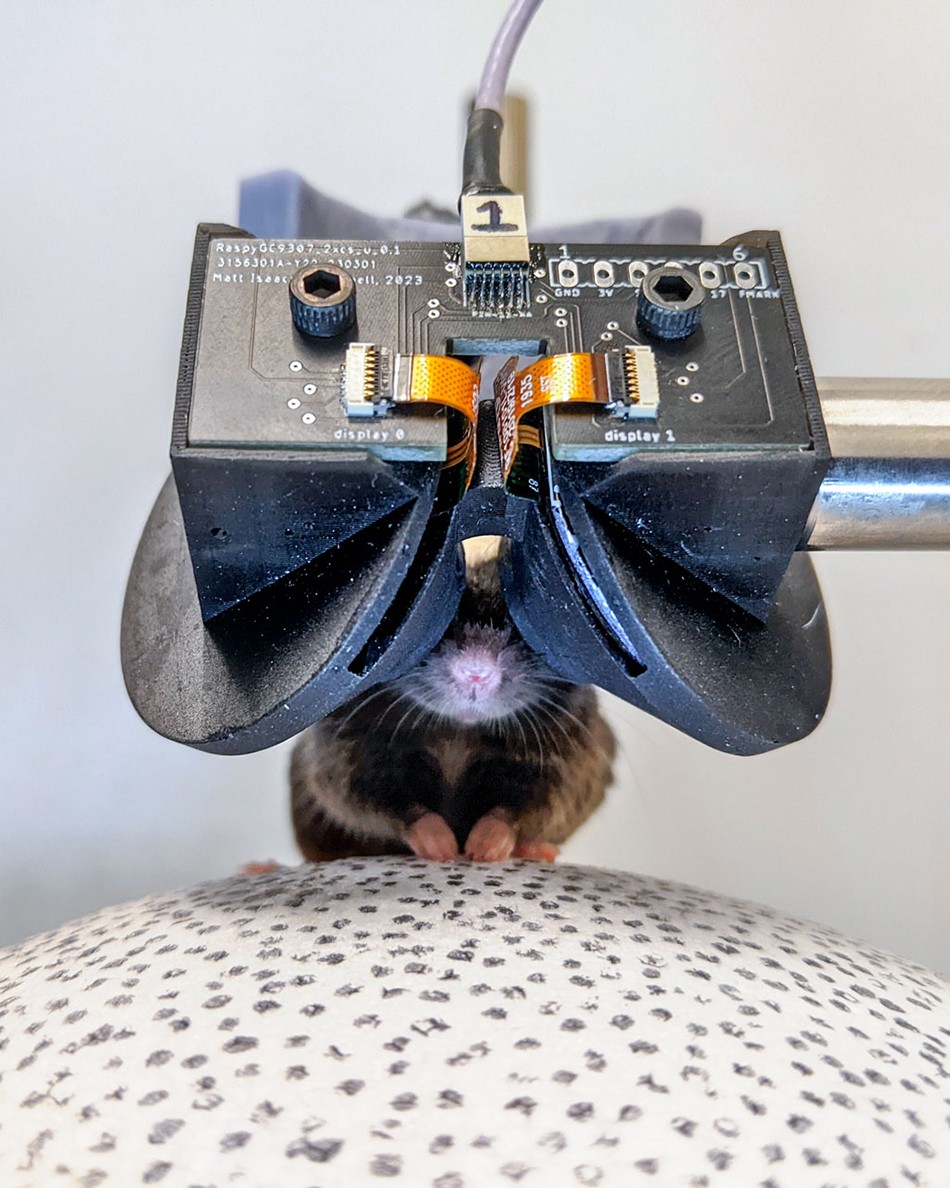
That is not what the Illinois team found. Instead, they discovered clear decision-making signals showing up directly in S1 — far earlier in the brain's processing hierarchy than classical theory says they should exist. And the activity pattern itself was strange: a dramatic collapse of high-dimensional neural spiking into a single latent variable, followed by a slower, near-synchronous "ramping up" of activity across the entire cortical column.
In plainer terms: rather than information flowing neatly in one direction from senses to judgment, the mice's brains showed decision-related activity erupting almost immediately in a region that was supposed to be a passive way station — activity shaped by rapid feedback loops running back down from higher brain areas, rather than a single upward climb.
"We want to learn from a billion years of evolution," Vlasov said, describing the broader ambition behind the work. "How is that biological intelligence organized architecturally?"
Sixty Years of Neuroscience, Rewritten
To understand why this matters, you have to understand just how deeply the "hierarchical" model of brain function has been baked into science. Since the mid-20th century, the dominant framework for understanding perception and cognition has treated the brain like an assembly line: raw sensory data goes in one end, gets processed and abstracted at each successive station, and a fully formed "decision" comes out the other end in the frontal and premotor cortex — the regions classically considered the seat of choice and executive control.
That model has shaped decades of research, medical understanding of brain injury and disorders, and — perhaps most consequentially for 2026 — the entire architecture of modern artificial intelligence. Most deep learning systems, including the large language models now reshaping the tech industry, are built on a similar assumption: information flows forward through layers, each one extracting more abstract features than the last, until a final output layer produces the "decision."
The Illinois findings suggest that's not how biological brains actually work — and that the assumption may have been holding back both neuroscience and AI research for a very long time. Instead of a single upward climb, the brain appears to run on a densely interconnected system of nested feedback loops, where "lower" sensory regions and "higher" cognitive regions are in constant two-way conversation, and decisions can begin forming almost as soon as sensory information arrives — not after it's been fully processed and passed up the chain.
Commentary accompanying the study's release put it bluntly: the discovery "challenges the foundational assumption behind most modern artificial intelligence: that decisions are made at the top of a hierarchy, after information has flowed all the way up from the senses."
Why Tech Companies Are Suddenly Interested in Mouse Whiskers
It might seem like a stretch to connect a mouse whisker experiment to the trillion-dollar AI industry, but the timing could not be more relevant. As of this week, AI labs across Silicon Valley and Beijing are locked in an arms race over model efficiency — not just raw capability, but how much electricity and computing power it takes to get there. Training and running today's largest AI models consumes staggering amounts of energy, and companies are pouring resources into finding architectures that deliver more intelligence per watt.
That's exactly where this neuroscience discovery gets interesting. Biological brains are almost absurdly efficient by comparison to artificial neural networks — the human brain runs on roughly 20 watts of power, about what it takes to run a dim light bulb, while training a single large AI model can consume enough electricity to power thousands of homes for a day. Researchers behind the Illinois study argue that natural intelligence's use of distributed, bidirectional feedback loops — rather than a single forward pass — may be a big part of why biological brains achieve so much with so little power.
The implication is that future AI systems designed to mimic this feedback-heavy, non-hierarchical structure could, in theory, be both more capable and dramatically more energy efficient than today's forward-flowing deep learning architectures. It's a tantalizing idea for an industry that is increasingly running up against real physical limits — power grid capacity, data center cooling, chip supply — in its race to build ever-larger models.
Not Just About Robots and Chips — It's About Understanding Ourselves
Beyond the AI angle, the discovery has real implications for how scientists think about human cognition, decision-making disorders, and even conditions like ADHD, anxiety, and certain neurological injuries — many of which have historically been understood through the lens of the very hierarchical model this study challenges.
If decision-making really does begin far earlier in sensory processing than assumed, and depends on constant feedback between brain regions rather than a single forward chain, that could change how researchers think about what goes wrong when decision-making breaks down — whether that's due to injury, disease, or developmental differences. It could also reshape brain-computer interface research, where engineers are trying to build devices that read and predict human intent; if decisions are legible earlier in the sensory stream than previously thought, that could open new possibilities for faster, more responsive neural interfaces.
The Skeptics' Corner
As with any finding that challenges six decades of established theory, some caution is warranted. The study was conducted in mice, not humans, and focused specifically on a tactile, whisker-based perceptual task — researchers will need to confirm whether the same early-decision signals show up in other sensory modalities (vision, hearing) and, crucially, in human brains, which are structurally more complex than a mouse's. Replicating and extending these findings will take time, and translating a mouse whisker-corridor experiment into concrete blueprints for a new class of AI chips is still a significant leap.
Still, the study's publication in a high-profile, peer-reviewed journal like PNAS, combined with the pedigree of an engineering-neuroscience collaboration explicitly aimed at bridging biology and computing, has given the findings unusual credibility and reach across two very different scientific communities that don't always talk to each other.
What This Means for You
If you've ever made a snap judgment — swerving to avoid a pothole, catching a falling glass, answering a question before you'd consciously "thought it through" — this research offers a scientific explanation for why that felt instantaneous. Your brain wasn't waiting for information to climb all the way up to some executive command center before acting. It may have started deciding the moment the sensory signal arrived, using rapid-fire feedback loops your conscious mind never registers.
For the average person, the more tangible impact will likely arrive indirectly, through your devices. If AI companies do begin incorporating these feedback-based, brain-inspired architectures into future chips and models — something several research teams are now actively exploring — the AI assistants, voice recognition systems, and smart devices of the next decade could become both sharper and dramatically less power-hungry, a shift that would ripple all the way from data center electricity bills to how long your phone's AI features last on a single charge.
The Bigger Picture
What makes this discovery genuinely exciting to scientists isn't just that it overturns an old idea — it's that it points toward a fundamentally different way of thinking about intelligence itself, biological or artificial. For sixty years, the working assumption was that thinking is a ladder: climb up through sensory processing, and cognition waits at the top. The Illinois team's data suggests it might be closer to a conversation — a constant, rapid back-and-forth between different parts of the brain, with decisions forming in the give-and-take rather than at a single finish line.
As Vlasov put it, the goal is learning from "a billion years of evolution" to understand how biological intelligence is architecturally organized. Six decades of neuroscience assumed it already knew the answer. This July, a lab full of mice running through a virtual corridor suggested otherwise.



