Written By | Torch Media Africa
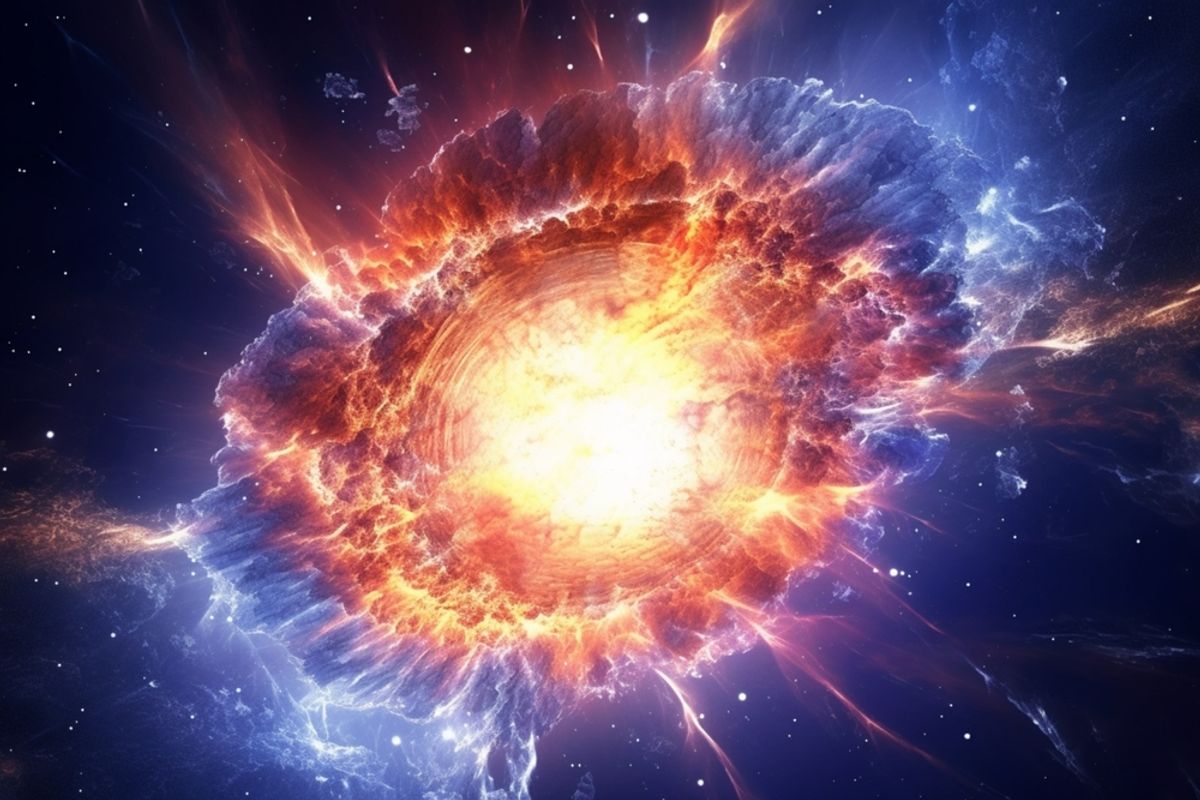
Meet Unite, the biggest supernova map ever assembled, and the crack it has just widened in our model of the cosmos.
SCIENCE & TECH
Twenty-eight years ago, two rival teams of astronomers looked at a scattering of exploding stars and delivered news so strange that most of them assumed they had made a mistake: the universe is not just expanding, it is expanding faster and faster. Something is pushing space apart. Nobody knew what it was, so they gave it a name that admitted as much — dark energy — and in 2011 the discovery won the Nobel Prize in Physics.
Ever since, the standard model of cosmology has rested on a comfortable assumption: whatever dark energy is, it is constant. The same density everywhere, at every moment, forever. A permanent property of empty space itself.
This week that assumption looks shakier than it has in a generation — and the blow has come not from a single dramatic observation, but from a painstaking act of bookkeeping carried out in Australia.
“Instead of confirming the standard model of cosmology which assumes dark energy is fixed and unchanging, we have more evidence that dark energy may change over time.” — Ryan Camilleri, University of Queensland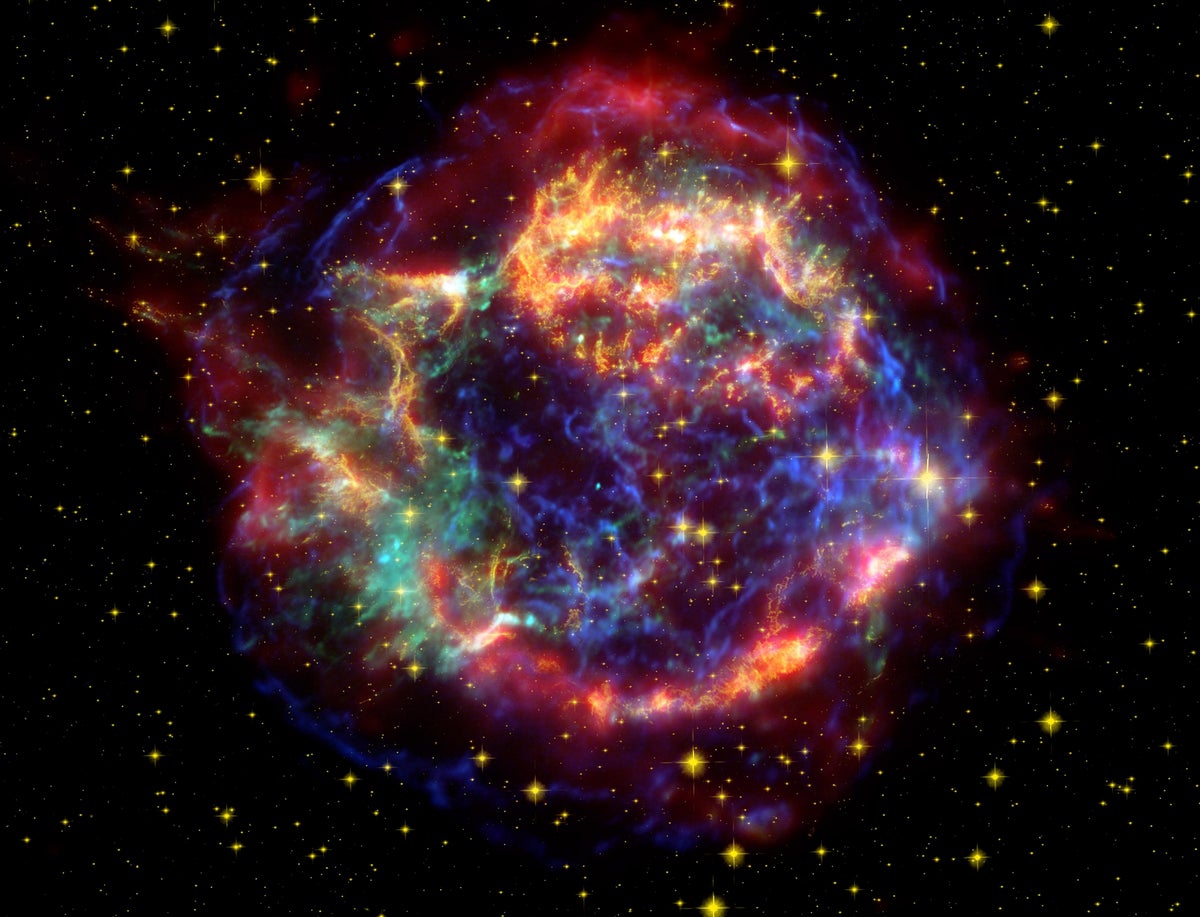
What they built
On September 4, a team led by University of Queensland PhD candidate Ryan Camilleri posted a 28-page paper to the arXiv preprint server with a deceptively modest title: “Supernovae Unite: Combining Pantheon+ and DES-SN5YR.” The University of Queensland announced the results on September 8, and the story has been rippling outward through the astronomy press ever since.
What the team did was merge the two great modern supernova catalogues — Pantheon+, the long-running compilation of more than 1,700 Type Ia supernovae, and the Dark Energy Survey’s five-year sample, published in 2024 — into a single, internally consistent dataset of 2,884 likely Type Ia supernovae. They called it Unite. It is the most comprehensive catalogue of exploding white dwarf stars ever assembled.
That sounds like filing. It is not. Different telescopes, built in different decades with different detectors and different calibration habits, do not simply add up. Historic observations had to be reanalysed with modern understanding. The team re-derived the stellar masses of the host galaxies for more than 98 per cent of the sample using one consistent framework, applied a single approach to sample selection and bias corrections, and folded in subtle effects that older analyses treated inconsistently or not at all.
“We’ve rebuilt three decades of astronomical observations into a single, consistent framework,” Camilleri said. “Over the years we’ve learned a lot more about how supernovae behave so we’ve been able to go back and apply that improved understanding to older data.”
Among the complications they had to model: cosmic dust dimming the light, the mass of the host galaxy subtly shifting a supernova’s apparent brightness, and gravitational lensing — the bending and magnification of light as it passes massive objects on its journey to Earth.
Why exploding white dwarfs are the ruler of the cosmos
A Type Ia supernova is what happens when a white dwarf — the dense cinder left behind by a dead sun-like star — gains too much mass and detonates. Crucially, they detonate at a fairly predictable brightness. Astronomers call them standard candles: if you know how bright something truly is, and you measure how bright it looks, you know how far away it is.
Line up thousands of them at different distances, compare distance against how much the universe has stretched the light on the way over, and you have a history of cosmic expansion written across billions of years. That is the Hubble diagram, and it is the single most consequential graph in modern cosmology.
It is also fragile. Everything depends on those candles being genuinely standard. Any systematic drift — supernovae in old galaxies behaving slightly differently from those in young ones, say — propagates straight into a statement about the fate of the universe. That is precisely why an exercise in careful, unglamorous recalibration is worth a headline.
The numbers that matter
Using Unite alone, assuming a flat universe with a plain old cosmological constant, the team measured the matter density of the universe at 0.310, with an uncertainty of about 0.012 — comfortably in line with expectations. So far, so orthodox.
The interesting part arrives when Unite is combined with the cosmic microwave background — the relic light of the Big Bang — and with baryon acoustic oscillation measurements from both the Dark Energy Survey and the Dark Energy Spectroscopic Instrument, DESI, which maps ancient sound waves frozen into the distribution of galaxies.
When the team fitted a model in which dark energy’s equation of state is constant — the textbook assumption — they found what they describe as strong evidence of tension between the microwave background measurements and the combined supernova-plus-galaxy data. The pieces of the universe stopped agreeing with each other.
That tension is relieved when dark energy is allowed to change with time. Fitting the standard two-parameter evolving model, they obtained a present-day equation-of-state value of about −0.861 and an evolution term of about −0.60 — numbers that, if taken at face value, describe a dark energy that was weaker in the past and is not the unchanging vacuum energy of the textbooks. The measurement is also sharper than what came before: the team reports a dark energy “Figure of Merit” of 315, roughly a 30 per cent shrinking of the uncertainty region compared with the previous best combination of Dark Energy Survey, DESI and microwave background data.
The honest caveat the headlines keep dropping
Here is where responsible reporting has to slow down, because the paper itself does.
The authors are explicit that the two standard ways of assessing the result disagree. Bayesian evidence — the statistical framework that penalises extra free parameters — shows only a weak preference for time-evolving dark energy. Frequentist analysis is more enthusiastic, favouring evolving dark energy over the flat cosmological-constant model at 2.5 standard deviations using one measure, or 3.1 using another.
In particle physics, 5 sigma is the threshold for claiming a discovery, and 3 sigma is conventionally “evidence, watch this space.” Cosmology is more forgiving, but the principle holds: this is a serious, well-built crack in the standard model. It is not a demolition. Anyone telling you dark energy has been disproved this week is running ahead of the data — including, at times, the press releases.
“Two completely independent measurements have found hints of time variation in dark energy, challenging the standard model that dark energy doesn’t change.” — Professor Tamara Davis, University of Queensland
Expert perspective: two roads to the same unease
Professor Tamara Davis, the University of Queensland astrophysicist who co-authored the work, frames the significance in terms of convergence rather than any single number. The Dark Energy Survey’s 2024 supernova results first hinted that dark energy might vary over time. DESI, surveying the early universe’s relic sound waves, found hints pointing the same way. Now Unite — a rebuilt, independent compilation — sees a deviation from the standard model too, although, as Davis carefully notes, “in a slightly different direction.”
That caveat matters. Independent hints agreeing that something is wrong is far more interesting than one dataset shouting. Independent hints disagreeing about what is wrong is a reminder that the systematics are not yet nailed down.
Davis also gestures at the prize behind all of this. “All of this research may also hold the clue to explain how gravity and quantum physics fit together,” she said. “We know these two theories are each immensely successful in their own realms, so if we can figure out how to put them together that would be a huge step in theoretical physics.”
It is worth noting that not everyone in cosmology is moving in the same direction. In June, a separate team led by the Tata Institute of Fundamental Research in Mumbai with Oxford’s Professor Emeritus Subir Sarkar published a far more radical claim in the Monthly Notices of the Royal Astronomical Society: that once supernova brightness is corrected for the age of the stars that produced them, the data suggest the universe is decelerating, and that the apparent acceleration varies with direction in a way dark energy cannot explain. In the very same journal issue, a paper led by the University of Southampton argued the opposite — that the evidence for acceleration remains solid. The field is arguing with itself in print, which is exactly what a healthy field does when its foundations are under load.
What this means for you
Dark energy will not change your commute. But it is roughly 70 per cent of everything there is, and whether it is fixed or evolving decides how this story ends.
If dark energy is a true constant, the universe expands forever at an ever-quickening pace, galaxies slide out of view one by one, and the far future is cold, dark and empty. If dark energy weakens over time — which is the direction these hints point — that ending is no longer guaranteed. A universe whose push fades is a universe that might coast, or slow, or in the most dramatic versions eventually reverse.
There is a nearer-term payoff too. Cosmology is one of very few places where the mismatch between Einstein’s gravity and quantum mechanics shows up in data rather than in equations. A dark energy that changes is a clue about physics beyond both — and clues that arrive as measurements, not speculation, are rare.
The test that settles it
Everyone involved agrees on what comes next. The Vera C. Rubin Observatory’s Legacy Survey of Space and Time will measure hundreds of thousands of supernovae — two orders of magnitude beyond Unite’s 2,884. The DEBASS programme is already gathering hundreds more nearby supernovae, closer to Earth than the Dark Energy Survey reached, which anchors the nearby end of the distance ladder where it is currently thinnest. Those data will be folded into the Unite framework.
If dark energy really is evolving, a sample that large should push the signal past argument within a few years. If it is not, the same sample will expose whichever systematic quirk is currently masquerading as new physics — and that, too, would be worth knowing.
Either way, the interesting thing about this week is not a single number. It is that a careful, unglamorous act of housekeeping — three decades of photographs of dying stars, reprocessed into one honest ledger — has made the most famous constant in cosmology look negotiable. The universe has been telling the same story since 1998. It may be about to revise it.



