UNCLE SAM PICKS A SIDE
In one court filing, the Justice Department told a Manhattan judge that hoovering up the world's journalism to build ChatGPT is perfectly legal. Publishers are calling it the biggest uncompensated transfer of intellectual property in American history.
NEW YORK
It arrived on a Wednesday afternoon, in the dry language of a federal court filing, and it may end up being the most consequential thing that happens to the news business this decade.
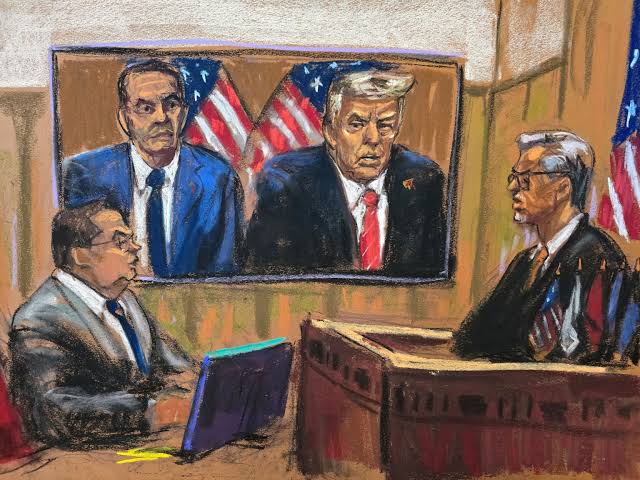
On September 2, the Trump administration's Justice Department filed a statement of interest in the sprawling copyright litigation against OpenAI now consolidated before U.S. District Judge Sidney Stein in the Southern District of New York. Its position, stripped of the legalese, is this: training a large language model on copyrighted books, articles and reporting is fair use. Full stop.
Not "may be" in narrow circumstances. Not "depends on the facts." The government's brief states that the United States "has a strong interest in this court rejecting any argument that training LLMs on copyrighted texts violates copyright law."
For the first time since publishers, authors, artists and record labels began suing AI companies in earnest three years ago, the federal government has walked into the courtroom and taken a side. It picked the machines.
WHAT ACTUALLY LANDED ON THE DOCKET
The filing was flagged by Puck's Eriq Gardner and quickly confirmed across the trade press. It was signed by associate attorneys general Stanley Woodward Jr. and Brett Shumate, along with senior counsel to the attorney general Michael Weisbuch — senior names, not a junior staffer's freelance opinion.
A "statement of interest" is a specific legal instrument. It lets a federal agency tell a court what the government's view is without becoming a party to the case. It is not binding. Judge Stein is under no obligation to follow it and will decide the fair use question himself.
But nobody in Washington files one of these by accident. A statement of interest is a signal flare, and everyone in the AI economy saw it.
The government's argument runs on two rails. The first is doctrinal: that the plaintiffs are trying to shrink the fair use doctrine below its historical shape. "In this litigation, the New York Times seeks to narrow fair-use doctrine to exclude the training of OpenAI's large language models (LLMs)," the brief argues. "That result would be inconsistent with basic copyright law principles and severely hamper 'the Progress of Science and useful Arts'" — a direct lift from the Constitution's copyright clause, deployed against the copyright holders.
The second rail is competitive, and it is cleverer than it first appears. "An erroneous fair use ruling would hamper competition in the market for LLMs, because only the largest technology companies might have the capital necessary to pay licensing fees," the filing warns. In other words: force AI firms to pay for training data and you don't protect the little guy, you hand the entire industry to whoever has the deepest pockets.
Underneath both rails sits national security. The brief argues the U.S. "has a strong interest in continuing to develop a robust and competitive artificial intelligence industry that sets the standard for the practice and procedure of AI use globally," and that the public benefits of powerful American AI far outweigh any competitive harm to publishers. That framing — AI as strategic infrastructure in a race against China — has been the throughline of administration technology policy since Trump signed a December 2025 executive order aimed at overriding state AI laws with a single federal standard to "ensure that the United States wins the AI race, as we must."
HOW WE GOT HERE
The case at the centre of this began on December 27, 2023, when the New York Times sued OpenAI and Microsoft in Manhattan federal court, accusing them of copying millions of its articles without permission or payment to build the models behind ChatGPT. The Times argued the resulting products compete directly with its journalism and siphon off subscription, licensing and advertising revenue.
OpenAI has never conceded the point. "Training AI models using publicly available Internet materials is fair use, as supported by long-standing and widely accepted precedents," the company has said, framing the principle as essential to innovation and American competitiveness.
On March 26, 2025, Judge Stein largely denied the motions to dismiss, letting the core infringement claims go forward. That was the moment the case stopped being a press release and became a genuine threat.
Since then it has grown teeth and company. The Intercept had filed its own suit in February 2024; a judge dismissed its claims against Microsoft in November 2024 but allowed a Digital Millennium Copyright Act claim against OpenAI to survive. That case was later folded in alongside the Times, Tribune Media Company and Ziff Davis under Judge Stein's supervision. In June 2026, a coalition of nearly 400 news publishers sued OpenAI and Microsoft over content scraped without permission or compensation.
Discovery has been bloody. In November 2025 a magistrate ordered OpenAI to hand over a sample of 20 million de-identified ChatGPT conversation logs; OpenAI's motion for reconsideration was denied in December, and Judge Stein affirmed the order in January 2026. In July 2026, the Times and more than a dozen other media organisations moved for sanctions, accusing OpenAI of withholding evidence during discovery. OpenAI disputed the allegations and said it would keep defending both its users' privacy and "the long-established principles of fair use."
Summary judgment briefing wrapped in April 2026. Stein has since ordered the parties to show cause, in writing by September 11, 2026, why the action should not be stayed pending resolution of summary judgment motions in other active cases in the same multi-district litigation.
Translation: the judge is close to ruling on something big. The government filed its brief days before that deadline.

"AN UNPRECEDENTED, UNCOMPENSATED TRANSFER"
The reaction from the plaintiffs' side was immediate and furious.
Matt Topic, the attorney litigating The Intercept's case, told the outlet that the administration's position was both legally untethered and existentially dangerous for journalism.
"This is pretty reflective of the administration's pro-AI policies, which are out of step with the public skepticism of AI and out of step with our long tradition in this country of protecting human expression," Topic said. "If the administration's position was accepted, it would result in an unprecedented, uncompensated transfer of IP rights from news organizations to tech companies."
Topic also raised a procedural objection that lands harder than it might sound. The Justice Department has not participated in discovery. It has not seen the evidence. It has not reviewed the 20 million chat logs or the internal documents at the centre of the sanctions fight.
"What they're saying isn't based on any understanding of actual facts," Topic said. "It just reflects what Microsoft's and OpenAI's PR machines have been putting out into the public."
The New York Times, for its part, has kept its public messaging narrow and pointed: "Both AI and creators can thrive — AI companies simply need to pay fairly for the content that makes their products possible, as copyright law requires."
That single sentence is the whole fight. Nobody suing OpenAI is arguing that large language models should not exist. They are arguing about the invoice.
THE HOLLYWOOD FRONT
This is not only a newspaper story. Studios, unions and individual creators have been fighting the same battle on a parallel track, and they read the DOJ filing the same way publishers did.
More than 400 Hollywood creatives and executives publicly urged the administration last year to reject proposals from OpenAI and Google that they argued would gut copyright protection for creative work. That lobbying effort has now, at least on this issue, clearly lost.
The economics are simple enough that they don't require a law degree. A generative model trained on decades of reporting, screenplays, novels and photographs can produce work that competes with the humans who made the training material — without those humans receiving a cent. If fair use covers that, the licensing market that publishers and studios have been trying to build never comes into existence. There is nothing to license, because there is nothing to pay for.
If fair use does not cover it, the bill is astronomical. Statutory damages for willful infringement run up to $150,000 per work. The Times alone has sought damages in the billions. Multiply that across nearly 400 publishers and the consolidated author cases and the numbers stop being survivable for anyone.
WHO ACTUALLY DECIDES
For all the noise, the person who matters is Judge Sidney Stein, and he is not bound by any of this.
Statements of interest carry persuasive weight, not authority. Stein has already shown he is willing to rule against OpenAI on significant motions, and he has an evidentiary record the Justice Department does not. He will apply the four-factor fair use test — the purpose and character of the use, the nature of the copyrighted work, the amount used, and crucially the effect on the market for the original — to actual facts, not policy preferences.
That fourth factor is where publishers think they win. It is one thing to call a use "transformative," which the government insists LLM training is. It is another to explain why a chatbot that summarises today's news for free has no effect on the market for a newspaper subscription.
Whatever Stein decides, it will be appealed. This ends at the Second Circuit at minimum, and quite plausibly at the Supreme Court. The DOJ brief should be read less as an attempt to win this motion and more as the opening move in a multi-year campaign to shape appellate law.
WHAT THIS MEANS FOR YOU
If you read news, watch films, listen to music, take photographs or write anything for a living, this case decides the terms of your industry.
If the government's position prevails, AI training data becomes effectively free. Model quality improves faster, tools get cheaper, and smaller AI developers can compete without licensing budgets — the administration's stated goal. But the business model that funds original reporting takes a direct hit, at a moment when local news is already collapsing. Publishers lose their last real point of leverage.
If the publishers prevail, a licensing market gets built almost overnight. Content owners get paid. Newsrooms get a new revenue line. But AI development in the U.S. gets slower and dramatically more expensive, and the advantage may well flow to the largest incumbents — exactly the concentration the DOJ warned about — or to jurisdictions with looser rules.
There is no version of this where nothing changes. And there is a quieter consequence worth noticing: the 20 million ChatGPT logs already ordered into evidence are a reminder that the things you type into a chatbot are discoverable material in litigation you have never heard of.
CONCLUSION
Governments file statements of interest when they want a court to understand that a ruling has consequences beyond the parties in the room. That much, at least, the Justice Department got right. This ruling will have consequences far beyond the Times, The Intercept and OpenAI.
What is remarkable is which consequence the government chose to worry about. Faced with a choice between the financial survival of American journalism and the training-data appetite of American AI companies, it did not hedge. It filed a brief.
Judge Stein has a show-cause deadline of September 11. The rest of the industry — every newsroom, every studio, every freelancer whose work sits somewhere in a training set — is now waiting on one federal judge in Manhattan to decide what their work is worth.
Published By | Tech Wiz