Written By | Torch Media Africa
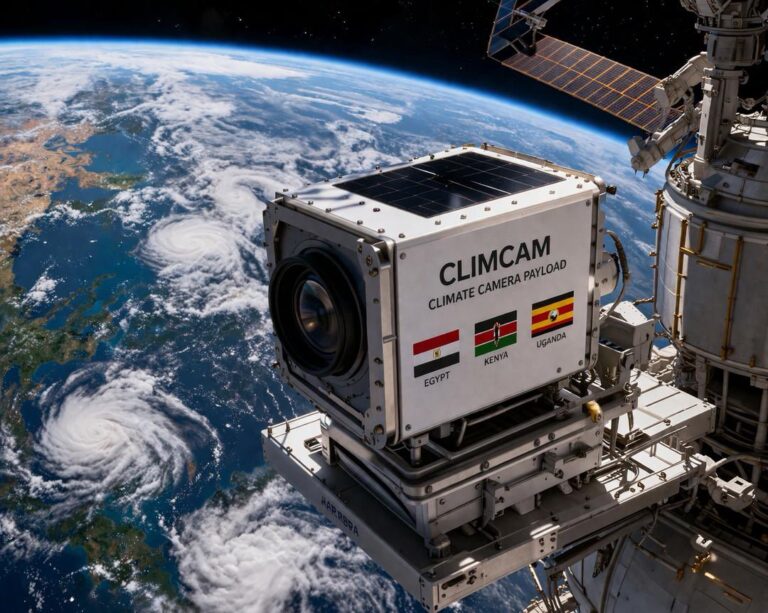
What makes ClimCam notable isn't just the diplomacy behind getting three governments to co-develop and fly a shared instrument — it's the specificity of what it is built to watch for
Four months after Uganda, Kenya, and Egypt made history by jointly launching Africa's first tri-national Earth-observation instrument to the International Space Station, that payload — known as ClimCam, short for Climate Camera — is now entering the phase its designers have been waiting for: commissioning. According to the mission timeline laid out by its developers, ClimCam was expected to begin commissioning around August 2026, with data transmission to follow later in the year, meaning the small satellite camera bolted to the ISS is, this month, transitioning from a dormant piece of hardware into an active instrument feeding climate data back to East Africa for the first time.
The ClimCam payload lifted off on April 11, 2026, at 1:41 p.m. East African Time, from Cape Canaveral Space Force Station in Florida, riding aboard a SpaceX Falcon 9 rocket as part of a Cygnus cargo resupply mission to the ISS. The launch was described by regional outlets and space-industry trackers as the first time three African nations had jointly built and deployed an Earth-observation instrument in space — a milestone for a continent that has historically been a data consumer rather than a data producer in global Earth-observation networks. The 3.5-kilogram payload will spend roughly a year mounted externally on the space station, using onboard machine-learning algorithms to analyze conditions across East Africa in near real time.
What makes ClimCam notable isn't just the diplomacy behind getting three governments to co-develop and fly a shared instrument — it's the specificity of what it is built to watch for. The camera is calibrated to track water levels on Lake Victoria, monitor drought stress across the Horn of Africa, map flood extents during the region's rainy seasons, and flag early indicators of locust outbreaks, all problems that have historically been difficult to monitor cheaply and continuously across a region as large and infrastructure-poor as East Africa. Operationally, the mission plan calls for daily color imaging of at least 20 square kilometers over East Africa, captured at a ground resolution of about 10 meters from an orbital altitude of roughly 400 kilometers, with a minimum of one usable image captured per day across the mission's planned one-year lifespan. Perhaps the most consequential design target is speed: the system is engineered to compress the time between a satellite observation and an actionable alert on the ground from the multi-day lag typical of many existing Earth-observation pipelines down to under 30 minutes — a difference that matters enormously for flood warning and disaster response, where hours can determine whether evacuation orders reach people in time.
The project sits within a broader regional push, spearheaded by the space agencies of Uganda, Kenya, and Egypt, to build indigenous African capacity in space-based climate monitoring rather than relying solely on data purchased or donated from Western and Chinese satellite operators. For Uganda specifically, the ClimCam collaboration has been championed publicly by the country's science leadership as evidence that its investment in the Science, Technology and Innovation Secretariat is beginning to bear fruit beyond domestic research and into genuine international scientific partnerships. That framing has taken on extra weight this year: Uganda's National Science Week 2026 was explicitly built around the theme of shifting the country "from pathfinding to acceleration" in its stated ambition to grow into a $500 billion economy, with science and technology infrastructure positioned as a core pillar rather than a side project. The Uganda Deep Technology Summit, held earlier this year, similarly focused on applied artificial intelligence and deep-tech capacity-building, with the country's Science, Technology and Innovation Secretariat positioning itself as the coordinating body behind projects like ClimCam.
Practical payoff for ordinary Ugandans and their East African neighbors is still months away — the commissioning phase now underway is about validating that the instrument works as designed in orbit before its data starts flowing into agricultural, disaster-management, and forecasting systems used on the ground. But agencies involved in the project have been explicit about their intended users: farmers making planting and irrigation decisions, disaster-management agencies preparing flood responses ahead of East Africa's rainy seasons, and natural-resource managers tracking longer-term environmental change across a region increasingly affected by climate volatility.
ClimCam is not the only sign of Uganda's growing technology and innovation ambitions this month. Kampala is set to host the inaugural East Africa Open Robotics Championship from August 20 to 22, drawing young innovators and robotics teams from Uganda, Kenya, Tanzania, Rwanda, and other countries across the region. Organizers have framed the competition as a way to unlock engineering and problem-solving talent among East African youth, giving the region's fast-growing population of young engineers and computer scientists a competitive showcase that has not previously existed at this scale locally. The event follows a string of other Uganda-hosted technology gatherings this year, including a digital transformation conference held at Next Media Park in Naguru, Kampala, under the banner "Beyond Connectivity: Turning Access into Opportunity," where communications-sector stakeholders — including officials from the National Information Technology Authority-Uganda (NITA-U) — discussed how to convert the country's expanding internet and mobile connectivity into tangible economic participation, job creation, and better public services rather than connectivity for its own sake.
Taken together, the ClimCam commissioning and the upcoming robotics championship reflect a deliberate strategy by Uganda's science and technology establishment: pairing high-visibility international collaborations, like the tri-national satellite project, with grassroots capacity-building events aimed at the country's youth, in an effort to build both the infrastructure and the talent pipeline the government says it needs to hit its stated long-term economic ambitions.
What to watch next: whether ClimCam's commissioning phase, now underway, proceeds without technical setbacks and begins transmitting usable climate data to Ugandan, Kenyan, and Egyptian agencies on the timeline its developers have projected; how quickly that data gets integrated into existing flood and drought early-warning systems used by disaster-management agencies in the region; and turnout and outcomes from the August 20–22 East Africa Open Robotics Championship in Kampala, which organizers hope will become an annual fixture on the region's technology calendar.



