Written By | Torch Media Africa
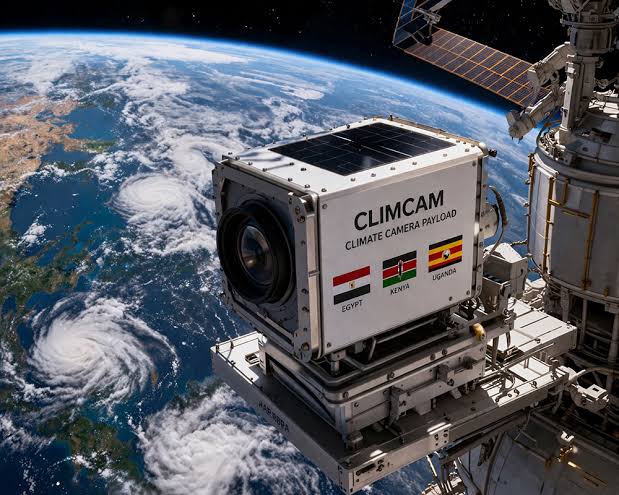
ClimCam launched to the ISS on April 11, 2026, aboard the Cygnus NG-42 resupply mission, lifted by a SpaceX Falcon 9 rocket from Space Launch Complex 40 in Florida
SCIENCE & TECH
Four months after Uganda joined Egypt and Kenya in launching Africa's first tri-national space payload to the International Space Station, that instrument is now entering the phase that will determine whether it actually works as designed. ClimCam, a 3.5-kilogram AI-enabled Earth-observation camera built to monitor climate conditions across East Africa, is scheduled for a 30-day commissioning process this August, the step that stands between a successful rocket launch and the moment the camera starts delivering usable climate data to scientists and emergency planners on the ground.
What Is Happening
ClimCam launched to the ISS on April 11, 2026, aboard the Cygnus NG-42 resupply mission, lifted by a SpaceX Falcon 9 rocket from Space Launch Complex 40 in Florida. It is now installed on the Airbus Bartolomeo external platform attached to the European Columbus Module, where it will operate for a planned one-year mission. Once installed and powered up, the payload undergoes a structured commissioning process — engineers verify that its systems, sensors and communications links are functioning correctly before it is cleared for routine operations. That commissioning window falls in August 2026, with data transmission expected to begin later in the year once the instrument passes its checks.
The camera's technical objectives are specific and measurable: daily colour imaging of at least 20 square kilometres over East Africa at a ground sampling distance of 10 metres, captured from an orbital altitude of roughly 400 kilometres, with a minimum of one image taken per day across the full one-year mission. Uganda's Minister for Science, Technology and Innovation, Monica Musenero, has said the camera will pass over East Africa up to four times a day, capturing detailed imagery that scientists and government agencies can use to detect emerging climate risks earlier than current systems allow. In Uganda specifically, the resulting data will be downlinked through the POMA ground station at a rate of 1 Mbps, feeding directly into national monitoring systems rather than requiring a detour through a foreign data provider.
Background And Context
ClimCam is a joint initiative of the Egyptian Space Agency, the Kenya Space Agency and the Uganda National Space Programme, developed with support from the United Nations Office for Outer Space Affairs (UNOOSA) and European aerospace group Airbus. The Egyptian Space Agency led the engineering, assembly, integration and testing work, with its Cairo facilities serving as the primary technical hub for building and validating the payload before launch — meaning the hardware itself is largely Africa's own work, rather than an imported instrument simply carrying African branding.
The mission is explicitly framed around practical, near-term utility rather than pure research. Its stated applications span flood detection, agricultural assessment and weather forecasting — three areas where East Africa has faced repeated, costly climate shocks in recent years, from erratic rainfall affecting crop yields to sudden flooding events that current ground- and satellite-based monitoring systems have often struggled to flag with enough lead time for effective response. By tracking shifts in weather patterns and issuing earlier warnings of floods and drought, the partner agencies say ClimCam is intended to directly strengthen the region's capacity to anticipate and respond to climate-related disasters, rather than simply adding to the existing pool of climate research data.
The project also carries symbolic weight beyond its immediate technical goals. It is described by its partners as the first African-led, multi-country payload to operate from the ISS, and officials have framed it as a marker of a broader shift: Africa moving from being solely a consumer of space-derived climate data, generated and controlled by foreign agencies, to becoming a producer and co-owner of its own space-based data infrastructure. The initiative is explicitly positioned as a forerunner to further African-led missions, including the planned African Development Satellite (AfDevSat) initiative.
Who Are The Main Players
On the Ugandan side, the Uganda National Space Programme is the lead technical partner, with Minister for Science, Technology and Innovation Monica Musenero serving as the government's public face for the project. The Egyptian Space Agency holds primary technical leadership for the payload's engineering and testing, while the Kenya Space Agency rounds out the tri-national partnership. International backing comes from UNOOSA, the United Nations body responsible for promoting international cooperation in the peaceful uses of outer space, and Airbus, which provided both the Bartolomeo hosting platform on the ISS and broader technical support.
Why It Matters
For Uganda, ClimCam represents a tangible extension of a space programme that began with the country's first satellite launch in 2022 and has since expanded through partnerships and infrastructure upgrades, including improvements to the Mpoma Satellite Earth Station to support satellite assembly and operations domestically. Successfully operating a shared orbital instrument — rather than simply consuming satellite imagery purchased or donated from elsewhere — is a meaningful capability step for a national space programme still in its early stages, and gives Uganda a direct stake in an operational space asset rather than a purely observational role.
More immediately, the practical stakes are high for a country where climate volatility already has direct economic and humanitarian consequences: agricultural growth in Uganda slowed in the second half of 2025 specifically due to lower rainfall levels, according to recent economic assessments, illustrating how directly weather variability feeds into food security and broader economic performance. A functioning early-warning system for floods and drought, even a modest one built around a single small payload, could meaningfully improve disaster preparedness for a country where such events routinely cause displacement and crop losses in vulnerable regions.
The project also lands amid a wider push by Uganda's science and technology establishment to position the country as a serious player in applied science and technology-driven economic transformation, a theme underscored at April's National Science Week 2026 and reinforced by initiatives like the Uganda Deep Technology Summit, which has focused attention on AI, digital infrastructure and innovation ecosystems as pillars of the government's ambition to grow the economy toward the $500 billion mark it has set as a long-term target.
What To Watch Next
The immediate milestone to track is whether ClimCam successfully completes its 30-day commissioning process this August without technical setbacks — a step that determines whether the mission moves into routine data collection or requires troubleshooting that could delay useful output. Following commissioning, the key development to watch is the start of actual data transmission, expected later in 2026, and how quickly Ugandan, Kenyan and Egyptian agencies are able to translate the resulting imagery into usable products for farmers, emergency planners and researchers. The three partner agencies have also indicated plans to roll out a joint online portal providing researchers and emergency planners with access to imagery and climate alerts; the timeline and functionality of that portal will be an important test of whether ClimCam delivers on its promise of practical, real-time utility rather than remaining a largely symbolic technology demonstration. Longer term, ClimCam's performance over its one-year mission will likely shape the case for follow-on African-led space missions, including the AfDevSat initiative already referenced by mission partners.



