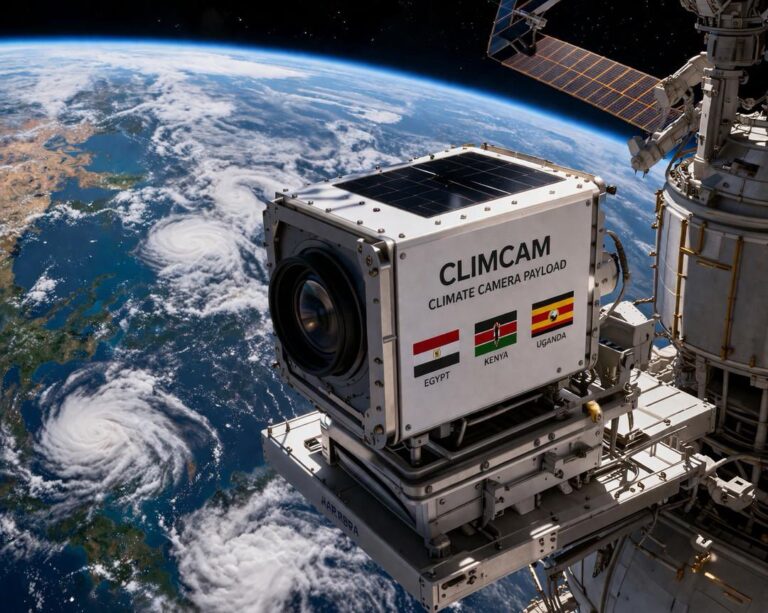
Roughly 400 kilometres above East Africa, a 3.5-kilogram payload bolted to the International Space Station's European Columbus module is beginning full operations this month, marking one of the most significant milestones yet for Africa's young space sector. The device, known as ClimCam, is a joint climate-monitoring camera developed through a partnership between the Uganda National Space Programme, the Kenya Space Agency, and the Egyptian Space Agency. After launching to the ISS on April 11 aboard a Cygnus cargo mission lifted by a SpaceX Falcon 9 rocket from Cape Canaveral, and a subsequent period of installation and testing on the station's Bartolomeo external platform, ClimCam is now moving into its operational phase in August, when it is expected to begin transmitting regular imagery and processed climate data to ground teams in all three partner countries at least four times a day.
The mission represents Africa's first tri-national payload placed aboard the International Space Station, and Ugandan officials have been eager to frame it as evidence that the country's still-nascent space programme can deliver credible science rather than symbolic gestures. Speaking ahead of the April launch, Minister of Science, Technology and Innovation Monica Musenero described the camera as a practical tool rather than a prestige project, emphasising its intended applications in flood monitoring, drought assessment, agricultural planning, disaster response, and broader environmental management across a region that faces recurring climate shocks. The camera uses onboard machine learning algorithms to process imagery before it is transmitted to the ground, an approach designed to reduce the bandwidth and turnaround time needed to get usable climate data into the hands of national meteorological and disaster-response agencies.
ClimCam is scheduled to remain aboard the ISS for approximately one year, during which its data will feed into flood early-warning systems and agricultural advisories in Uganda, Kenya, and Egypt, three countries whose combined geography spans the source of the Nile, the Rift Valley, and the Nile Delta, giving the mission an unusually wide range of terrain and climate conditions to observe from a single vantage point. For Uganda specifically, the camera builds on the country's earlier steps into space technology, following the 2022 launch of PearlAfricaSat-1, Uganda's first satellite, which was developed by Ugandan engineers with support from Japan's Kyushu Institute of Technology. Officials have described ClimCam as evidence of a maturing programme, moving from single-country technology demonstrations toward genuine regional scientific collaboration with tangible applications.

The launch and forthcoming operations have been closely tied to Uganda's broader ambitions to position science, technology, and innovation as pillars of long-term economic transformation. Those ambitions were on full display at National Science Week 2026, held from April 30 to May 3 under the theme 'STI Works: Powering Uganda to a USD 500 Billion Economy,' where government officials and researchers argued that the country needed to move from what they termed a 'pathfinding' phase of scattered pilot projects toward a genuine acceleration phase in which science and technology investment scales into measurable economic output. The Uganda Deep Technology Summit 2026, organised by the Science, Technology and Innovation Secretariat, extended that conversation into artificial intelligence, digital governance, and infrastructure, reflecting a government push to ensure Uganda is not left behind as AI adoption accelerates across the continent.
That same push toward turning research into commercial and economic value was visible closer to the ground in late July, when the Ministry of ICT and National Guidance moved to accelerate the commercialisation of homegrown digital innovations developed at the Uganda Institute of Information and Communications Technology, or UICT. During a familiarisation visit to UICT's Nakawa campus on July 31, Minister of State for ICT Alioni Yorke Odria gave the institute's technical teams a two-week deadline to compile a comprehensive inventory of locally developed digital innovations and software ready for commercial deployment. The directive is aimed at creating clearer pathways for promising tools built by Ugandan students and researchers, including a digital monitoring system for the government's Parish Development Model that tracks beneficiaries, fund disbursement, and loan repayments in real time, to move out of campus laboratories and into the marketplace. During the same visit, Odria toured UICT's augmented and virtual reality laboratory and its electronics and electrical engineering facilities, and the ministry reiterated its commitment to supporting the institute's broader digital skilling agenda, which has already trained more than 48,000 Ugandans in digital and emerging technologies.
Taken together, the ClimCam operations milestone and the UICT commercialisation push illustrate two complementary strands of Uganda's current science and technology strategy: high-visibility international collaboration that builds credibility and technical capacity at the frontier of space science, paired with more grounded efforts to ensure that domestic innovation, much of it produced by university students and young engineers, does not stall out at the prototype stage for lack of a commercial pathway. Officials across both initiatives have repeatedly invoked Uganda's youthful population, with a median age under 17, as both the country's greatest asset and its greatest urgency, arguing that without deliberate investment in translating research into jobs and enterprises, the demographic dividend risks becoming a demographic burden instead.
There are, however, real questions about durability and follow-through. Africa's space sector remains heavily dependent on international partnerships and funding, and ClimCam's one-year mission life on the ISS means Uganda, Kenya, and Egypt will need to decide relatively soon whether and how to fund a successor mission or transition to an independently operated satellite platform. Similarly, the UICT commercialisation drive depends on the Ministry of ICT following through on the support pathways it has promised, including intellectual property protections, seed funding mechanisms, and connections to private investors, none of which were spelled out in detail during the July visit. Uganda's track record on translating innovation-hub enthusiasm into scaled, self-sustaining local technology companies has so far been mixed, with numerous well-publicised pilot projects failing to progress much beyond the demonstration stage.
In the near term, the most concrete thing to watch is whether ClimCam's data begins flowing reliably to Uganda's meteorological and disaster-management agencies as promised, and whether it demonstrably improves the timeliness of flood or drought warnings during Uganda's upcoming rainy season. On the digital innovation side, the two-week inventory deadline set for UICT in late July will offer an early test of whether the ministry's commercialisation push moves at the pace officials have promised, or joins a long list of similar initiatives that generated headlines without a durable follow-up. Both threads will offer a clearer read, within the next few months, on whether Uganda's stated ambition to convert scientific and technological investment into economic growth is translating into results on the ground.
Published By | Tech Wiz