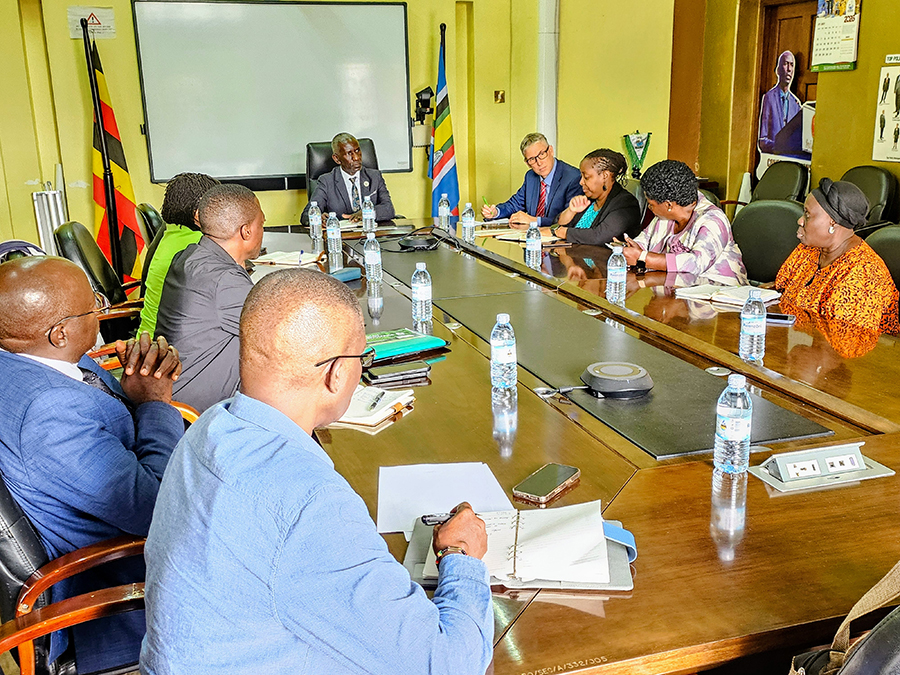
A courtesy call in Entebbe on Friday put artificial intelligence, data governance and parasitic wasps on the same agenda — and exposed how much of Uganda’s crop protection now depends on moving information rather than chemicals.
Entebbe
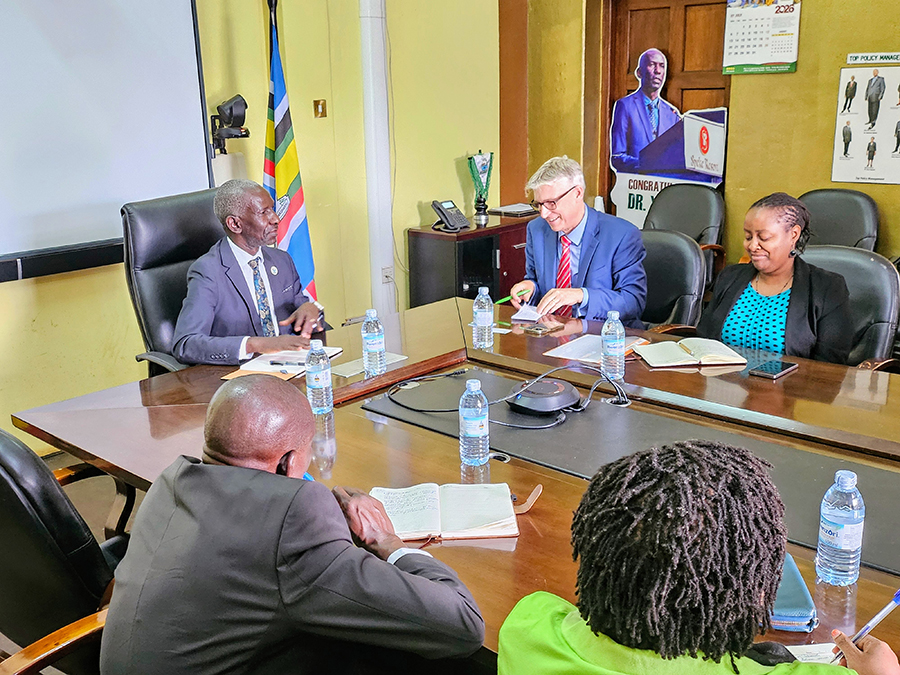
Dr Daniel Elger, chief executive of the Centre for Agriculture and Bioscience International (CABI), spent Friday at the headquarters of the National Agricultural Research Organisation (NARO) in Entebbe. On paper it was a courtesy visit. The agenda was anything but ceremonial: climate change adaptation, agricultural digitisation, artificial intelligence, data governance, pest and disease management, and joint resource mobilisation — a list that reads like an inventory of the things Uganda’s crop protection system currently cannot do at scale.
The most consequential sentence of the meeting came from the host. NARO director general Dr Yona Baguma said the organisation is in the process of establishing a team to spearhead its work on artificial intelligence, and wants CABI’s help building an institutional framework around it. "We want NARO to be a champion in establishing a governance framework for AI in Uganda," Baguma said, adding that the two organisations would "look forward to developing an institutional framework to harness AI for service of humanity." He also identified climate-change transformation, the digitisation of research processes and shared data platforms as areas where the partnership could expand.
Elger framed the urgency in biological terms. Changing climatic conditions, he said, are altering pest and disease patterns globally — pushing invasive species into new locations and shifting both the timing and the geographic range of agricultural pests. "Climate change is an absolute key priority," he said. "We work with our member countries on ways to make agriculture more resilient in the face of some of these pressures, particularly for smallholder farmers, and to help ensure food security." Protecting food production, he added, goes beyond controlling pests: it requires getting timely, appropriate information and technologies into farmers’ hands.
Why the pest map matters more than it used to
Uganda has always paid a heavy pest tax. National assessments put pre-harvest crop losses to pests and diseases at 10 to 20 per cent and post-harvest losses at 20 to 30 per cent, with annual monetary losses estimated at US$35–200 million for bananas, US$60–80 million for cassava, US$10 million for cotton and US$8 million for coffee. Banana bacterial wilt, cassava brown streak disease, coffee wilt, fruit flies and citrus canker are permanent fixtures of the extension calendar. Fall armyworm, first detected in Africa in 2016, threatened some 450,000 tonnes of Ugandan maize within a year of arrival.
What has changed is that the map is no longer stable. A season like 2026 — an abrupt drought in May following unusually heavy rains, now giving way to an above-normal rainfall outlook running through December — does not merely stress crops. It resets the phenology of the insects and pathogens that attack them, bringing outbreaks forward, extending them later, and opening highland districts that were previously too cool to fungal and insect pressures they have never had to manage. Advisory content written for a 2015 pest calendar is, in a growing number of districts, simply wrong.
The wasp that proves the model
The strongest evidence that Uganda can respond to that instability without reaching for a spray can is a programme most Ugandans have never heard of. Papaya mealybug, an invasive polyphagous pest, causes yield losses of 57 to 91 per cent in East Africa and household economic losses of up to about £2,224 per hectare. Around half of affected farmers in the region have managed it with pesticides that also kill beneficial insects. Under CABI’s PlantwisePlus programme, a tiny parasitic wasp, Acerophagus papayae, was introduced as a classical biological control agent instead.
In Uganda, the project is now led almost entirely by NARO and its National Crops Resources Research Institute, with PlantwisePlus providing technical backstopping and supervision. A fully functional production unit supplies the wasps for nationwide releases, which expanded to twelve new districts during 2025, and monitoring shows the parasitoid spreading both naturally and through farmer-to-farmer distribution, suppressing mealybug populations while fruit production recovers. Across the border, a 2025 socioeconomic study of 405 farmers in four Kenyan counties found that, measured against a 2019 baseline, the wasp’s introduction raised papaya yields by 19 per cent, sales by 18 per cent and household income by 57 per cent. CABI trained 494 farmers and 54 agricultural officers in the method during 2025 alone, bringing the total reach since 2021 to more than 4,400 farmers and 500 agricultural officers.
The relevance to Uganda right now is direct. In May 2026 the Ministry of Agriculture halted import permits for nine agricultural chemicals — among them alpha-cypermethrin, atrazine, carbofuran, chlorothalonil and dichlorvos — with full withdrawal due by the end of the year, and placed a further nine under restriction. Removing chemistry without replacing it leaves a control gap that farmers will fill with whatever is available, legal or otherwise. Biological control and integrated pest management are the intended replacement, and they are knowledge-intensive rather than product-intensive. They are delivered through advice, not through an agro-dealer’s shelf. That is precisely why the AI and data conversation in Entebbe is not a technology fad but a delivery question.

Data is the hard part
Elger pressed the point himself, noting that national research systems like NARO do not only generate technologies and advice — they accumulate valuable evidence on what works in which farming environment. "How do we make the most of that data? How do we harness that data? How do we ensure that that data is managed in a respectful way from the perspective of the people who’ve generated that data?" he asked. It is a pointed question in a country where farm-level data is routinely collected by projects, published as a donor deliverable and then lost when the project closes.
CABI is at least now institutionally anchored to do something about it. On 6 May 2026, Uganda signed a Host Country Agreement with CABI — executed by Abubakhar Jeje Odongo for government and Morris Akiri, CABI’s executive director for Africa — following Uganda’s ratification of the CABI instrument in 2025. The agreement moves the organisation from a project-based presence to a permanent country office in the Greater Kampala Metropolitan Area, and sits alongside an EU-funded €8 million plant health programme that includes plans for a Centre of Excellence at Entebbe International Airport. That last element is aimed squarely at export competitiveness: interceptions and phytosanitary rejections of Ugandan horticultural consignments have been a persistent drag on a sector the government wants to grow to Shs7 trillion by 2030.
The unresolved risk is the last mile, and Uganda has an unflattering recent precedent. The Department of Meteorological Services has itself acknowledged that its forecasts largely fail to reach smallholders in a usable form, constrained by a national budget of around Shs20 billion, no funding to translate advisories into the roughly 35 languages farmers actually speak, and no district meteorologist position in the local government structure. A pest early-warning system built on artificial intelligence will hit the identical wall unless somebody funds the delivery layer. The most sophisticated outbreak model in Entebbe is worth nothing to a farmer in Bugiri who never receives the alert, or receives it in a language and format she cannot act on.
Three things are worth watching over the coming months. Whether NARO’s AI team is actually resourced, in an organisation that has been carrying research funding arrears. Whether the biocontrol rearing unit that works for papaya mealybug can be extended to higher-value targets such as fall armyworm or tomato leafminer. And whether any of the data that both institutions now say they want to govern properly ends up in the hands of the people who generated it. The meeting in Entebbe was, in the end, an agreement about intentions. Uganda’s pests are not waiting for the framework.
Published By | Tech Wiz