Written By | Torch Media Africa
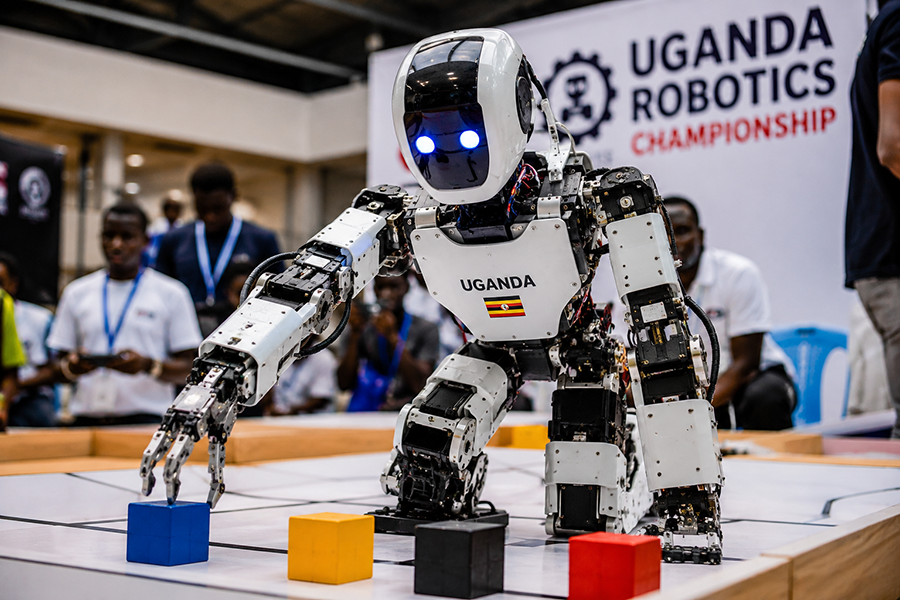
Uganda's growing robotics movement is inspiring a new generation of innovators and strengthening the country's position as East Africa's technology hub.
Kampala will host the first-ever East Africa Open Robotics Championship from August 20 to 22, a three-day competition that organisers describe as one of the most significant STEM and innovation events the region has staged, and one that positions Uganda as an emerging hub for youth robotics on the continent. The event, aimed at children and young people between six and 21 years old, will bring together teams from across East Africa and beyond to design and program autonomous robots to complete a series of engineering missions.
The championship is organised by NextGen Restyling Uganda, a Kampala-based STEM education organisation, in partnership with Uganda's Ministry of Education and Sports, the Uganda Communications Commission and WorldSkills Uganda. That combination of a private innovation outfit, a national ICT regulator and a technical-skills body reflects a deliberate strategy: Uganda's science and technology institutions have spent much of 2026 explicitly trying to convert STEM competitions from one-off showcases into a pipeline connected to the country's broader digital and industrial ambitions.
The event did not appear out of nowhere. NextGen Restyling Uganda has run a series of national STEM and robotics competitions over the past several years, most recently a third National STEM/Robotics Competition and Hackathon held in partnership with Kabojja International School, UCC and Greenhill Academy. According to reporting on the organisation's trajectory, the success of that most recent national event and its growing regional participation — drawing competitors from Kenya, Rwanda, South Sudan and Tanzania — prompted NextGen's headquarters in Houston, Texas, to approve an expansion into a full East African championship, with an eventual Africa-wide competition envisioned as the next step. Mellon Kenyangi, the organisation's founding director, described the choice to involve university students alongside younger competitors as deliberate, arguing that many university graduates in Uganda struggle to translate classroom knowledge into practical, applied engineering skills — a gap the competition format is explicitly designed to close.
Organisers say the August championship will draw entrants not only from the core East African bloc of Uganda, Kenya, Tanzania and Rwanda, but from a wider set of countries including South Sudan, South Africa, Nigeria, Ghana, Sierra Leone, Cameroon, Zambia and even Cambodia, reflecting the increasingly international character of youth robotics competitions built on shared formats such as those used by the World Robot Olympiad and VEX Robotics circuits, both of which have active Uganda chapters feeding into the ecosystem. During the competition, teams will design and program autonomous robots to complete staged missions, a format intended to test creativity, teamwork and applied engineering skill rather than rote technical knowledge alone.
The championship lands in the middle of a broader push by Ugandan science and technology institutions this year. National Science Week 2026, held earlier this year under the banner of shifting Uganda from "pathfinding" to "acceleration" in pursuit of the government's long-term goal of building a $500 billion economy, showcased science and innovation as central to that strategy rather than peripheral to it. Uganda has also partnered with Kenya and Egypt on CLIMCAM, a regional climate and weather-monitoring system expected to move toward commissioning around the same period, part of a wider pattern of the country positioning itself within regional technical and scientific infrastructure projects rather than pursuing purely domestic initiatives.
The stakes behind these STEM investments are not abstract. Uganda has one of the youngest populations in the world — an estimated 33 million of its roughly 46 million people are under 30 — and youth unemployment, driven substantially by skills gaps and a shortage of formal-sector jobs, remains one of the most persistent concerns raised in national surveys, alongside corruption. Government and private-sector figures involved in the robotics push have repeatedly framed competitions like the East Africa Open Robotics Championship as a direct response to that mismatch: an attempt to give young Ugandans hands-on engineering and coding experience that translates more directly into employability than conventional classroom instruction does, while also identifying and nurturing a smaller cohort of standout innovators who might go on to found companies or lead technical teams.
There is also a regional-positioning dimension to Uganda hosting rather than simply participating in an event of this scale. East Africa's STEM and youth-tech competition landscape has grown crowded, with South Africa, Nigeria, Ghana and other markets running established national and continental robotics and AI competitions, including the Presidential African Youth in Artificial Intelligence and Robotics Competition and various VEX and World Robot Olympiad national opens. By securing approval to run the first East African championship rather than simply sending teams to compete elsewhere, Uganda is betting that hosting capacity — venues, logistics, sponsorship relationships and the ability to attract international competitors — will itself become a form of soft-power and investment draw, in the same way that National Science Week organisers have framed science infrastructure as a pillar of the country's economic diversification strategy.
Telecommunications infrastructure is part of the backdrop as well. Uganda's communications sector spent much of July and August discussing the country's next phase of digital transformation, with stakeholders gathering at Next Media Park in Naguru to examine how expanding connectivity can be converted into economic participation, innovation, job creation and better public services. NITA-U, the national IT authority, has separately outlined its own digital transformation agenda to the ICT minister. Against that backdrop, a flagship youth robotics event serves a dual purpose for organisers and government partners alike: a visible, photogenic showcase of STEM talent, and a recruiting ground for the technically skilled workforce that broader digital-transformation plans will eventually require.
What happens after the August 20-22 championship will be the real test of whether the investment pays off. NextGen Restyling Uganda has signalled ambitions to grow the event into an Africa-wide competition following this year's East African edition, a step that would require sustained sponsorship, venue capacity and buy-in from education ministries across multiple countries rather than the single-government backing the event currently has. For competitors, the more immediate question is whether strong showings translate into scholarships, mentorship or job pipelines — the kind of concrete follow-through that turns a well-attended competition into a lasting talent pipeline rather than an annual one-off spectacle. Organisers, government partners and the hundreds of young engineers expected in Kampala this month will all be watching to see which outcome it becomes.



