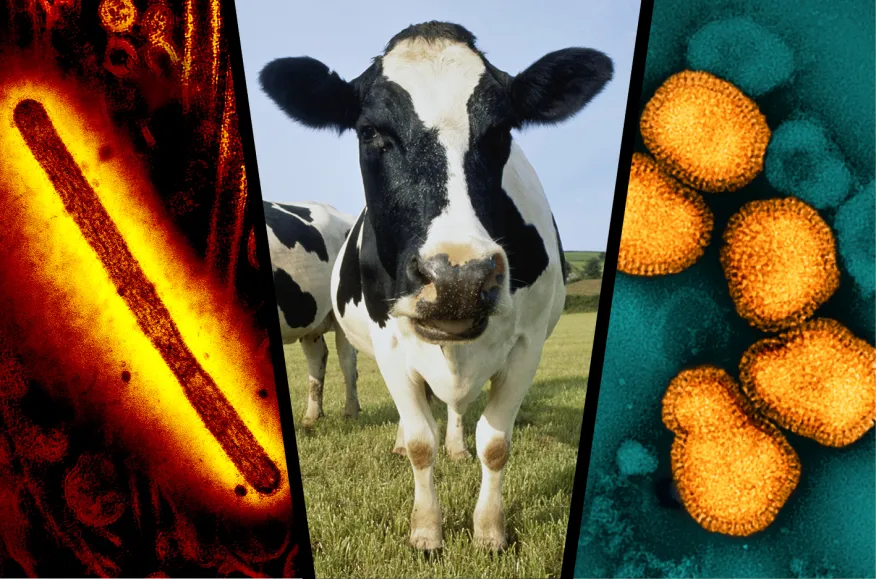
A two-year medical whodunit is over. Pittsburgh researchers say they've found the exact molecular doorway H5N1 uses to invade dairy cattle — and the same door is wide open in pigs, sheep, goats, alpacas and humans.
PITTSBURGH
When bird flu first showed up in American dairy herds in the spring of 2024, veterinarians were stumped in a way few infectious disease experts had seen before. Highly pathogenic avian influenza — H5N1, the virus that has been quietly devastating wild bird populations and occasionally jumping into mammals for two decades — is supposed to attack the respiratory system. It did that in foxes, in cats, in seals, in the handful of unlucky humans who caught it. But in cows, it did something nobody expected: it left the lungs almost completely alone and tore through the udder instead, triggering a wave of severe, baffling mastitis across dairy operations that took weeks to even correctly diagnose as bird flu at all.
Now, more than two years and one dairy-industry crisis later, scientists say they've finally cracked exactly why — and the answer has implications that reach well beyond the milking parlor.
The discovery: a "perfect breeding ground" hiding in plain sight
A team at the University of Pittsburgh School of Public Health, publishing in the journal Science Advances on June 19, says it has identified the precise molecular receptor that makes cow udders such an inviting target for H5N1 — and such an unlikely one for the lungs.
Viruses don't infect cells randomly. Influenza viruses in particular need to physically latch onto specific sugar molecules, called sialic acid receptors, that sit on the surface of host cells like locks waiting for the right key. Different versions of these receptors are scattered unevenly across different tissues and different species, which is a big part of why some flu strains spread easily between humans and others mostly stay confined to birds.
The Pittsburgh team, led by senior author Suresh Kuchipudi, chair of Infectious Diseases and Microbiology at Pitt Public Health, set out to map exactly which receptor subtypes existed where in cattle tissue — and which ones the bird flu virus could actually grab onto. Using a multimodal approach combining laboratory binding experiments, specialized staining methods and ultra-high-resolution imaging, the researchers found that only one particular subclass of receptor, known as N-linked sialic acid receptors, had a strong enough affinity to let H5N1 latch on and start an infection.

The kicker: those receptors were almost completely absent from the airway tissue lining cow lungs — but densely packed throughout the mammary epithelial cells that make up the udder. In Kuchipudi's words, that combination turned the udder into what his team calls "a perfect breeding ground for the virus," while leaving the lungs comparatively untouched.
"Mastitis is a classic disease in milk-production animals, and veterinarians were dutifully looking to all the usual suspects for the source, like bacterial pathogens," Kuchipudi said of the early, confusing weeks of the outbreak. "When the real culprit turned out to be bird flu, everyone in the field was caught completely by surprise."
Why this took two years to figure out
It's worth pausing on just how strange this finding really is, because it explains why the outbreak was so hard to contain in its early weeks. Farmers and veterinarians are trained to watch for respiratory symptoms when they suspect influenza in livestock — coughing, labored breathing, nasal discharge. Bird flu in cattle produced almost none of that. Instead, cows simply went off their feed, produced less milk, and developed thick, discolored milk consistent with ordinary mastitis, a common and usually bacterial udder infection that dairy farms deal with routinely.
That meant the actual signal — a dangerous, zoonotic avian influenza virus circulating through the national milk supply chain — was, for a period of weeks, camouflaged as a mundane farm problem. By the time genetic testing confirmed H5N1 in affected herds, the virus had already established itself in multiple states and, through contaminated raw milk and close contact with infected animals, had begun spilling over into farmworkers. As of public health tallies cited by researchers, H5N1 has now been documented in more than 100 different bird and mammal species worldwide, with the U.S. dairy cattle outbreak marking one of the largest sustained mammal-to-mammal transmission events ever recorded for this particular flu lineage.
The Pittsburgh study doesn't just explain the past two years — its authors say it hands public health officials a faster way to catch the virus's "next surprise move." Knowing precisely which receptor subtype enables infection, and where in the body it's concentrated, gives researchers a predictive tool: instead of waiting for a new and confusing set of symptoms to emerge in some other species before scrambling to identify the cause, they can now screen tissue types for N-linked sialic acid receptor density and get a head start on flagging which organs, and which animals, are most vulnerable to the next jump.

The part that should make you sit up: it's not just cows
Here's the detail buried in the study that's likely to get public health officials' attention well beyond the agriculture beat: the same class of receptor that turned cow udders into a viral breeding ground isn't unique to cattle. According to the research team, the mammary glands of pigs, sheep, goats, beef cattle and alpacas all show the same biological susceptibility — and so do human mammary glands.
To be clear, that doesn't mean H5N1 is poised to start spreading udder-to-udder across the barnyard and into human breast tissue tomorrow. Human H5N1 infections remain rare: roughly 889 cases have been reported globally from 2003 through April 2024, concentrated mostly in people with direct, intensive exposure to infected birds or livestock. But the case fatality rate among those reported cases outside the U.S. has historically run extremely high — around 52% — which is precisely why virologists treat every new piece of information about how this virus picks its targets as a serious matter, even when the immediate public risk is low.
From March through October of 2024 alone, the U.S. recorded 46 human H5N1 cases, the large majority tied to direct exposure to infected dairy cows or poultry rather than any sustained person-to-person spread. Current public health guidance, including from the CDC, continues to describe the risk to the general public as low. But "low" is not "zero," and a virus that has already demonstrated an unexpected talent for finding new tissue doorways into mammals is exactly the kind of pathogen infectious disease specialists watch most closely for the slow, incremental mutations that could eventually make person-to-person transmission easier.
What this means for your milk, your grocery bill, and your health
For consumers, the most immediate practical takeaway is one public health officials have repeated since 2024 and that this new research only reinforces: pasteurization works. Studies have repeatedly confirmed that standard commercial pasteurization — heating milk to roughly 72 degrees Celsius for at least 15 seconds — completely inactivates H5N1 in milk, even though leftover, harmless fragments of the virus's genetic material can sometimes still be detected by sensitive lab tests afterward. The FDA and CDC have both said that drinking commercially pasteurized milk, even from a region with confirmed outbreaks, does not put people at meaningfully increased risk.
Raw, unpasteurized milk is a different story, which is why regulators have continued to act against it. California regulators recalled batches of raw milk from at least one Fresno-area dairy farm after bird flu virus turned up in testing, and federal officials continue to advise against drinking unpasteurized milk specifically because of avian influenza risk, on top of the older, more familiar risks raw milk carries from bacteria like Salmonella and Listeria.
For the dairy industry itself, the Pittsburgh findings could eventually translate into better, faster on-farm screening. If receptor density predicts vulnerability, it may become possible to identify and isolate at-risk animals before they show any clinical signs at all — a meaningful upgrade over the current reactive approach of testing only after cows are visibly sick.
The bigger picture: a virus that keeps finding new doors
Influenza researchers have spent decades trying to predict which species a given flu strain might jump to next, and for just as long, the virus has had a habit of surprising them. H5N1's detour through cow udders is now widely regarded in virology circles as one of the more dramatic recent examples of that unpredictability — a textbook respiratory virus that found an entirely different organ system to colonize, simply because the right lock-and-key receptor happened to be sitting there waiting.
That unpredictability is precisely the argument researchers are making for taking this new mammary-gland finding seriously rather than filing it away as a curiosity about cows. If the same receptor architecture that let H5N1 colonize cattle udders is sitting, largely unexamined, in the mammary tissue of multiple other farmed species — and in humans — then the Pittsburgh team's mapping work isn't just retrospective. It's a warning label for what to watch next.
Conclusion
Two years after dairy farmers first noticed something was badly wrong with their herds, science has finally caught up with an explanation precise enough to act on: a single receptor subtype, oddly concentrated in udder tissue, that gave a respiratory virus an unexpected new way into the body. The mystery of the bird flu that skipped the lungs is solved. The bigger question the discovery leaves behind — how many other unexpected doors this virus might still find, in how many other species — is the one researchers say they're now racing to answer before the virus finds it for them.
Published By | Tech Wiz