SCIENCE & TECH
For half a century, solar physicists have been staring at one of the strangest puzzles in the solar system, hiding in plain sight roughly 93 million miles from Earth. The surface of the Sun — the photosphere — simmers at a comparatively mild 5,500 degrees Celsius. But climb just a few thousand kilometers higher, into the Sun's outer atmosphere, the corona, and the temperature rockets to over a million degrees. That's backwards. Heat isn't supposed to get hotter the farther you move from the furnace. Something up there is pumping in enormous amounts of extra energy, and for fifty years nobody could point to exactly what.
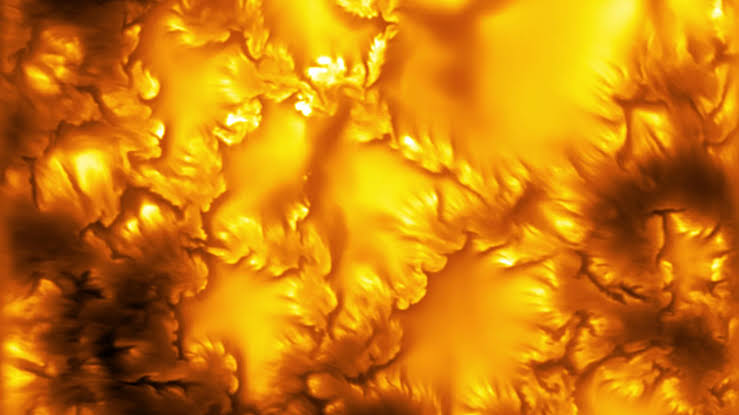
This month, a team of astronomers using the Daniel K. Inouye Solar Telescope in Hawaii says they've finally caught the culprit in the act — thousands of tiny, previously invisible whirlpools of plasma, churning across the Sun's surface like storms on the ocean, each one barely wider than a small town.
A Telescope Built to See the Impossible
The discovery, published August 5 in the journal Nature, was only possible because of the sheer optical muscle of the Inouye Solar Telescope, a four-meter instrument perched on the volcanic slopes of Maui that is, by a wide margin, the most powerful solar observatory ever built. To catch these vortices, the telescope needed to resolve features roughly 20 kilometers across on an object sitting 150 million kilometers away — a feat scientists have compared to being able to tell a one-euro coin apart from a two-euro coin from 180 kilometers away, or picking out a single grain of sand on a beach seen from an airplane.
The team, drawing researchers from the US National Solar Observatory, Germany's Max Planck Institute for Solar System Research, and the US High Altitude Observatory, pointed the telescope's instruments at the quiet regions between the Sun's magnetic structures and captured something nobody had ever directly imaged before: small-scale spiral patterns spinning up at the edges of magnetic regions, forming and dissolving in a matter of minutes.
Physicists have a name for exactly this kind of swirl. It's called a Kelvin-Helmholtz instability — a universal phenomenon that shows up whenever two layers of fluid or gas slide past each other at different speeds. It's the same physics that curls the crest of an ocean wave, that ripples a flag snapping in the wind, and that occasionally shows up in cloud formations as long, breaking rows that look uncannily like a wave about to crash. Scientists had long suspected the same instability might be happening on the Sun's roiling surface, where plasma is in constant, turbulent motion. Nobody had ever actually seen it — until now.
Why a 20-Kilometer Whirlpool Matters to a Million-Degree Mystery
It's a fair question: how does a whirlpool barely wide enough to cover a golf course help explain a temperature gap of nearly a million degrees happening thousands of kilometers away?
The answer lies in magnetism. The Sun's surface is threaded with magnetic field lines that reach up into the corona, and those field lines are the leading suspects for how energy actually gets transported upward into the superheated outer atmosphere. The trouble has always been figuring out the mechanism — the pump, so to speak — that grabs energy from the churning plasma below and injects it into those magnetic field lines in a form that can travel upward and eventually be released as heat.
Kelvin-Helmholtz vortices may be exactly that pump. As these tiny whirlpools spin up and collapse at the boundaries of magnetic regions, researchers believe they twist and tangle the magnetic field lines threading through them, effectively winding them up like rubber bands storing potential energy. That stored energy doesn't have to be released dramatically, in a single giant solar flare visible from Earth. Instead, scientists suspect it might be dribbled out constantly, all across the Sun's surface, in the form of tiny bursts of energy called nanoflares — far too small and too numerous to observe individually, but collectively perhaps significant enough to help explain the corona's extreme heat.
The vortices may also help solve a second, related puzzle: how energy and disturbances manage to propagate through the solar atmosphere far faster than existing models predict they should. If magnetic tangling from these instabilities is constantly seeding waves that ripple upward, it could account for that speed gap too.

What the Scientists Are Saying
Researchers involved in the discovery are treating it as a genuine turning point in solar physics, while stopping short of declaring the coronal heating mystery fully solved.
"We believe that the discovery of Kelvin-Helmholtz instability in the solar photosphere, backed up by analysis of numerical simulations, is a major step forward in our understanding of the dynamics and evolution of solar and stellar plasma, and will serve as a basis for future discoveries," said Dr. David Boboltz, Deputy Director at the National Solar Observatory, which operates the Inouye telescope.
That note of caution is deliberate. Solar physicists have chased false dawns on the coronal heating problem before — mechanisms that looked promising in isolated observations or simulations, only to fall short of explaining the full scale of the temperature gap once tested against real data. The research team is careful to frame these vortices as a likely piece of the puzzle rather than the entire answer, noting that other proposed mechanisms — including larger-scale magnetic reconnection events and various classes of plasma waves — may also be contributing simultaneously. Untangling how much of the corona's heat budget each mechanism accounts for will likely take years of follow-up observation.
Fifty Years in the Making
The coronal heating problem isn't a new mystery — it's one of the oldest open questions in modern astrophysics, first identified in the 1940s when scientists realized spectral lines in the Sun's corona could only be explained by temperatures in the millions of degrees, a finding so counterintuitive it was initially met with skepticism. In the decades since, it's motivated an entire generation of solar missions, from NASA's Parker Solar Probe — which flew directly through the corona to sample its plasma up close — to ESA's Solar Orbiter, to ground-based instruments like Inouye itself.
What's made the mystery so stubborn is largely a matter of scale. Theorists have had strong hunches about the general categories of processes that might be responsible — magnetic waves, small-scale reconnection events, turbulence — for years. But actually observing those processes in enough detail to confirm them requires resolving features just tens of kilometers across on a star, using telescopes on the ground looking through Earth's turbulent atmosphere. The Inouye telescope, which achieved first light in 2022 and has been steadily pushing the boundaries of solar imaging ever since, is the first instrument with the combination of aperture, adaptive optics, and instrumentation sensitivity to actually catch these structures directly rather than infer their presence indirectly.
Why This Isn't Just an Academic Curiosity
Solar physics might sound like a purely intellectual pursuit — a very expensive way of admiring sunspots — but the corona's behavior has direct, practical consequences for life on Earth. The same magnetic processes that may heat the corona are also responsible for solar flares and coronal mass ejections, the violent eruptions of charged particles that can disrupt satellites, GPS navigation, power grids, and radio communications when they slam into Earth's magnetic field.
A better understanding of exactly how energy builds up and releases in the Sun's atmosphere — down to the small-scale mechanisms like these vortices — feeds directly into space weather forecasting, the discipline that tries to give utility companies, airlines, and satellite operators advance warning before a solar storm hits. The more precisely scientists understand the engines driving that activity, the better those forecasts can become, potentially the difference between a grid operator having hours of warning before a disruptive storm versus getting caught off guard.
There's also a broader astronomical payoff. The Sun is the only star humanity can study up close, in this kind of granular detail. Whatever physical mechanisms are confirmed here — Kelvin-Helmholtz instabilities twisting magnetic fields and seeding nanoflares — are assumed by astrophysicists to be at work in the atmospheres of countless other stars across the galaxy, most of which will never be resolved in anywhere near this kind of detail. Understanding the Sun's plumbing is, in a real sense, a way of understanding stars in general.
What This Means for You
You won't feel these tiny plasma whirlpools directly, but their downstream effects already touch daily life more than most people realize. Every time a geomagnetic storm forces airlines to reroute polar flights, knocks out GPS precision for farmers running auto-steer tractors, or threatens satellite constellations that carry cell service and broadband to remote areas, the root cause traces back to the same energy-release processes this discovery is helping explain. As solar activity continues through the current elevated stretch of the Sun's roughly eleven-year cycle, improvements in the basic science of how the corona heats and erupts translate, with a lag, into better warnings for the infrastructure modern life depends on.
For anyone who simply finds the universe fascinating, there's a simpler takeaway: a fifty-year-old mystery about the star that makes life on Earth possible just got its most convincing physical explanation yet, discovered not with a bigger telescope pointed at some far-off galaxy, but by finally being able to see, in exquisite and almost impossibly fine detail, something that had been swirling on our own Sun's surface the entire time.
The Bottom Line
Kelvin-Helmholtz vortices, long theorized and now finally photographed, appear to be one of the missing engines behind the Sun's most enduring temperature paradox. Researchers are quick to caution that this is a major piece of the coronal heating puzzle rather than a complete solution, and years of follow-up work — comparing these observations against numerical models, hunting for the vortices' fingerprints in the corona itself, and quantifying just how much heat they can plausibly deliver — lie ahead. But for a field that has waited fifty years for a mechanism this direct and this visible, catching thousands of tiny whirlpools in the act is as close to a breakthrough as solar physics gets.
Published By | Tech Wiz