Written By | Torch Media Africa
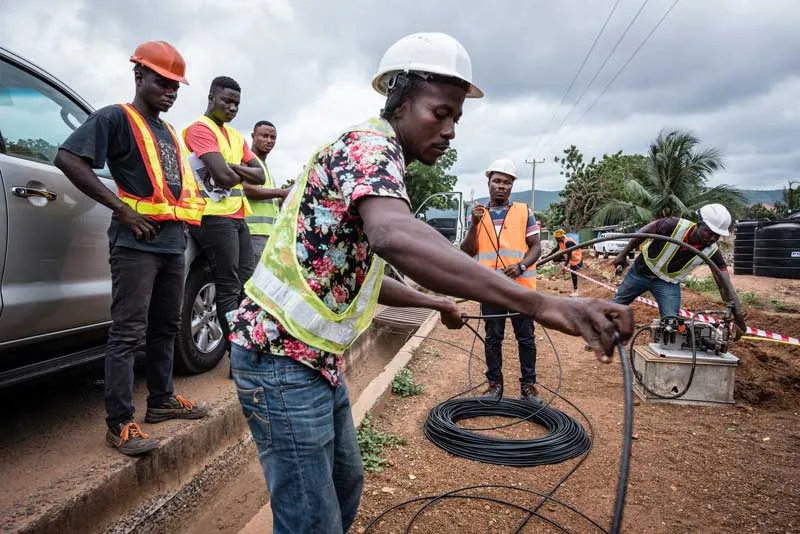
Niger has just finished building the pipes
On 14 November 2025, at the Niger Telecoms offices in Niamey, officials signed off on the provisional acceptance of 1,031 kilometres of fibre-optic cable. It was the closing act of the Trans-Sahara Optical Fibre Backbone project, a €43 million scheme financed by the African Development Fund with a national counterpart contribution, and it gave a landlocked country with no submarine cable landing of its own a physical path to five neighbours’ coastlines. Four months later, on 11 March 2026, the government opened the validation workshop for a National Digital Development Policy covering 2026 to 2035 and an accompanying sector plan through 2030.
Both are real achievements of state capacity in a country that has been under military government since July 2023 and outside ECOWAS since early 2025. Neither, on its own, changes the number that defines Niger’s digital economy: at the end of 2025, according to DataReportal’s Digital 2026 report, 21.6 million people in Niger — 76.8 percent of the population — did not use the internet at all.
The baseline
Niger had 6.52 million internet users in October 2025, an adoption rate of 23.2 percent. The user base grew by 206,000 over the preceding year, or 3.3 percent — which happens to match the 3.3 percent rate at which the population itself grew, from a base of 28.1 million. In other words, Niger’s internet penetration rate was unchanged year-on-year. Connectivity is expanding in absolute terms and standing still in relative terms.
The other headline figures are similarly sobering. There were 17.4 million cellular connections at the end of 2025, equivalent to 61.7 percent of the population, of which GSMA Intelligence classifies 71.7 percent as broadband-capable. Social media user identities stood at 772,000 — 2.7 percent of the population, and just 11.8 percent of the internet user base — with the adult audience 80.1 percent male. The median age is 15.6 and 82.5 percent of the population lives in rural areas. A country this young and this rural does not have a content problem; it has an access, affordability and electricity problem.
Official numbers tell a different story, which is itself informative. ARCEP, the electronic communications and postal regulator, reported internet penetration at around 40 percent and geographic coverage at 32 percent as of March 2025. The gap between the regulator’s subscription-derived figures and the survey-and-platform-derived estimates used by international trackers is a governance issue in its own right: a ten-year policy cannot be monitored against a baseline nobody agrees on.
What the backbone actually buys
The Trans-Sahara project was built in two components: the 1,031-kilometre national and cross-border network, and a Tier III national data centre, with an 88-kilometre urban local loop connecting the main administrative sites to that facility. The five routes are deliberately outward-facing — Arlit–Assamaka to the Algerian border (220 km), Diffa–N’Guigmi to Chad (186 km), Zinder–Magaria to Nigeria (117 km), Niamey–Dosso–Gaya to Benin (300 km) and Niamey–Makalondi to Burkina Faso (118 km).
The logic is straightforward capacity diversification. Nigeria is served by eight submarine cables, Benin by three and Algeria by five, with more expected. A landlocked country buying international transit through a single route is exposed to both the price and the politics of that route; five routes are cheaper and more resilient than one. At the Niamey ceremony, the AfDB’s country head Mamadou Tangara described the network as a step towards "a connected, inclusive and technologically sovereign Africa," while project coordinator Abdoulkarim Soumaila framed the payoff in terms of lower connectivity costs and new services in e-commerce, mobile financial services and e-government. Communications minister Adji Ali Salatou tied it to the government’s Programme for the Refoundation of the Republic and its stated ambition of a very-high-speed national network open to the sub-region.
There is a caveat worth stating plainly. Four of the five routes terminate at borders with states whose diplomatic relations with Niamey have shifted substantially since 2023. Physical redundancy reduces engineering risk; it does not by itself reduce political risk, and the usefulness of the Gaya or Magaria crossings depends on agreements that sit outside the telecoms ministry’s control.
The operators who have to carry the traffic
Backbone capacity is wholesale; households buy retail. Here Niger’s market structure is unusually lopsided. ARCEP data cited in March 2026 put Airtel at 8.09 million mobile subscribers at end-June 2025, Moov Africa at 4.1 million, and the state-owned incumbent Niger Télécoms at 908,692 — a 5.24 percent market share, down from 1.2 million subscribers at end-December 2021. On mobile internet the picture is starker: Niger Télécoms had 236,025 subscribers for a three percent share, against Airtel’s 4.8 million and 58 percent.
The incumbent’s remaining strength is in fixed infrastructure — it held 117,297 of the country’s 117,563 fixed lines in 2024 and 27,311 of 30,080 fixed internet subscriptions — and in the fibre network itself. That matters, because the operator that will inherit the new backbone is the one losing the retail market fastest. When minister Salatou visited the company in March 2026, executives asked for help recovering receivables and advancing planned infrastructure projects; the minister’s response identified poorly targeted investment decisions, financial imbalances and weak staff engagement with company objectives, and made government support conditional on a turnaround plan and revised governance.
The structural fix on the table is old. In August 2023 the authorities proposed merging Niger Télécoms with Zamani Telecom — the former Orange Niger, acquired in 2019 by Nigerien businessman Mohamed Rhissa and Senegalese investor Moctar Thiam — on the reasoning that Zamani’s roughly 800 sites plus Niger Télécoms’ 200 would yield a 1,000-site national operator with a state majority stake, on top of the incumbent’s fibre. Three years on, no progress has been announced, and both companies have continued to lose ground in the interval.
The satellite shortcut
Into that gap came Starlink, licensed for five years after negotiations that began in late 2024 and launched commercially on 13 March 2025, making Niger roughly the twentieth African market for the service. The communications ministry framed the deal around a 200 Mbit/s average speed target and around reaching schools, universities, health facilities, farms and businesses that terrestrial networks do not serve. By 2026, at least one connectivity measurement placed Starlink among the country’s largest internet-access providers by observed share — a remarkable position for a service barely a year old in a market of 28 million people.
That is genuine capability, and it is also a policy problem with two edges. Satellite service priced in dollars serves institutions, businesses and better-off urban households; it does not close a divide defined by rural affordability. And across the Sahel more broadly, unregistered terminals have raised documented concerns about connectivity that operates outside any national regulatory perimeter. A regulator whose licensing framework was designed for towers and spectrum is now supervising a network it cannot physically inspect.
The ten-year plan and the demand side
The National Digital Development Policy 2026–2035 and the Digital Sector Development Plan 2026–2030 are organised around three pillars: governance and security of the digital sector, expansion of digital infrastructure and services, and digital skills and innovation. The stated ambitions include positioning Niger as a regional interconnection hub in West Africa, modernising public administration through e-government, improving rural and administrative-village connectivity, promoting digital financial inclusion, encouraging local digital content and supporting national startups. Official framing acknowledges that about 70 percent of the population lacks internet access and that 3G and 4G coverage is only partial.
The most instructive precedent is the Smart Villages for Rural Growth and Financial Inclusion project, the World Bank operation running with roughly US$100 million from 2020 to 2026, which set out to bring 3G/4G coverage to 2,175 localities, high-speed internet to 300 schools and 340 health centres, and 150 digital centres nationwide, alongside mobile payments expansion. Niger has been the pilot country for the ITU-linked "Building Smart Villages" blueprint, presented internationally as a whole-of-government model for rural digital transformation. That the flagship rural connectivity programme closes in 2026 with national adoption flat is the single most important input the new ten-year policy should be absorbing.
Which points to the real constraint. Niger has now demonstrated it can build: 1,031 kilometres of cross-border fibre, a Tier III data centre, an 88-kilometre administrative loop, a licensed satellite entrant and a validated decade-long strategy. What it has not yet demonstrated is that it can convert capacity into use. The binding constraints on the demand side — device cost, electricity in villages where the grid does not reach, adult literacy, French-language interfaces in a multilingual country, and a gender gap visible in the four-to-one male skew of the online population — are not solved by any amount of cable. They are solved, if at all, by the least glamorous line items in the new plan: skills, local content, and services that give someone with 3,000 CFA francs a month a concrete reason to spend part of it on data.



