Written By | Torch Media Africa
Three launches in under 13 hours, a classified Falcon Heavy mission, and a Starship that finally reached orbit days earlier: inside the wildest week in the private space race
TECH & SCIENCE
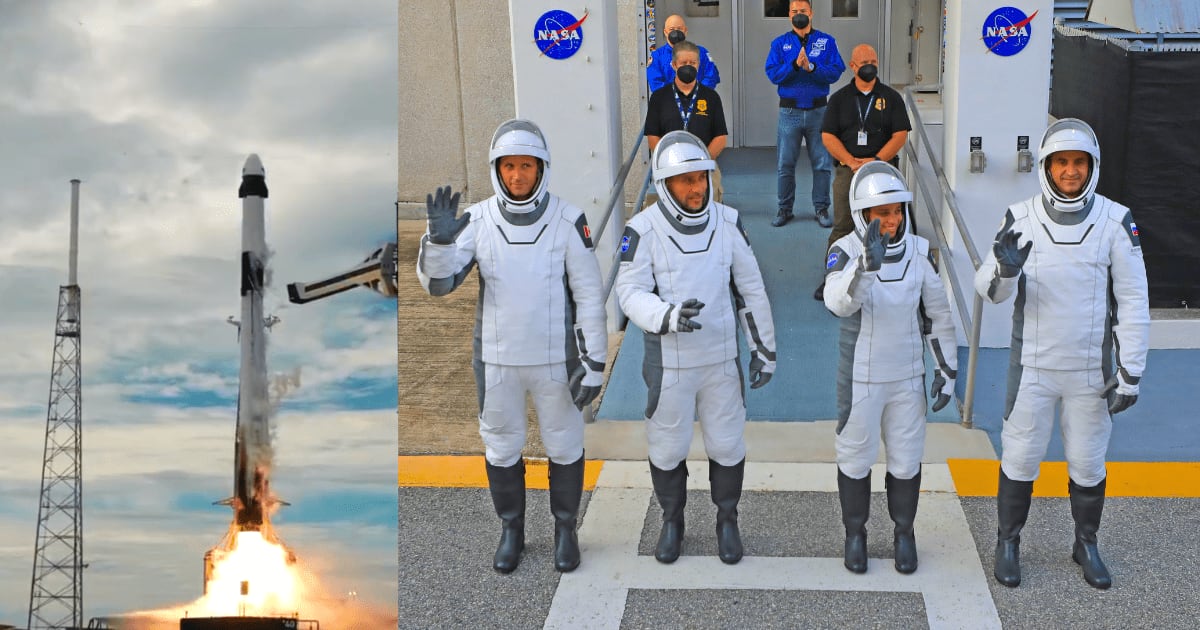
If you had been standing on the Florida coast on the first day of October, you would have needed earplugs, a strong coffee and a very understanding boss. In the space of roughly 13 hours, SpaceX sent four astronauts to the International Space Station, launched 130 satellites from California in a single rocket, and then blasted a classified spy satellite into the night sky from the same pad that carried the Apollo astronauts to the Moon.
It was, by any measure, a tripleheader for the history books. According to Space.com, it was SpaceX's third launch in under 13 hours, beating the company's own previous record of three launches in 12.5 hours, set back in March 2025. And as if that were not enough, Spaceflight Now reports it was the first time SpaceX has ever landed four boosters in a single day.
Oh, and just three days earlier, the same company had finally pushed its giant Starship rocket into orbit for the very first time. Space fans, take a deep breath. This is the story of the week that SpaceX stopped looking like a rocket company and started looking like an airline.
Launch One: Astronauts Blast Off at 11:10 a.m.
The marathon began at 11:10 a.m. Eastern time on Thursday, 1 October, when a Falcon 9 rocket lifted off from Space Launch Complex 40 at Cape Canaveral Space Force Station. On top sat a Crew Dragon capsule carrying NASA's Crew-13 mission: NASA astronauts Jessica Watkins and Luke Delaney, Canadian Space Agency astronaut Joshua Kutryk, and Russian cosmonaut Sergey Teteryatnikov.
Watkins is already something of a record-breaker. Spaceflight Now noted that she is the first NASA astronaut to fly a second time on a Dragon spacecraft. The crew is headed for a roughly six-month stay aboard the orbiting laboratory, where they will join the Expedition 75 crew of NASA's Anil Menon and Russia's Pyotr Dubrov and Anna Kikina.
The trip itself was a speedy one. NASA said the Dragon would take about 7 hours and 50 minutes to reach the station, docking autonomously at the forward port of the Harmony module at about 7 p.m. that evening. The agency billed it as the fastest launch-to-docking by a U.S. spacecraft in the station's history. That is quicker than most people spend commuting to work in a bad week.
Once aboard, there will be a brief handover with the outgoing Crew-12 team — NASA's Jessica Meir and Jack Hathaway, ESA's Sophie Adenot and Roscosmos cosmonaut Andrey Fedyaev — who will then head home to Earth.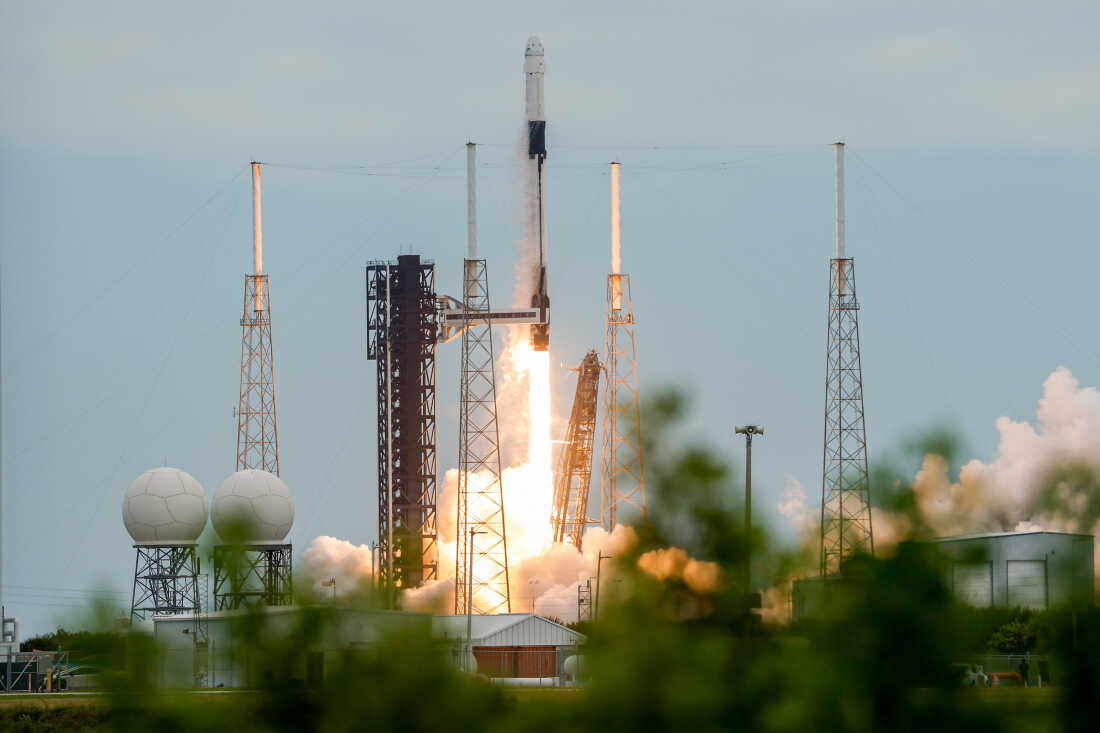
Launch Two: 130 Satellites in One Go
While the Dragon was still climbing toward the station, SpaceX was already prepping its next act on the other side of the country. At 11:32 a.m. Pacific time, a Falcon 9 lifted off from Vandenberg Space Force Base in California carrying the Transporter-18 rideshare mission. Aboard were 130 separate payloads headed for a Sun-synchronous orbit.
Think of Transporter missions as a space bus service. Universities, start-ups and national space agencies each buy a seat, and SpaceX drops them all off in the same orbit. It is cheap, it is frequent, and it has quietly become the way a huge slice of the world's small satellites reach space. Having 130 passengers on a single flight shows just how crowded that bus has become.
Launch Three: The Secret One
Then came the main event after dark. At 11:54 p.m. Eastern, a Falcon Heavy — essentially three Falcon 9 first stages strapped together — thundered off Launch Complex 39A at NASA's Kennedy Space Center, the same historic pad used for Apollo and the Space Shuttle. It was the 14th Falcon Heavy flight since the rocket's debut in February 2018.
The payload was a mystery. The mission, known as NROL-97, was flown for the National Reconnaissance Office, the U.S. agency that runs America's spy-satellite fleet. Details are classified, and SpaceX did not disclose the target orbit. Space.com pointed out that the choice of the mighty Falcon Heavy suggests a heavy payload, a far-off destination, or both.
It was the NRO's first Falcon Heavy mission. According to the tracking site KeepTrack, it followed 22 earlier NRO launches on the smaller Falcon 9, and it was also the first NRO launch bought under the Pentagon's NSSL Phase 3 Lane 2 contract. In plain English: the spy agency has decided its biggest and most sensitive cargo can ride on SpaceX's heaviest rocket.
At the NRO's request, the live webcast ended shortly after the two side boosters returned for landing. No cameras followed the payload into the dark. The mission patch, however, told its own story. It carries the Latin phrase "Orbem mundi mutandum conservare" — which the NRO describes as roughly meaning "to preserve a changing world" — and honors the victims of the 11 September 2001 attacks on the 25th anniversary. The design includes four stars for the four aircraft lost that day and the Moon phase from 11 September 2026.
Four Landings, One Day
The rocket-recycling show was just as impressive as the launches. The two Falcon Heavy side boosters, known as B1104 and B1072, touched down at Cape Canaveral's Landing Zones 1 and 2 just under eight minutes after liftoff, in the dramatic side-by-side landings that never fail to stun a crowd. Earlier in the day, another Falcon 9 booster, B1101, landed after launching the Crew-13 astronauts.
The numbers around the Heavy's boosters are remarkable. KeepTrack reports that B1072 had last flown on 30 August on the mission for NASA's Nancy Grace Roman Space Telescope — a turnaround of just 32 days, the shortest between Falcon Heavy flights so far. The fairing, the nose cone that protects the payload, was also reused, having flown on July's NROL-95 mission.
Not everything came home. The brand-new center core, B1106, was expended in the Atlantic Ocean, a normal sacrifice when a payload needs the extra energy to reach a high-energy orbit. Teslarati also noted that Landing Zone 1 may have seen its final landing, since SpaceX's lease on the site ended in 2025.
Four boosters on the ground in a single day. Not long ago, landing one rocket was front-page news.
The Week Starship Reached Orbit
If that were the whole story, it would already be a cracking yarn. But just three days earlier, on Monday, 28 September, SpaceX did something it had been chasing for years. At 7:48 a.m. Central time, the 14th Starship test flight lifted off from Starbase in Texas and, for the first time, reached orbit. "Starship is orbital," SpaceX announced.
According to SpacePolicyOnline, the huge vehicle deployed 26 operational Starlink V3 satellites — the first operational units of that generation — over about 30 minutes after the payload bay door opened, with contact established with each. Those satellites are a big leap. The report says V3 offers 10 times the downlink and 22 times the uplink capacity of the V2 version. Another report described each satellite as adding around 1 Tbps of capacity to the constellation.
It was not a flawless flight. One of the ship's six second-stage engines cut off early, and the ship lost one of its three vacuum-optimized Raptor engines during ascent. The Super Heavy booster lost one of its 33 engines shortly after liftoff, which did not affect performance. SpaceX chose not to attempt a tower catch of the booster, the first time since the eighth test flight; it made a soft landing in the Gulf instead.
The ship itself splashed down in the north Pacific after 3 hours, 8 minutes and 27 seconds — well short of the planned flight of about 10 hours and six orbits, which was supposed to end in the south Pacific west of Chile. SpaceX had prepared recovery teams for both locations and had not explained the decision at publication. In a twist, the ship did not explode after splashdown as most earlier ones did, which, as with the previous flight, gave engineers valuable heat shield data.
NASA Administrator Jared Isaacman congratulated the team, calling the launch "Gorgeous" and praising the orbit insertion.
What the Experts and Officials Are Saying
Officials were quick to frame the week as a win for the whole U.S. space enterprise. Of the Crew-13 launch, Isaacman said: "Crew-13 is another demonstration of America's unmatched capability in human spaceflight." Dr. Lori Glaze, NASA's associate administrator for the Human Spaceflight Mission Directorate, added: "Each space station mission adds to our blueprint for exploration."
Analysts have pointed to a deeper shift. A New Space Economy analysis asked what NROL-97 reveals about America's heavy-lift launch market, and the answer many are drawing is that the government's most demanding customers increasingly default to SpaceX. Teslarati reports that SpaceX has flown four Space Force missions from Vandenberg since mid-August, several believed to carry Starshield satellites, and that its 2026 Pentagon contract total is past $8 billion. It also noted the Space Coast saw only one launch in all of September as SpaceX shifts East Coast infrastructure toward Starship.
There are real questions ahead, too. SpacePolicyOnline notes that SpaceX's version of Starship for NASA's Artemis moon program needs cryogenic refueling at an Earth-orbit fuel depot that has not yet been built or demonstrated, with a 2024 SpaceX estimate of "10-ish" launches for the job. Artemis II flew four astronauts around the Moon in April 2026, and NASA has reshaped Artemis III into an Earth-orbit test of docking with Starship and Blue Origin's Blue Moon Mk2, planned for next summer.
Science on the Station
Lost in the rocket fireworks is the actual work the Crew-13 astronauts are about to do. NASA says they will produce human stem-cell-derived tissues in microgravity for personalized medicine, disease modelling and drug testing, including research on heart disease and Parkinson's. They will also use a mostly autonomous plant-growth system to test crop production, continue studies of blood-flow abnormalities in microgravity, and trial a new in-flight diagnostic device for monitoring astronaut health.
The mission is part of NASA's Low Earth Orbit Program, which leans on private companies to provide access to space and support research aboard the station. That is the same commercial model that put four boosters back on the ground in one day.
What This Means for You
You might not own a spy satellite, but the ripple effects reach your living room. The 130 satellites on Transporter-18 and the new Starlink V3 spacecraft are the building blocks of everything from weather forecasting and crop monitoring to broadband in places cables never reached. The more often and more cheaply rockets fly, the faster those services improve and the lower their cost.
Starlink's own numbers show the scale. KeepTrack's tally lists 12,988 Starlink satellites launched to date, with 11,156 on orbit and 11,142 working. If the V3 generation delivers on its promised capacity, expect faster, more reliable connections in rural areas, at sea and in the air.
The medical research on the station, meanwhile, may one day mean treatments tailored to your own cells, tested in the weightless lab above your head.
The Bottom Line
Three launches, four landings, a secret payload, a record-breaking day and a historic orbital Starship flight just days earlier: SpaceX has turned what used to be once-a-month national events into something closer to a daily timetable. There are still wrinkles — engines that cut out, a fuel-depot challenge that remains unsolved, and plenty of rivals eager to catch up.
But on 1 October 2026, a company that began by blowing up its first rockets showed it can put people, satellites and secrets into space on the same day and bring most of the hardware back to do it again. Space travel is no longer a spectacle. It is becoming a routine. And the show, as they say, is just getting started.



