Written By | Torch Media Africa
How a state-run digital skills programme became West Africa's largest tech-training pipeline, and why jobs, not classrooms, are now the bottleneck
Technological Transformation
From bootcamp to national system
Discussion of Africa's digital economy usually centres on capital: venture rounds, data centres, submarine cables. In Nigeria, the most ambitious technology policy of the past three years has been about people. The 3 Million Technical Talent programme, known as 3MTT, is run by the Federal Ministry of Communications, Innovation and Digital Economy and the National Information Technology Development Agency (NITDA). It aims to train three million Nigerians in software development, data science, cybersecurity, cloud computing and artificial intelligence by 2027. In 2026 it formally moved out of its pilot phase. Its own planning documents describe the new phase, called 3MTT 2.0, as a national "Talent Operating System" rather than a training scheme.
This change matters because it comes as private edtech in Nigeria and across the continent is shrinking. The open question is whether a government-led talent pipeline can do what venture-funded learning startups could not. That means producing large numbers of job-ready technical workers, and then making sure enough jobs exist, at home or remotely abroad, to employ them.
The numbers so far
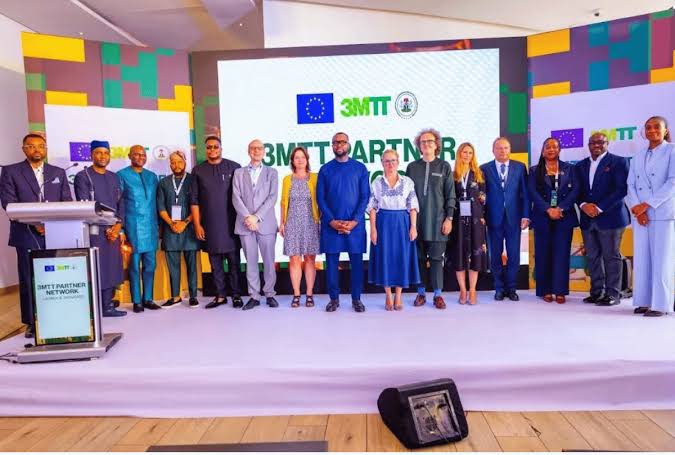
3MTT started in December 2023 with a first cohort of 30,000 fellows across all 36 states and the Federal Capital Territory. The second phase was planned as 270,000 fellows in cohorts of 60,000, 90,000 and 120,000, and the cohort sizes have since been adjusted. Official totals differ. At the Partner Network launch in Lagos on 26 March 2026, officials said three completed cohorts had trained about 135,000 fellows through roughly 200 active learning centres. The programme's partner materials from the same month, and a federal statement in May 2026, put the figure at more than 160,000. Registrations far exceed training places: about 1.87 million Nigerians have signed up.
NITDA Director-General Kashifu Inuwa Abdullahi has said the programme has run more than 60,000 psychometrically validated assessments with a 99.6% completion rate. NITDA has also reported that 67% of the first 30,000-strong cohort found jobs or advanced their careers within six months. That result is promising but self-reported and covers only the first, smallest and probably most selective group. No independent evaluation of later cohorts has been published.
The financing model mixes public and private money. Partner materials list a 2026 federal delivery budget above ₦10 billion. In March 2026 the European Union and Denmark committed an additional €11 million (€5 million from the EU and €6 million from Denmark) to support curriculum, learning infrastructure and partner coordination. Telecoms and infrastructure firms provide much of the physical reach. MTN Nigeria's ₦3 billion commitment covers training, data bundles and devices for more than 90,000 fellows across 197 Applied Learning Clusters. Airtel Nigeria committed ₦1 billion, reaching more than 25,000 beneficiaries, and IHS Towers committed ₦1 billion for physical learning communities. Google.org funded AI and data-science upskilling for 20,000 young people, and Data Science Nigeria runs an advanced "DeepTech Ready" track.
From supply to demand
The most significant change in 3MTT 2.0 is a shift from counting trainees to counting outcomes. The programme now runs a six-tier Partner Network covering training delivery, employers, labour-market intelligence, innovation challenges, funders and media amplification. It also has supporting infrastructure: the Skilladder learning platform, a Talent Registry and the Nigeria Launchpad. Several 2026 initiatives show the new focus:
Minister Bosun Tijani has described the logic in terms of "absorptive capacity": a country's ability to adopt and use digital technology depends on connectivity, governance and human capital together. He has also called for an endowment-style funding structure so the programme can outlast any single administration. That concern is reasonable for a flagship tied to the current government's Renewed Hope agenda.
Why private edtech stepped back
3MTT's growth contrasts with the state of commercial edtech. Aggregator data from au-startups.com count only about US$96–99 million raised by African edtech startups across roughly 50 recent rounds, a small share of the continent's venture total. Nigeria accounts for just nine rounds worth about US$7.4 million. uLesson, Nigeria's best-funded edtech company, has raised about US$25.6 million according to Tracxn, but it is an outlier. Edukoya, which raised a US$3.5 million pre-seed round led by Target Global, shut down in February 2025 and said the market was not ready for its live-learning model.
The basic problem is ability to pay. Nigerian households that can afford premium online tutoring are few, and they were hit hard by the inflation and currency depreciation of 2023–25. The successful private models have kept prices extremely low or relied on philanthropy. ALX, backed by the Mastercard Foundation, reports 347,100 graduates across Africa and charges US$5 a month, and its corporate arm, ALX Enterprise, has trained more than 10,000 professionals. Large-scale workforce training has therefore become something that governments, telcos and foundations fund, not something venture capital profits from. 3MTT is the clearest example of that shift.
The absorption problem
The programme's own materials state the scale of the challenge. About 70% of Nigeria's 240-million-plus population is under 30. Roughly 3.5 million young people enter the labour market every year, and about 92% of employment is informal. Even at full target, 3MTT's three million graduates would equal less than one year of new labour-market entrants. That is significant, but it does not transform the labour market on its own.
Demand is real but limited. Surveys reported by Techpoint Africa found that about 70% of Nigerian startups struggle to hire software developers and 57% struggle to find product managers. That points to a shortage of experienced engineers rather than entry-level graduates. Meanwhile, Nigeria's venture funding fell sharply in 2023–24, and layoffs have hit growth-stage firms across the continent. Employers want seniority, and short training programmes produce juniors. Survey evidence cited in Nigerian tech media also suggests many skilled professionals are considering emigration, which is why the September 2025 National AI Strategy explicitly names brain drain as a structural risk. That strategy targets equipping 70% of Nigerians aged 16–35, half of them women, with AI-related skills.
Global demand is moving as well. ALX Enterprise, citing KPMG's 2025 Africa CEO Outlook, notes that 71% of African CEOs are investing in AI. The World Economic Forum's Future of Jobs Report 2025 identifies skills gaps as the main barrier to business transformation, and Nigerian firms rank talent shortages among their top obstacles. Generative AI is also automating some of the entry-level coding and data work that short courses prepare people for. 3MTT's emphasis on AI tracks, applied projects and remote-work visibility through Hello.CV is a sensible response, but whether it is enough will only show up in placement data.
What to watch
Nigeria has shown that a federal government can build a nationwide technical-training pipeline from scratch in under three years, with telecom networks as its distribution channel and development partners as co-funders. 3MTT has largely solved the problem of supplying trainees. The test now is whether those graduates find enough paid work.



