SCIENCE & TECH
For years, it was the question hanging over every Starship launch: will it actually get to orbit? On 28 September 2026, the answer finally arrived, and it came with a plume of fire, a nail-biting engine failure and a decision made in real time that could define the next decade of spaceflight.
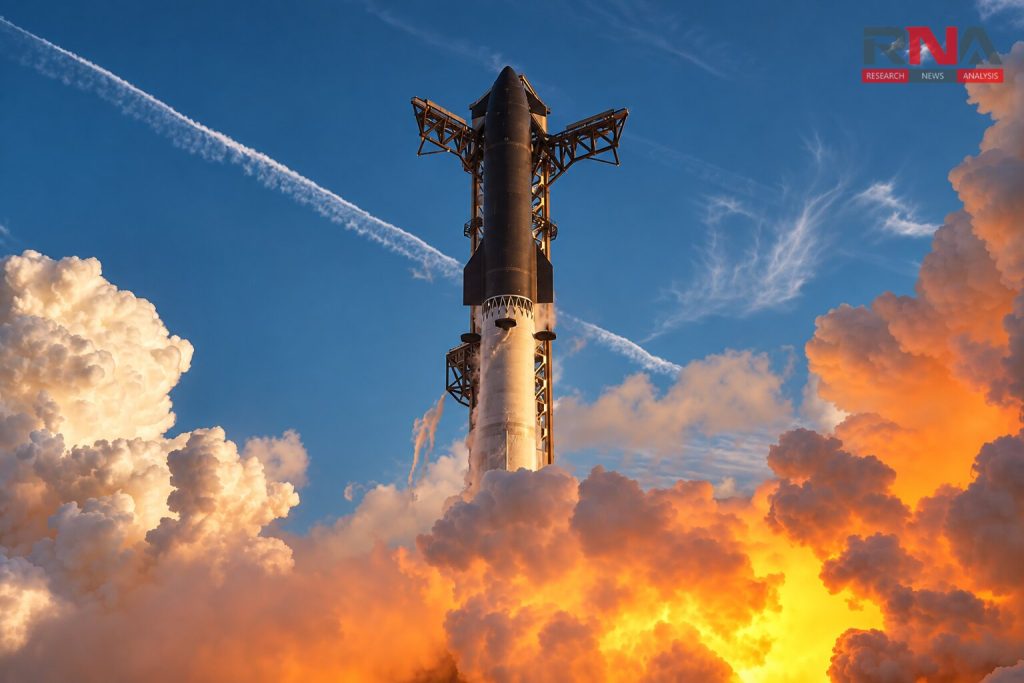
SpaceX's towering Starship, at 407 feet (124 metres) the largest and most powerful rocket ever flown, lifted off from Pad 2 at Starbase, Texas, at 7:48:59 a.m. Central Time. About three hours later, it was back in the ocean. In between, the upper stage, Ship 41, did something no Starship had ever done: it reached orbit and opened its doors to release a full load of 26 next-generation Starlink V3 internet satellites.
It was not a perfect flight. Far from it. But two weeks on, the wreckage of the doubters' arguments is still smoking, and the fallout from Flight 14 is rippling from Wall Street to the White House to the launch pads of Cape Canaveral.
Liftoff: The Morning Everything Changed
SpaceX had given itself a 75-minute launch window opening at 8:15 a.m. Eastern. The stack, Booster 21 topped by Ship 41, had been assembled at Starbase on 23 September, with a wet dress rehearsal following the very next day. SpaceX called the pre-launch work 'opportunistic full stack testing', and then, on launch morning, came the call that every Starship fan waits for: 'Go for propellant load.'
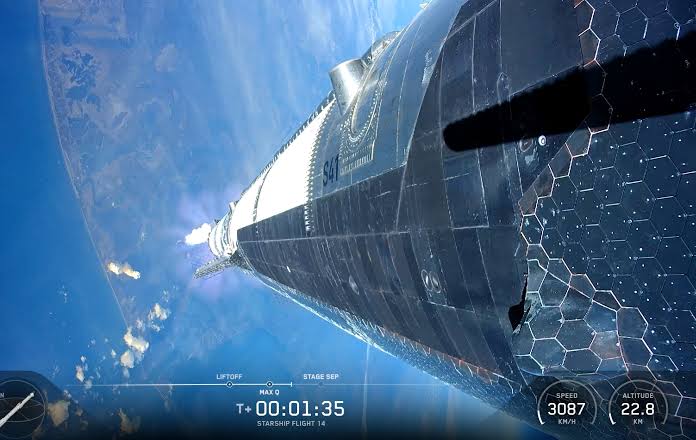
Liftoff came at 8:49 a.m. Eastern. Two minutes and 34 seconds later, the booster and ship separated in the violent manoeuvre known as hot staging, with the ship's engines igniting while the two stages were still connected. The Super Heavy booster flipped around and began its boostback burn, while the ship powered on toward space.
The booster itself had a small scare: one of its 33 Raptor engines shut down shortly after liftoff. According to reporting from SpacePolicyOnline, that did not affect its performance. Super Heavy completed its landing burn and made a soft touchdown in the Gulf of Mexico. There was no dramatic tower catch this time. SpaceX chose not to attempt one, the first time it has skipped the catch since Flight 8.
Drama in the Engine Bay
Then came the moment that made the livestream go quiet. During the ship's initial burn, one of its six Raptor 3 engines shut down early. SpacePolicyOnline also reports that one of the ship's three vacuum-optimised engines was lost during ascent. The ship compensated and finished the burn anyway, but now SpaceX's flight controllers faced a choice.
Option one was to commit to orbit with the engines they had left. Option two was to play it safe and stay on a suborbital path that would have dropped Starship into the Indian Ocean, just as earlier test flights had done. After reviewing the new data, SpaceX went for orbit.
A single Raptor fired the orbital insertion burn, circularising the ship's path at roughly 170 miles (275 kilometres) above the Earth. For the first time in the history of the program, Starship was not on its way back down. It was staying up.
26 Satellites in 30 Minutes
With the ship safely in orbit, the payload door opened and the work began. Within about 30 minutes, all 26 Starlink V3 satellites had been released, and SpaceX confirmed contact with every one of them. Three of the satellites carried cameras, pointed back at the ship to inspect its heat shield, the tiles that must survive the fiery return to Earth.
The images that followed were spectacular: satellites drifting away from the open bay with the curve of the planet beneath them. It was also a first with real consequences. Earlier Starship flights had ejected dummy and test V3 satellites on suborbital paths, and those satellites simply fell back and burned up. These ones are staying in space.
Why the V3 Is a Monster
If the old Starlink satellites were smartphones, the V3 is a fibre-optic backbone with solar panels. Each V3 weighs about 2,000 kilograms (4,400 pounds), roughly double its predecessor. SpaceX says each one supports 1 terabit per second of downlink and 160 gigabits per second of uplink. That is about ten times the downlink and 22 times the uplink of the current V2 satellites.
The numbers get bigger when you multiply them out. Starship can carry around 60 V3 satellites per mission, and SpaceX says that adds up to roughly 20 times the capacity of a Falcon 9 launch carrying V2s. As the company put it: 'we'll be able to deploy ~20x the capacity per Starship launch.' The satellites' antennas support 2,048 downlink and uplink beams.
The catch for Falcon 9: the V3 is simply too big for it. Starship is the only rocket that can launch them.
The Early Exit
The plan was ambitious: roughly ten hours in space across six orbits, ending with a splashdown in the South Pacific, west of Chile. That is not what happened. After evaluating the ship's condition at its first orbital checkpoint, SpaceX decided to bring it home early rather than spend another seven and a half hours circling the planet.
Ship 41 fired a Raptor for the deorbit burn, aimed instead at the North Pacific. It re-entered the atmosphere and splashed down at about 11:58 a.m. Eastern, a flight time of roughly three hours and eight minutes, cutting the mission short by about six hours and 50 minutes. As on most earlier flights, the ship settled upright in the water, toppled over and exploded from leftover fuel, a moment recorded by a buoy.
As of this writing, SpaceX has not publicly explained exactly why it called the flight early. The company is expected to detail its reasoning in due course. The missing engines are the obvious suspect, but that is speculation until SpaceX says otherwise.
The Falcon 9 Era Is Fading
Flight 14 landed in the middle of a quiet revolution in SpaceX's own fleet. The company's workhorse Falcon 9 flew 165 times in 2025, a company record. This week, NASASpaceflight counted the 111th Falcon 9 mission of 2026 on the manifest for the Space Development Agency's Tranche 1 Transport Layer A, with the 112th, a Starlink batch of 27 V2 Mini satellites from Vandenberg, lined up for 10 October.
But NASASpaceflight also reports that SpaceX is winding down Falcon 9 operations, with Starship starting operational Starlink V3 deployments on Flight 14 and no further Falcon 9 Starlink missions planned from Florida. The rocket that made SpaceX a giant is quietly being handed its retirement papers.
The Moon Is Watching
Starship is not just an internet-delivery truck. It is also the spacecraft NASA has bet on to put astronauts back on the lunar surface. SpaceX holds the contract for a Starship Human Landing System that would ferry crews between lunar orbit and the Moon. That version needs a feat nobody has pulled off yet: transferring super-cold propellant between ships in Earth orbit.
The timeline is tight. NASA's stated aim is to land astronauts before President Trump leaves office in January 2029, and before Chinese taikonauts get there. Artemis II, the four-person crewed lunar flyby, was completed in April 2026. NASA Administrator Jared Isaacman has since reworked Artemis III from a landing into an Earth-orbit test, planned for summer 2027, in which Orion practises rendezvous and docking with both Starship and Blue Origin's Blue Moon Mk2 lander. That test does not require refuelling.
Isaacman congratulated SpaceX after Flight 14 and said NASA wants Starship missions to become routine. SpaceX still has to build an orbital propellant depot and demonstrate in-space refuelling. The number of launches needed is unofficial; back in January 2024, SpaceX's Jessica Jensen called it a 'rough guess' of '10-ish'.
Musk's Giant Numbers
Elon Musk, as ever, is thinking far bigger. According to the figures reported around the flight, he has said the Starlink V3 constellation will eventually reach about 100,000 satellites, a number that would take nearly 1,700 Starship launches. He has also said SpaceX aims for 10,000 Starship launches per year by 2030, and the company has talked about a million orbital 'Starmind' AI data centres, all carried up by Starship.
Treat those as ambitions, not forecasts. Starship has just flown its first orbital mission, and it did so with engines missing. Going from one orbital flight to thousands per year is a leap of several orders of magnitude, and Starship timelines have a long record of shifting.
The Experts' Verdict: Real Milestone, Open Questions
The reaction from the space-policy community was celebratory but careful. SpacePolicyOnline's headline simply read 'Starship Achieves Orbit for the First Time', but its report noted in the same breath that the flight did not go fully as planned. The engine shutdowns, the early return and the skipped booster catch are all open items on SpaceX's to-do list.
There are two ways to read the flight. The optimistic view: SpaceX decided in real time to commit to orbit with a damaged ship, deployed every satellite and got the vehicle back down on a planned recovery zone, which suggests robust design margins. The cautious view: Starship still has engine reliability issues, no one has yet demonstrated that the heat shield can survive a full orbital re-entry on a long mission, and the cut-short flight means some planned test objectives were never attempted.
One precedent to remember is Flight 13, the only previous flight whose ship survived splashdown intact. The heat-shield data from it was reported as especially valuable, and SpaceX had to carry out a complex recovery operation. Flight 14's three camera-equipped satellites should give engineers another close-up look at the tiles.
What This Means for You
If you use Starlink, or are thinking about it, this is the flight that makes faster, higher-capacity service credible. More capacity per satellite means more bandwidth in remote areas, planes and ships, and potentially more competition for telecom operators. SpaceX says V3 will not be launched by anything but Starship, so the pace of upgrades now depends on the rocket.
If you follow the Moon race, this is the first real evidence that the Starship lander plan is not fantasy. It is still a long way from a crewed landing, but reaching orbit is a prerequisite for everything else.
And if you just like watching big things fly, expect Starship launches to become more frequent, and more consequential, in the coming months.
The Bottom Line
Flight 14 will not go down as a flawless mission. A missing engine, a mission cut short by more than six hours and a booster that was left to splash into the Gulf are all reminders that Starship is still a test vehicle. But it reached orbit. It deployed 26 satellites. It came home on its own terms.
For a rocket that has exploded, tumbled and been criticised on its way here, that is a big deal. The next questions are simple and enormous: can SpaceX do it again, can it do it reliably, and can it learn to refuel in orbit before the clock runs out on the Moon deadline? The countdown to the answers has already begun.
Published By | Tech Wiz