Written By | Torch Media Africa
After 13 Test Flights, Explosions and Years of Delays, SpaceX's Giant Rocket Reaches Orbit for the First Time — and Beams Down a Record-Shattering Wave of Next-Gen Internet Satellites
SPACE ND TECHNOLOGY
The biggest rocket ever built just did something it had never done before: it went all the way around the planet.
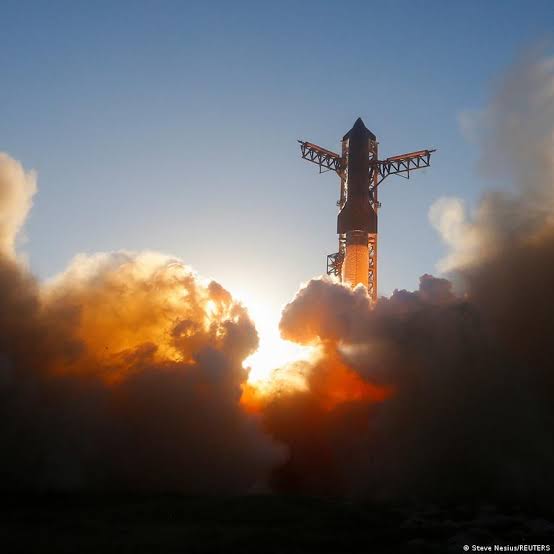
At 8:15 a.m. EDT on Monday morning, SpaceX's Starship — a 400-foot stack of stainless steel taller than the Statue of Liberty — thundered off the launch pad at Starbase, South Texas, and, for the first time in the program's turbulent seven-year history, made it to full orbit. Nearly ten hours later, after circling Earth roughly six times, the upper-stage "Ship" splashed down in the Pacific Ocean off the coast of Chile, closing out a mission that SpaceX employees at company headquarters greeted with the kind of screaming, arm-waving elation usually reserved for Super Bowl wins.
It is, by any measure, the milestone SpaceX has been chasing since Starship's very first hop test back in 2019. Thirteen flight tests. Multiple fireballs. Years of "rapid unscheduled disassembly," the company's now-famous euphemism for rockets blowing up. And on Monday, all of it led to nine hours and fifty minutes of near-flawless flight — plus a payload delivery that quietly may be just as big a deal as the orbit itself.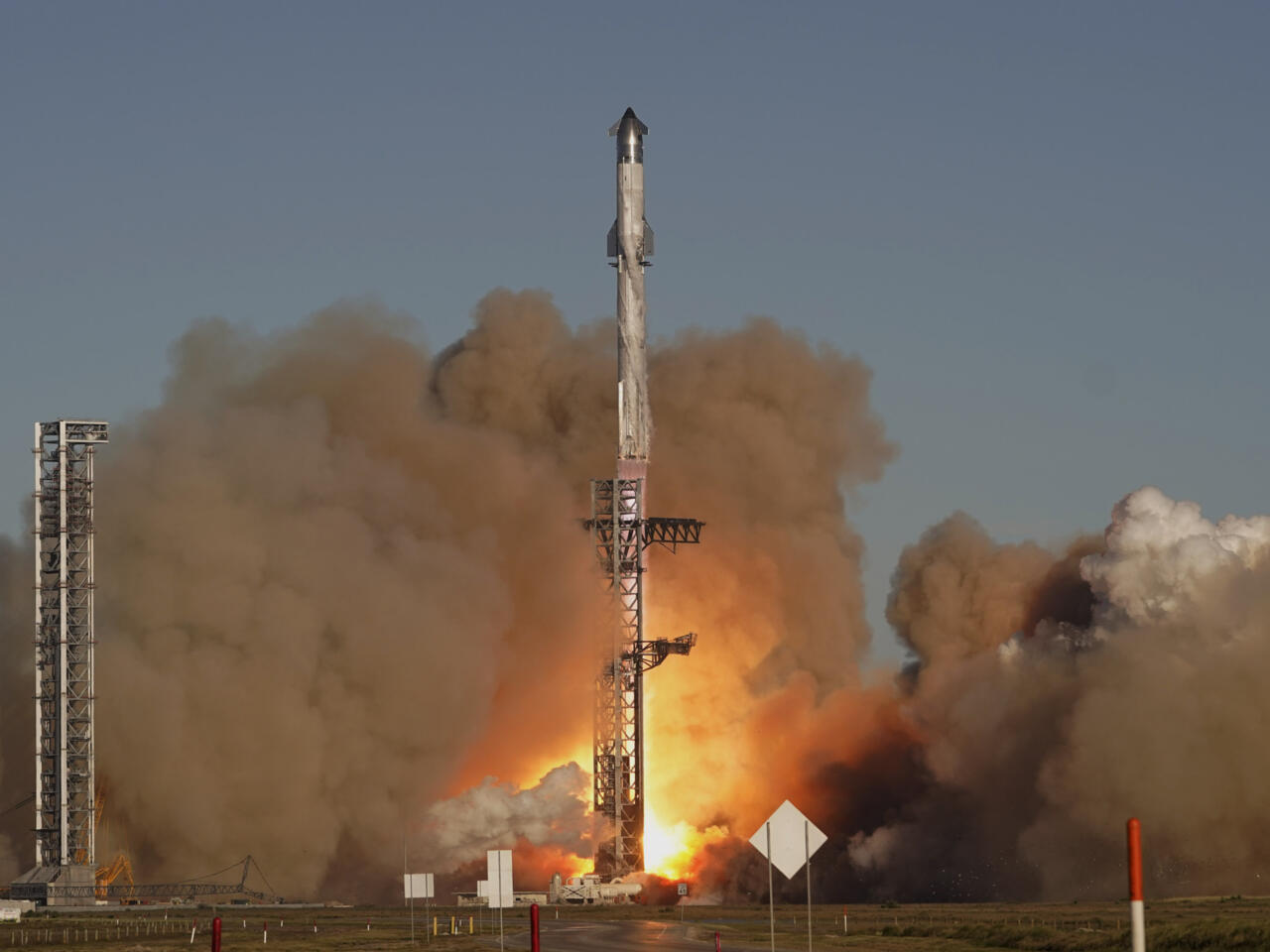
THE LAUNCH THAT CHANGED EVERYTHING
Flight 14 lifted off from Starbase's Pad 2 inside a launch window that ran from 8:15 to 9:30 a.m. EDT, with backup opportunities held in reserve for September 29 and 30 in case Monday's attempt slipped. It didn't need them.
Two minutes and twenty-two seconds into the flight, the Super Heavy booster — the massive first stage packing 33 Raptor engines — separated cleanly from the Ship on top of it. Just under five minutes later, at T+7:01, the booster completed a controlled splashdown in the Gulf of Mexico, a maneuver SpaceX has now practiced enough times that it barely raised eyebrows in mission control.
The real drama came next. Unlike every previous Starship test, which flew a suborbital "boost and coast" trajectory designed so the vehicle would safely reenter the atmosphere no matter what went wrong, Flight 14 was built to go all the way to orbit. Around the 25-minute mark, Ship's engines relit for an orbital insertion burn, pushing the vehicle up to roughly 171 miles (275 kilometers) in altitude — comfortably above the International Space Station's orbit.
"By going to orbit, the next phase of developing Starship to be fully and rapidly reusable can begin," SpaceX said in mission materials released ahead of the launch, a line that undersells just how significant Monday's flight really is. Every previous test, however successful, was still technically a very elaborate skydive. This one was spaceflight.
FROM FIREBALLS TO ORBIT: A ROCKY ROAD
It's worth pausing to appreciate how far Starship has come to get here. The program's early flights were defined almost as much by their explosions as by their successes. Flight 1, back in April 2023, tumbled out of control and had to be destroyed by its own flight termination system less than four minutes after liftoff. Flight 2 made it further before an engine fire triggered another self-destruct. It took until the middle of the program's test campaign for SpaceX to nail the now-iconic "chopstick" catch of the Super Heavy booster back at the launch tower, and even after that milestone, Ship itself continued to suffer setbacks — engine failures, fuel leaks, and at least one dramatic breakup that scattered debris over the Caribbean and briefly disrupted commercial air traffic.
Each failure, in classic SpaceX fashion, was folded into the next design iteration at a pace that traditional aerospace contractors have never been able to match. By Flight 14, the vehicle flying was a substantially upgraded "Block 3" version of Starship, with reworked heat shielding, more robust engine bay insulation, and the structural changes needed to carry Monday's real headline-grabber: a payload bay stuffed with satellites.
26 SATELLITES, 26 TERABITS: THE STARLINK V3 PAYLOAD
Buried in the excitement over orbit was a second, arguably more consequential achievement: Starship's first delivery of SpaceX's next-generation Starlink V3 satellites.
Roughly 34 minutes into the flight, Ship's payload bay doors opened and began releasing 26 Starlink V3 satellites in a sequence that continued for about half an hour. Each V3 satellite is a monster by satellite-internet standards, adding an estimated 1 terabit per second of network capacity — meaning this single deployment alone added roughly 26 Tbps of new capacity to SpaceX's broadband constellation. For comparison, that's on the order of ten times the capacity SpaceX typically launches on a full Falcon 9 mission carrying older V2 Mini satellites.
The V3 satellites have been the missing piece of SpaceX's Starlink strategy for more than a year. They're too large and too heavy to fly on Falcon 9 at all — Starship's cavernous payload bay and heavy-lift capability are the only way to get them into orbit. That's part of why Monday's mission mattered so much to SpaceX beyond the symbolism of "reaching orbit": it was the first real proof that Starship can do the job it was actually built for — hauling enormous amounts of mass into space, again and again, cheaply.
Industry analysts have pointed out that Starlink's direct-to-cell ambitions, its push into rural broadband markets, and its plans to compete with fiber-level home internet speeds in underserved regions all hinge on getting V3 satellites into orbit at scale. Monday's launch was step one of what SpaceX hopes will become a rapid cadence of similar missions.
THE NINE-HOUR NAIL-BITER
For everyone watching, Monday's mission was less a single dramatic moment and more a slow-burn thriller stretched across almost ten hours. After satellite deployment wrapped up around the one-hour mark, Ship spent the bulk of the flight simply coasting — circling the globe roughly six times while SpaceX engineers monitored thermal performance, propellant levels, and the health of the vehicle's flight computers.
The tension ratcheted back up near the very end of the mission, as Ship began its reentry sequence, plunging back through the atmosphere at hypersonic speed before a landing burn intended to bring it down gently in the Pacific off the coast of Chile. SpaceX has never fully stuck an ocean splashdown of Ship without at least some damage on previous flights, so the final minutes of Flight 14 — culminating around the nine-hour-fifty-minute mark — were, by SpaceX's own admission, the part of the mission engineers were most nervous about.
When telemetry confirmed splashdown, the celebration inside SpaceX's mission control was immediate and unrestrained. It capped what will likely be remembered as the defining moment of the Starship program's development phase — the flight where "test rocket" started to become "operational vehicle."
WHY THIS MATTERS FOR NASA'S MOON PLANS
Beyond the commercial satellite business, Monday's success carries enormous weight for NASA. A modified version of Starship, known as the Human Landing System (HLS), is the vehicle NASA has contracted to carry astronauts down to the lunar surface under the Artemis program — the U.S. effort to return humans to the Moon for the first time since Apollo.
That plan has faced persistent skepticism, in large part because the HLS architecture requires an unprecedented number of orbital refueling launches — Starship tankers filling up a depot in orbit before a lunar-bound Starship can top off its tanks and head to the Moon. Skeptics inside and outside NASA have questioned whether SpaceX could reliably execute that kind of complex, repeated orbital operation on the timeline the agency needs.
Monday's flight doesn't answer every one of those questions, but it answers the most basic one: can Starship reliably reach orbit at all? Until Flight 14, the answer was still technically no. Now it's yes — and every subsequent milestone toward Artemis, from propellant transfer demonstrations to an uncrewed lunar landing test, depends on that foundation being solid.
EXPERT PERSPECTIVE
Aerospace analysts who have tracked the program's bumpy history described Monday's flight as a genuine inflection point rather than just another test. The core argument: reaching orbit changes the entire risk calculus for everything that comes next. Suborbital test flights can tolerate almost any failure, because the vehicle was never going to survive reentry intact anyway. Orbital missions carrying real, revenue-generating payloads cannot. By successfully threading that needle on its first attempt — both reaching orbit and successfully deploying a full load of commercial satellites — SpaceX demonstrated a level of vehicle maturity that outside observers had openly doubted was close.
That maturity matters commercially as much as it does for NASA. SpaceX has taken deposits and signed contracts for future heavy-lift missions that assume Starship works as advertised; Monday's flight is the first hard evidence that those bets weren't premature.
WHAT THIS MEANS FOR YOU
If you're a Starlink customer — or thinking about becoming one — Monday's launch is the moment the service's next big leap in speed and capacity started arriving in orbit. The V3 satellites are central to SpaceX's plans to offer faster home internet in areas where cable and fiber don't reach, and to expand "direct to cell" service that lets ordinary smartphones connect to satellites for texting and eventually voice and data, even in dead zones with no cell towers nearby.
For anyone following the Artemis Moon program, Monday's success is the first genuinely reassuring sign in a while that NASA's timeline — however delayed it has already become — rests on a rocket that actually works. And for the broader space industry, a successful Starship orbital flight is a signal that the era of ultra-heavy-lift, rapidly reusable rockets is arriving faster than skeptics predicted, with implications for satellite pricing, space tourism, and deep-space exploration that will play out over the next decade.
CONCLUSION
Seven years, thirteen test flights and more than a few spectacular explosions after the program began, Starship finally did the one thing it was always designed to do: fly like a real orbital rocket, deliver a real payload, and come home. SpaceX still has plenty to prove — repeat flights, faster turnaround, in-orbit refueling, and eventually landing humans on the Moon and, if Elon Musk's decades-old dream holds, on Mars. But Monday, for the first time, none of that felt like science fiction. It felt like the next flight on the schedule.



