Written By | Torch Media Africa
Despite an engine dying on the way up, the world's biggest rocket made history on its 14th flight, and your home broadband could be next in line
TECH & SCIENCE
It took fourteen flights, a mountain of exploded hardware and more than a few shattered launch-day dreams. But on the morning of 28 September 2026, the biggest rocket ever built finally did the thing it was designed to do: it reached orbit, opened its payload bay and kicked 26 brand-new Starlink V3 satellites out into space.
And it did it while limping. Moments after the 124-metre-tall Starship stack blasted off from SpaceX's Starbase site in south Texas, one of the six engines on its upper stage shut down during the climb. For a few tense minutes, the whole mission hung in the balance. Then the flight team made the call to carry on, and Starship made history anyway.
"All 26 Starlink V3 operational satellites deployed and operating nominally," Elon Musk confirmed afterwards. Seven words that, for the first time, turn Starship from a giant science experiment into a working delivery truck for the internet.
A Wobbly Climb And A Nail-Biting Decision
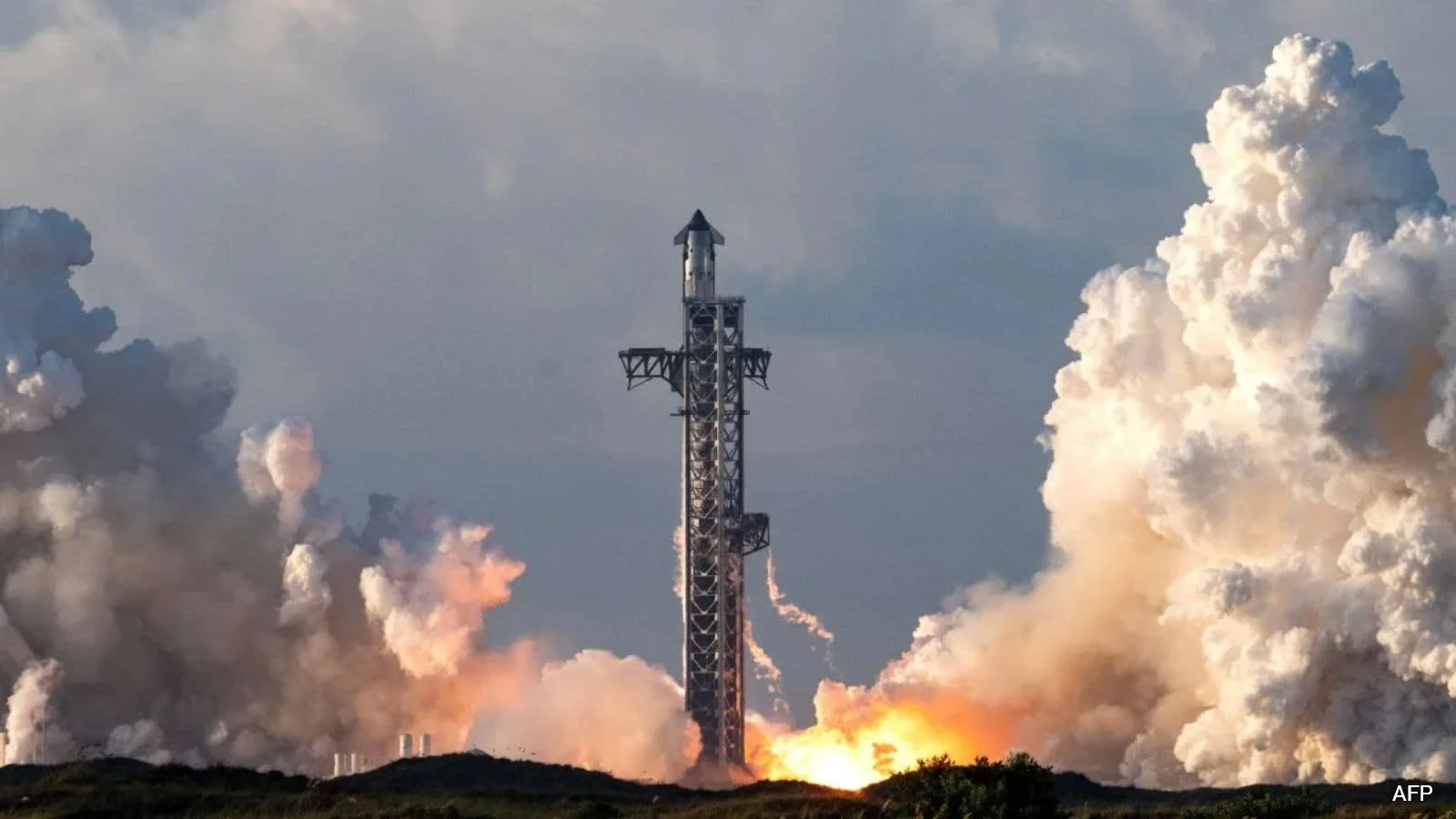
Liftoff came on the morning of 28 September from Starbase, with the combined Super Heavy booster, B21, and Starship upper stage, S41, rising on a pillar of fire. The launch window had been set for a 75-minute slot opening at 7:15 a.m. CDT, and the vehicle lifted off that morning for what was the 14th integrated flight of the Starship programme.
The booster did its job and, as planned, neither stage was recovered on this flight. The drama came higher up. One of the upper stage's six Raptor engines shut down during ascent, leaving the vehicle on an initially suborbital path. Reporting on the flight says the engine loss initially put the whole orbital attempt in doubt, and that SpaceX reconsidered before proceeding with the orbital burn roughly 22 minutes into the flight.
That decision is the kind of thing that separates a bad day from a historic one. A cautious team might have scrubbed the orbital insertion and let the ship fall back to the Pacific, banking data and calling it a partial win. Instead, with five healthy engines doing the work of six, SpaceX pressed on and Starship reached a peak altitude of roughly 275 kilometres, about 170 miles above the Earth.
Twenty-Six Satellites, One Very Busy Half Hour
Once in space, the ship got down to business. According to SpaceX's flight plan, the 26 V3 satellites were to be released at roughly one-minute intervals over around 30 minutes, a conveyor belt of hardware sliding out of the vehicle one after another. Every one of them made contact with ground teams, and SpaceX says they are expected to be operational within weeks.
Three of the 26 were no ordinary passengers. They carry extra cameras designed to film Starship's own heat shield, giving engineers a rare close-up look at the thousands of tiles that protect the ship when it screams back into the atmosphere. Heat shield durability is arguably the single biggest unsolved problem standing between Starship and rapid, airline-style reuse, so those pictures are worth their weight in gold.
The deployment was also a clean first. It marks the first time Starship has delivered a genuine operational payload, as opposed to dummy satellites or empty test mass. As one summary put it, it validates the Block 3 configuration for the V3 constellation build-out.
Why V3 Is A Very Big Deal
If you have never thought about satellite specifications before, here is the headline: V3 is a monster. Each satellite delivers around 1 terabit per second of downlink capacity and about 160 gigabits per second of uplink capacity. Compared with the previous V2 generation, that is roughly ten times more downlink and 22 times more uplink, according to Light Reading's reporting.
The antennas are a leap too. V3 supports 2,048 beams in each direction, against 192 downlink and 144 uplink beams on V2. In plain English, each satellite can talk to far more users at once, with far less squabbling over bandwidth.
The satellites are also physically enormous. They weigh in at around two tons each and unfold to about the size of a Boeing 737, according to Notebookcheck. Nothing of that size and mass could be launched economically on a Falcon 9, which is exactly why Starship exists. This single launch alone is estimated to boost Starlink's total network capacity by around 3 per cent, and the fully built-out V3 constellation is expected to deliver more than 100 times the network bandwidth available today.
The Money Behind The Moonshot
Starlink is already SpaceX's cash machine, and the competition is watching nervously. Gartner research cited by TelecomTV projects global spending on low-Earth-orbit satellite communications services will hit $14.8 billion in 2026. Rivals are racing to get their own constellations up, but launch slots are tight.
Telesat's chief operating officer acknowledged the sector is "very competitive at the moment" when it comes to securing rides to orbit, although Telesat locked in its SpaceX reservations years ago. That tells you everything about SpaceX's position: it is both the leading satellite operator and the leading launch provider, and a rocket the size of Starship only tightens that grip.
For customers, the first benefits are expected to arrive soon. Notebookcheck reports that business subscribers with Performance Gen 3 dishes could get access to the new satellites within weeks.
Cut Short, But Not A Failure
The original plan was an ambitious one: roughly six laps around the Earth, with a deorbit burn of just 11 seconds scheduled nearly nine hours after liftoff, followed by a splashdown off the western coast of South America. That was not what happened.
Because of the engine problem, SpaceX chose to limit the time spent in orbit. Light Reading, quoting SpaceX's mission summary, says the team "decided to limit the duration spent on orbit", and reports about three hours up there before the ship came home. Other outlets described a shorter flight of around two hours, and accounts differ on the exact orbit count and splashdown spot, with reports pointing to the northern Pacific. What is not in dispute is the outcome: the ship deorbited under control, came down in the Pacific and the payload was safely delivered.
Splashdown was followed by a fireball, which looked alarming on the livestream but is not a worry. As analysts at MoffettNathanson noted, "explosions after booster and upper stage splashdowns are not indications of a problem, given Starship is not designed for landing in cold water."
SpaceX also did not attempt to catch the upper stage with its giant launch-tower arms on this flight. That trick, already performed with boosters, is being saved for a future test, and it is central to the company's dream of reusing Starship within hours.
Expert Perspective: The Engine Question
The big technical question hanging over the flight is the engine that quit. Starship's upper stage relies on six Raptor engines, and the vehicle's ability to shrug off the loss of one is a reassuring sign of robustness. But it is also a red flag. Every orbital mission with a paying customer, and eventually people on board, will need to demonstrate that engine reliability is very high.
Analysts tracking the flight have framed the mission as a thermal stress test first and a satellite delivery second, which is why the early deorbit decision, which prioritised data and vehicle integrity over extending the profile, is being read as a sensible one rather than a retreat. The more important number, they will say, is not the engines that failed but the 26 satellites that worked.
It is worth noting that SpaceX has not yet published a full root-cause analysis for the engine shutdown, so any claims about what went wrong remain speculation. Expect that answer to shape how quickly the next flight can go.
What This Means For You
For most people, Starship will not change your life this week. But over the next couple of years it could change your internet. More capacity per satellite means more room for faster speeds, fewer congested cells and better service in the remote places where cables and masts do not reach, from farms and fishing boats to disaster zones.
It also means more pressure on traditional telecoms companies. If Starlink can add hundreds of gigabits of capacity with every launch, mobile carriers and broadband providers will face a competitor that does not need to dig up a single road.
There is a flip side. Ever-larger constellations raise fresh questions about crowded orbits, astronomers' dark skies and the dominance of one company over critical communications infrastructure. As the V3 fleet grows, regulators and rivals will be asking tougher questions about who controls the sky.
What Happens Next
SpaceX's next goals are clear: prove it can do this reliably, keep the engine problem from repeating, and attempt that tower catch of an upper stage in orbit-capable form. Do those, and the company moves from experimental flights to an operational schedule, where Starships roll off the pad as routinely as Falcon 9s do today.
Beyond Starlink, the same rocket is meant to carry NASA's lunar lander, huge cargo loads and one day crews bound for Mars. A ship that can lose an engine, reach orbit and still deliver every satellite is a ship that can credibly start to dream about those missions.
The Bottom Line
Starship's orbital debut was not pretty. An engine died, the mission was cut short, and there are still questions that need answers. But the headline stands: after thirteen suborbital tests, the world's largest rocket has reached orbit and delivered the goods, 26 satellites that are 10 times as powerful as the ones they will replace. The race to blanket the planet in high-speed internet just went up a gear, and the rest of the industry has a lot of catching up to do.



