Technology Transformation
A Mobile-Money Economy Without Modern Banking
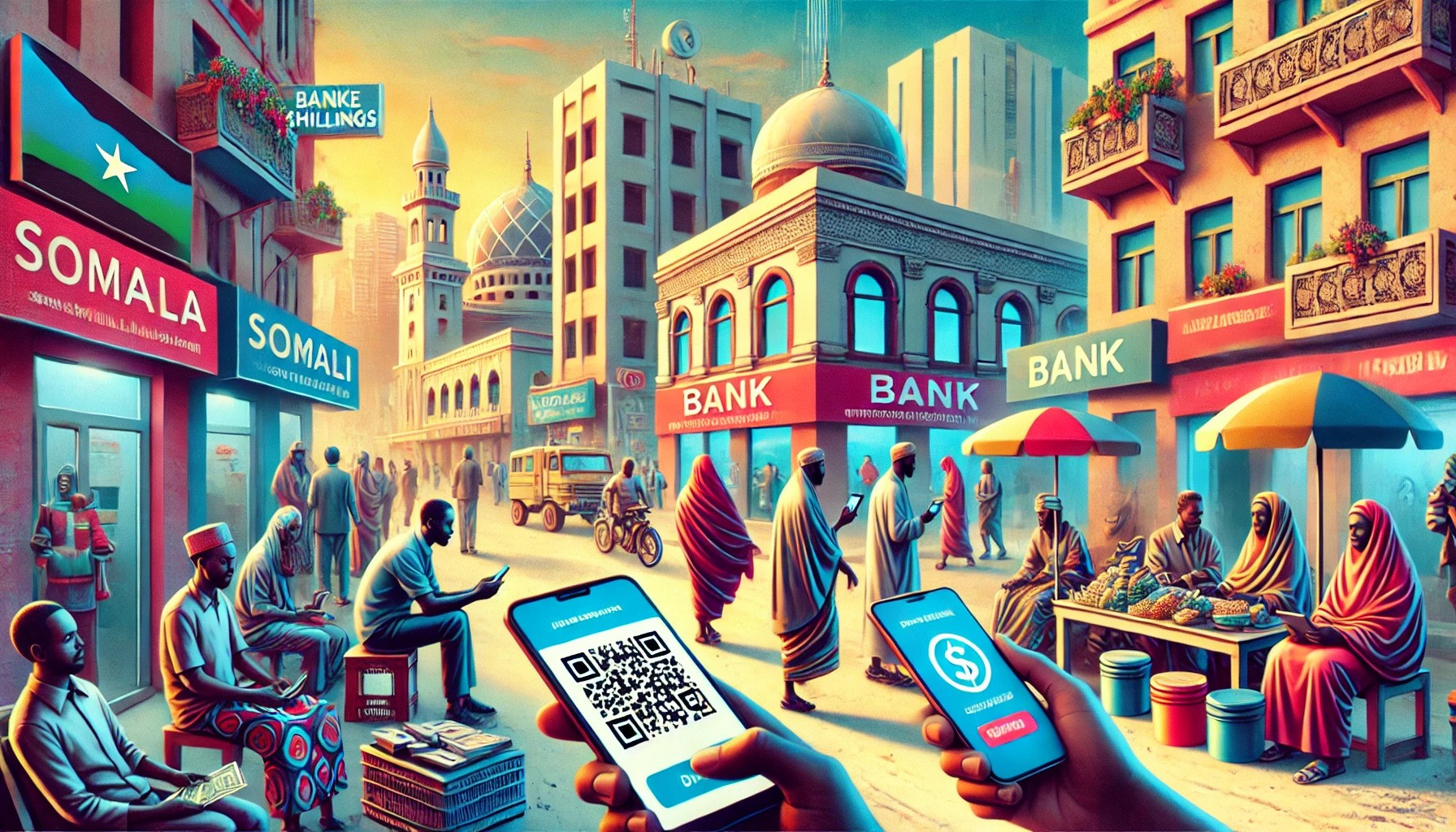
Somalia presents one of the more unusual case studies in global fintech: a country where mobile money became the default financial system not despite the absence of formal banking infrastructure, but largely because of it. More than 80% of Somali adults use mobile money as their primary financial tool, according to research compiled by the Central Bank of Somalia and cited across recent fintech coverage — one of the highest adoption rates recorded anywhere in the world. Hormuud Telecom's EVC Plus platform, the dominant service, is used by over 4.5 million Somalis for everyday transactions and by more than 145 humanitarian organisations to distribute cash aid across a country where conflict and displacement have repeatedly disrupted physical banking access.
In August 2025, Hormuud secured re-certification under the GSMA Mobile Money Certification programme, placing EVC Plus among just ten mobile money services worldwide to meet the GSMA's standards for consumer protection, safeguarding of funds, and anti-fraud controls — a notable credential for a service that grew up largely outside formal financial regulation. The platform's dominance was reinforced through 2026 by new integrations: Hormuud announced partnerships with MyBank and Agro Bank enabling direct interoperability between EVC Plus wallets and formal bank accounts, part of a broader push to stitch mobile money into a more conventional financial system rather than leaving it as a parallel one.
Closing the Device Gap
One of the more concrete constraints on deepening digital inclusion in Somalia has been device affordability, not network coverage. In May 2026, Hormuud and device-financing partner Get-Phone launched what is being described as Somalia's largest smartphone financing program, using EVC Plus itself as the repayment rail. The rollout's first phase targeted distribution of 10,000 devices by June 2026, with a stated goal of reaching 100,000 devices by the end of the year as the program expands beyond south-central Somalia into Puntland and Somaliland. The logic is straightforward: Somalia's mobile network already reaches most of the population, but a meaningful share of that population is still transacting over basic-feature phones with limited access to the fuller range of banking, e-commerce and government services now being built for smartphones.
That device gap shows up starkly in the connectivity data. DataReportal's Digital 2026 Somalia report recorded 11.5 million active cellular mobile connections at the end of 2025, equivalent to 58.1% of the population — but only 5.47 million internet users, an online penetration rate of 27.6%, with more recent tracking putting mobile internet penetration closer to 38.5% as smartphone adoption accelerates. The gap between mobile connections and actual internet use is the clearest single metric of how much of Somalia's digital economy still runs over voice and SMS rather than data.

Wiring the Country to the Rest of the World
Somalia's international bandwidth position is being transformed by its connection to the 2Africa submarine cable system, the Meta-backed project that, following the completion of its core infrastructure in November 2025, now links 33 countries across Africa, Europe and Asia and reaches more than three billion people via a 45,000-kilometre cable — longer than the Earth's circumference. Somalia's landing includes one dedicated fibre pair carrying four wavelengths of 400 to 600 gigabits per second each on the system's main trunk, a substantial capacity upgrade for a country that has historically relied on a thin and fragile set of international links. The system's Pearls extension, scheduled to go live later in 2026, adds further redundancy.
Somalia is emerging as a genuine connectivity hub along the East African coast rather than a mere endpoint: at least five major international submarine cable systems — EASSy, DARE1, PEACE, G2A and 2Africa — are either already landing in the country or under active development, a sharp change from the single-cable dependency that left Somali connectivity acutely vulnerable to outages for most of the past decade. Regulators have moved to formalise this shift, approving new submarine cable regulations intended to give investors and operators a clearer legal framework for landing and operating subsea infrastructure. The build-out is reinforced from the landward side by projects such as the World Bank-financed $750 million, 740-kilometre Isiolo–Mandera fibre corridor in neighbouring Kenya, designed explicitly to extend terrestrial fibre connectivity toward Ethiopia and Somalia, and by the European Union's Global Gateway-backed Somalia Connectivity Expansion programme, which is funding complementary digital infrastructure investment inside the country.
Regulating a System Built Before the Regulator Existed
For most of Somalia's mobile money boom, the financial infrastructure ran ahead of the state's capacity to regulate it — a legacy of the platforms emerging during the state-collapse years, when telecom operators effectively built parallel payment systems in the absence of a functioning central bank. The Central Bank of Somalia issued its first formal mobile money licence, to Hormuud, only in 2021, beginning a still-ongoing process of bringing an already-mature market under prudential supervision. Hormuud's EVC Plus now competes and interconnects with several rival platforms built on the same model: Golis' SAHAL, Somtel's E-DAHAB and Telesom's ZAAD, each tied to a different telecom operator and, historically, to different clan and regional bases of usage.
That fragmentation is the next problem the state is trying to solve. Reporting from Hiiraan Online in July 2026 describes plans to expand Somalia's instant payment infrastructure so that banks and the various mobile money platforms become fully interoperable by late 2026, under the twin frameworks of the Somali Payment Switch (SPS) and a new National Payment System Law. That builds on the 2025 launch of the Somali Instant Payment System (SIPS), the country's first nationwide instant payment rail, built on BPC's SmartVista platform and supporting QR-code payments — infrastructure that, if it delivers on its interoperability promise, would let a Hormuud customer pay a Somtel merchant instantly for the first time without informal off-network workarounds. On March 31, 2026, Hormuud signed a memorandum of understanding with the German development agency GIZ specifically to support cross-border mobile payment systems, signalling that the next frontier for Somali fintech is regional and diaspora remittance flows rather than purely domestic transactions.
Building an Identity Layer From Zero
Perhaps the most consequential digital infrastructure project now underway in Somalia is not a payments system at all, but the country's first national identity scheme. Somalia's National Identification and Registration Authority (NIRA) had registered more than one million citizens under its new national ID programme as of November 2025, according to Biometric Update, with the free registration drive subsequently extended through January 31, 2026 to accelerate uptake. The programme's ambitions are large relative to where it started: NIRA aims to register the entirety of Mogadishu's roughly 3.5 million residents and the wider Banadir region in its current phase, en route to a stated goal of 15 million Somalis registered nationwide by the end of 2029.
The system is designed around three formats — a physical ID card currently being issued, a temporary certificate that lets citizens access services while awaiting their permanent card, and a full digital ID that the government intends to launch in 2026. Somalia has begun making the ID mandatory for an expanding list of everyday transactions: passport applications now require proof of NIRA registration, biometric ID has been made mandatory for inter-state travel within the country, and banks have begun requiring the national ID to open or maintain accounts, formally linking Somalia's identity infrastructure to the same financial system that mobile money built over the preceding two decades. For a country building state institutions largely from scratch after decades of conflict, the sequencing is notable: Somalia developed mass-market digital payments before it had a national identity system, the reverse of how most digital-economy build-outs elsewhere on the continent have proceeded.
A Fintech-First Startup Scene
Somalia's broader startup ecosystem remains small relative to established African hubs such as Nairobi, Lagos or Cairo, but industry surveys describe it as unusually concentrated and resilient, with Mogadishu established as the primary hub and Hargeisa, in Somaliland, developing as a secondary centre of entrepreneurial activity. The ecosystem's defining feature is its direct lineage from the mobile money infrastructure described above: founders building in fintech and adjacent mobile-first services dominate the visible startup activity, and the Somali diaspora — dispersed across Europe, North America and the Gulf — plays an outsized role as a source of capital, technical expertise and market access that a domestic venture-capital industry has not yet developed at scale. As subsea capacity, payment interoperability and a national digital identity all mature roughly in parallel over the next two to three years, Somalia's technology sector looks set to remain a rare case of financial-services innovation running ahead of, rather than following, the state infrastructure that usually enables it.
Published By | Tech Wiz