Science & Tech
Somewhere above the far side of the Moon's western limb, a hollow aluminum tube the size of a school bus is falling. It has no engines, no fuel, no crew, and no purpose left in life — it is, in the coldest technical sense, garbage. But at approximately 6:35 a.m. UTC today, that garbage will end its 19-month drift through space by slamming into the lunar surface at roughly 5,400 miles per hour, gouging a fresh crater near the rims of Einstein and Bell craters on the Moon's western edge. And for once, when something falls out of the sky uninvited, the world's space agencies are not scrambling to stop it. They're scrambling to watch.
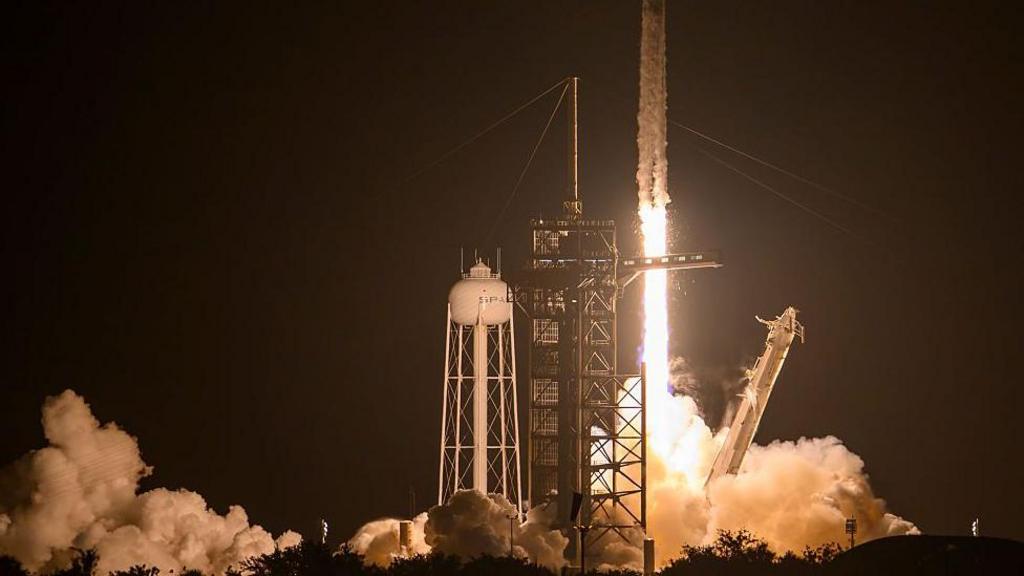
The object is the spent upper stage of a SpaceX Falcon 9 rocket, cataloged by orbital trackers as 2025-010D. It launched on January 15, 2025, from Cape Canaveral, and it did its job perfectly: it carried Firefly Aerospace's Blue Ghost Mission 1 lander to the Moon under NASA's Commercial Lunar Payload Services program, then separated and became, as NASA delicately puts it, "a used Falcon 9 upper stage." What nobody planned was where it would end up next.

A DEAD ROCKET WITH A MIND OF ITS OWN
According to NASA, the stage's return to the Moon was never in the mission plan. "Solar activity and gravitational forces caused the stage's unplanned return to the Moon," the agency said in a release issued Tuesday. In plain English: the discarded rocket body has spent the last year and a half looping through a chaotic orbit, nudged along by the gravitational tug-of-war between Earth, the Moon, and the Sun, along with subtle pressure from solar radiation, until physics finally ran out the clock. Independent astronomers, combing through publicly available tracking data, were the first to notice the stage's slow-motion collision course. NASA's Center for Near Earth Object Studies at the Jet Propulsion Laboratory — the same team that watches the skies for killer asteroids — later confirmed what the amateurs suspected: this thing has a 100 percent chance of hitting the Moon.
There was, NASA has stressed repeatedly, never any danger to Earth. The Moon is nearly a quarter of a million miles away, and the rocket body was never going to do anything but continue its long, slow fall toward a world with no atmosphere to catch it.
THE INTERNATIONAL WATCH PARTY
What makes today's impact remarkable isn't the crash itself — the Moon gets hit by natural debris constantly, absorbing meteoroid strikes with the same destructive energy as this rocket stage roughly once every six days, according to NASA's own estimates. What's remarkable is that, for the first time in a long time, scientists know almost everything about the object doing the hitting: its exact mass (about 4,000 kilograms, or roughly 8,800 pounds), its dimensions (39 feet long, 13 feet wide), its velocity, and its approach angle. Meteoroids arrive as mysteries. This rocket stage is arriving with a full paper trail.
That has turned the impact into an impromptu, multinational science experiment. NASA's Meteoroid Environments Office, based at the Marshall Space Flight Center in Huntsville, Alabama, is training ground-based telescopes on the impact site, though officials caution that weather and lighting conditions could make a clean view difficult. In orbit, NASA's Lunar Reconnaissance Orbiter — a veteran spacecraft that has spent 17 years photographing the Moon in extraordinary detail — will attempt to image the crater before and after the strike. Joining it is South Korea's Korea Pathfinder Lunar Orbiter, known as Danuri, whose ShadowCam instrument was purpose-built to peer into permanently shadowed craters near the lunar poles. Danuri is expected to execute an ultra-close flyby of the impact zone just minutes before the collision, threading the needle to capture the moment as it happens.
None of this will be visible to the naked eye from Earth — the flash and the debris plume are far too faint and far too small. But mission scientists say it may take several days to download and process the orbital imagery, meaning the world likely won't see "before and after" pictures of the fresh crater until later this week or next.
A CRATER WITH A KNOWN BIRTH CERTIFICATE
NASA estimates the impact will carve out a crater roughly 60 feet wide and 12 feet deep, though independent estimates from outside astronomers have put the figure as high as 89 feet across, with the blast releasing energy comparable to roughly three tons of TNT. Either way, it's a modest scar on a battered world — the Moon is pockmarked with millions of craters far larger, etched over four billion years of bombardment. What sets this one apart is that scientists will know, almost to the kilogram and the mile-per-hour, exactly what made it.
That precision is the entire point. Planetary scientists have long used lunar impacts — both natural and artificial — to reverse-engineer how cratering works: how much material gets thrown into the air, how far the ejecta travels, how the shape of a crater relates to the speed and angle of whatever made it. NASA itself has staged deliberate impacts before, most famously when spent Apollo-era rocket stages were flown into the Moon on purpose so seismometers left behind by astronauts could "listen" to the resulting moonquakes. Today's impact is unplanned, but scientists are treating it as a gift anyway: a natural experiment with all the variables known in advance, arriving in an era when a small fleet of active orbiters is finally in position to watch closely.
THE MESSIER PROBLEM HIDING BEHIND TODAY'S CRASH
For all the scientific enthusiasm, today's impact is also a preview of a headache that is only going to get worse. The Moon has no atmosphere to burn up incoming debris the way Earth's does, and unlike Earth orbit, cislunar space — the vast volume between Earth and the Moon — has no equivalent of an internationally coordinated space-traffic system. As governments and private companies ramp up lunar activity — NASA's Artemis program, its Commercial Lunar Payload Services landers, China's Chang'e missions, and a growing list of private ventures — more hardware than ever is heading moonward. Rocket stages, defunct landers, and other debris will increasingly end up drifting in unstable orbits, some of which will eventually intersect the lunar surface exactly as this one has.
NASA, for its part, argues that deliberately steering dead rocket stages into the Moon is actually good practice, not a problem to be avoided. "Disposing of upper stages on the lunar surface is a technically accepted and safe method and, in some cases, can be the only practical option for missions in low lunar orbit," the agency said, noting that many mission operators now choose controlled lunar impacts specifically because they provide a predictable, trackable end of life for hardware that would otherwise become an unmonitored hazard. This particular stage's death spiral wasn't planned — but the agency says the broader practice of aiming dead hardware at the Moon, rather than letting it wander indefinitely, is the safer of the available options.
Still, the long-term trend worries some in the field. As more countries and companies send more hardware to the Moon, tracking every discarded stage, monitoring its orbit for years, and predicting when and where it will eventually come down is a growing logistical and safety challenge — particularly as NASA and other agencies plan to put astronauts back on the lunar surface for extended stays under Artemis. A crater from a known rocket body near Einstein crater is instructive science today. A crater from an unknown or poorly tracked object near a future lunar base would be a very different story.
WHAT THE EXPERTS ARE SAYING
NASA has been careful to frame the event not as an accident to be embarrassed about, but as a rare scientific opportunity dressed up as a mishap. The agency says it is using the impact to "collect lunar data" and to "refine techniques for tracking objects in space" — skills it will need far more of as lunar traffic increases through the rest of the decade. Scientists studying impact cratering have noted that human-made objects hitting the Moon are still uncommon enough, and well-characterized enough, that each one offers a chance to calibrate models built mostly from indirect observation of ancient, unwitnessed natural impacts. Every known variable — mass, speed, angle, composition — turns an accident into a controlled-ish experiment that nature rarely provides for free.
WHAT THIS MEANS FOR YOU
You will not see this crash in the night sky, no matter how good your telescope is — even NASA's professional-grade instruments are only attempting the observation, with no guarantee of a clean shot given the Moon's lighting at the time of impact. But the ripple effects of today's event will show up in ways worth paying attention to. Expect new, sharper images of a young lunar crater to surface in the coming days from NASA and Korean space agency releases — a rare real-time look at the Moon's surface changing in front of active spacecraft rather than being inferred from ancient, weathered scars. Expect the debate over lunar space-traffic rules to get louder, especially as NASA's Artemis astronauts prepare for longer stays on or near the lunar surface in the coming years. And if you've ever wondered why space agencies obsess over tracking every bolt and battery they leave in orbit, today's headline is the answer: even "dead" hardware eventually goes somewhere, and it's a lot better to know where in advance.
THE BOTTOM LINE
A rocket that did its job flawlessly a year and a half ago is about to end its story by punching a fresh hole in the Moon — and rather than write the event off as space junk finally coming home to roost, NASA, SpaceX, and South Korea's space program have turned it into one of the best-documented lunar impacts in history. It's a strange kind of good news story: something went wrong, nobody is in danger, and scientists on two continents got a free, fully-specified experiment delivered straight to their favorite research subject. The Moon has been collecting impacts for four billion years without complaint. Today, for a few hours, humanity finally got to watch one happen in something close to real time.
Published By | Tech Wiz