ABOARD THE INTERNATIONAL SPACE STATION
At 7:30 in the morning, Eastern time, two astronauts flipped their spacesuits over to internal battery power.
That is it. That is the moment. There is no dramatic klaxon, no countdown, no swelling music. In the peculiar bookkeeping of human spaceflight, a spacewalk officially begins the instant the suits stop drawing power from the station and start running on their own — because from that second, the two people inside them are, in every meaningful sense, their own spacecraft.
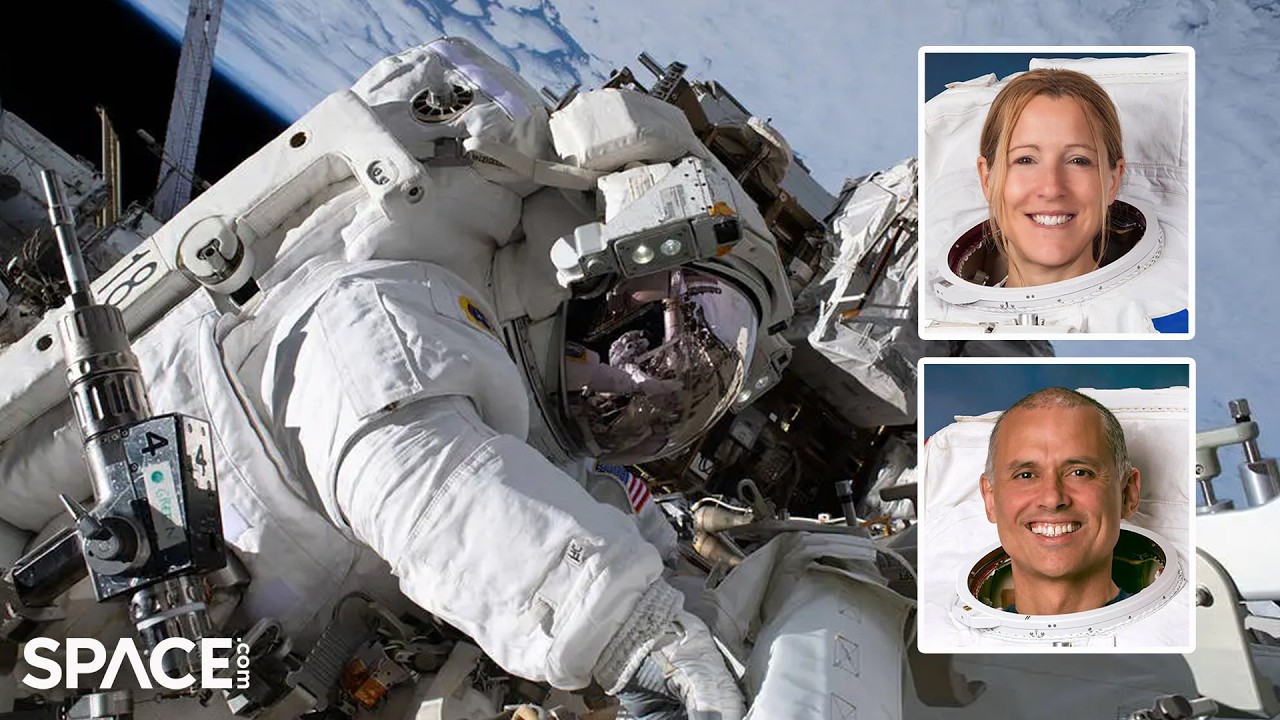
The two people inside them today were NASA's Jessica Meir and the European Space Agency's Sophie Adenot. Over the next six and a half hours, roughly 250 miles above the Earth, travelling at around 17,500 miles per hour, they went to work.
It was the 284th spacewalk conducted at the International Space Station since assembly began in 1998. It was Meir's seventh. It was Adenot's third.
And it was only the sixth all-female spacewalk in the entire history of human beings leaving spacecraft — a fact that says a great deal less about today than it does about the six decades that came before it.
What they actually did out there
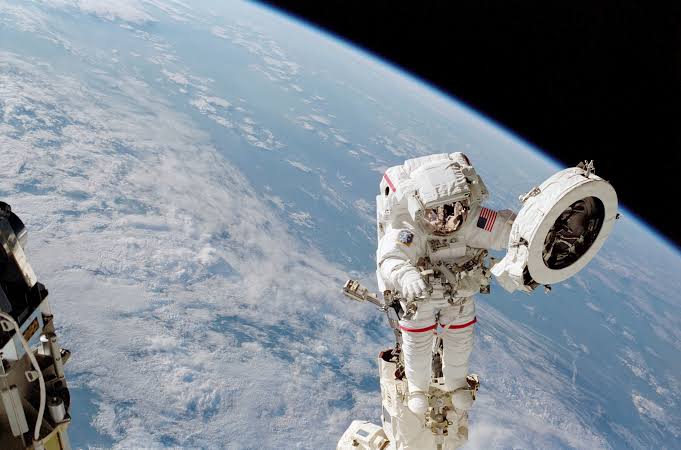
Strip away the milestone and this was, as most spacewalks are, a punishing shift of skilled manual labour performed in a vacuum by people wearing a small pressurised spaceship.
The headline task was a retroreflector on the forward port of the Harmony module. If that sounds obscure, consider what it does: a retroreflector bounces a laser signal straight back at whatever fired it, and visiting spacecraft use those returns to work out exactly where they are relative to the station during the final, terrifying stages of approach and docking.
Every Dragon capsule, every cargo freighter, every crew rotation that has ever slid gently into Harmony's forward port has been navigating, in part, by these small optical mirrors. They degrade. Sunlight, atomic oxygen, micrometeoroids and fifteen-plus years of thermal cycling between roughly plus 250 and minus 250 degrees Fahrenheit will do that to anything. Meir and Adenot replaced it — a small, unglamorous component upon which multi-hundred-million-dollar dockings quietly depend.
Then they moved to the harder job.
The two-billion-dollar machine on the outside of the station
Bolted to the exterior truss of the ISS sits the Alpha Magnetic Spectrometer — AMS-02 — a particle physics experiment that cost roughly two billion dollars and required a dedicated Space Shuttle flight to deliver in 2011.
Its job is to hunt for the things the universe is not supposed to contain: antimatter, dark matter signatures, and the exotic cosmic ray particles that never survive the trip through Earth's atmosphere and therefore cannot be studied from the ground. It has now catalogued hundreds of billions of cosmic ray events. It is, by any measure, one of the most productive scientific instruments ever placed in orbit.
It also was never designed to be serviced. When AMS-02 launched, the Shuttle programme was ending and nobody expected anyone would ever go out there with a wrench. Its cooling system began failing years ago, and astronauts have already been forced to perform a series of extraordinarily delicate repair spacewalks — cutting into stainless steel tubing, installing a new pump system, doing surgery on a machine engineered to be untouchable.
Today's task was preparation for the next round: getting the spectrometer's radiator ready for a future upgrade. Meir and Adenot also installed jumper cables to boost the station's data-relay capability — the plumbing that gets all that cosmic ray data home.
“They were doing keyhole surgery on a two-billion-dollar instrument, in vacuum, in pressurised gloves, at seventeen and a half thousand miles an hour.”
Anyone who has ever tried to undo a stiff bolt while wearing thick winter gloves has experienced roughly one percent of the problem. A pressurised EVA glove fights back against every single finger movement. Astronauts routinely finish spacewalks with bleeding fingernails and forearms that will not close a fist for a day. Six and a half hours of that is an athletic event as much as a technical one.
Who was out there: the Frenchwoman who flew 22 kinds of helicopter
Sophie Adenot, 44, is not a typical astronaut even by the fairly extreme standards of the profession.
Born in France in 1982, she trained as an engineer at ISAE-SUPAERO in Toulouse, specialising in aircraft and spacecraft flight dynamics, then took a master's degree in human factors engineering at MIT in 2004. In 2005 she joined the French Air Force to learn to fly helicopters. She is now a colonel in the French Air and Space Force.
In 2018 she graduated with honours from the Empire Test Pilots' School at Boscombe Down in the United Kingdom — arguably the hardest flying qualification on Earth — becoming France's first female helicopter test pilot. She has logged 3,000 flight hours across 22 different helicopter types.
In 2022 she was picked from more than 22,500 applicants as one of just five career astronauts in ESA's newest class. She finished basic training at the European Astronaut Centre in Cologne in 2024. On February 13 this year she launched to the ISS aboard SpaceX Crew-12, on a mission she named εpsilon.
Her Crew-12 commander was Jessica Meir. Today the two of them went outside together.
With this walk, Adenot becomes the first Frenchwoman ever to perform a spacewalk — a first that France has been waiting for since Claudie Haigneré became the country's first woman in space in 1996.

And the woman who was there the first time
Jessica Meir's presence today carries a particular weight, because she was one half of the pair that made the original milestone.
On October 18, 2019, Meir and Christina Koch stepped outside the ISS and completed the first all-female spacewalk in history — seven hours and twenty-three minutes replacing a failed power unit. It was Koch's fourth EVA. It was Meir's very first.
What made 2019 memorable was not only that it happened, but that it very nearly did not. NASA had scheduled an all-female spacewalk for March of that year and was forced to scrap it days beforehand because there was only one properly configured medium-size hard upper torso available on the station. The story went global, and not kindly. The agency spent weeks explaining that spacesuits are sized in a limited number of configurations, that reconfiguring one takes time and crew hours, and that the fleet of suits on orbit was designed in the 1970s for a very different astronaut corps.
The subtext was impossible to miss: the hardware itself had been built for a workforce that did not expect women. Seven years later, Meir is on her seventh spacewalk — and she has just moved into third place all-time for total EVAs among NASA's women, behind only Peggy Whitson with ten and Suni Williams with nine.
Meir, who grew up in Caribou, Maine, has become one of the most experienced spacewalkers in the American astronaut corps. On this expedition she is not the rookie following Koch out the hatch. She is the commander, taking a rookie's-eye-view colleague out for her third.
Expert perspective: why the milestone still matters, and why it should stop
There is a running, good-natured argument in the space community about whether "all-female spacewalk" should still be a headline at all.
One camp — including several astronauts themselves — argues that the goal has always been to make it unremarkable, and that continuing to flag it keeps women framed as the exception rather than the norm. Meir herself said in 2019 that she hoped the day would come when it simply was not news.
The other camp points at the arithmetic. Two hundred and eighty-four spacewalks at the ISS. Six of them without a man. That is roughly two percent. Human beings have been performing spacewalks since Alexei Leonov in March 1965 — sixty-one years — and this configuration has happened six times.
Both things are true at once, and the honest reading is probably this: the milestone is worth noting precisely because it is still rare, and the day it genuinely stops being reported will be the day the underlying numbers have fixed themselves. They have not fixed themselves yet.
What has visibly changed is the pipeline. ESA's 2022 class, from which Adenot was drawn, was deliberately built for balance. NASA's recent classes have been close to even. The suits are being redesigned — the next generation of EVA hardware, being built for lunar surface work, is finally being engineered around a genuinely wide range of body types rather than a 1970s military-pilot template. That is a slow, unglamorous, deeply consequential fix.
What this means for you
If you have ever wondered whether the space station is still doing anything: today it replaced a navigation component that keeps crewed spacecraft from hitting it, and serviced an instrument searching for the missing 85 percent of the matter in the universe. That is a fairly good Tuesday.
If you follow the physics: AMS-02 remains one of the few instruments capable of directly detecting the charged cosmic ray particles that carry potential dark matter signatures. Keeping it cool and running is not maintenance for its own sake — every additional year of operation sharpens statistics on measurements that no ground-based observatory can replicate.
If you have a daughter who has ever said the word "astronaut" out loud: today the first Frenchwoman in history to walk in space did it alongside a woman who has now done it seven times. That is a lot better than the 2019 version of this story, which was about a missing spacesuit.
And if you want to watch: NASA carries these live, from suit-to-battery through to repressurisation, with cameras mounted on the astronauts' helmets. It remains, hands down, the best free television humanity produces.
The last word
The ISS is now in the twilight of its operational life. NASA plans to deorbit the station around the end of this decade, and every spacewalk from here on is, in a quiet way, part of a long goodbye — keeping a twenty-eight-year-old orbital laboratory alive and productive right to the end.
The 284th spacewalk was not a rescue, not an emergency, not a headline-grabbing crisis. It was a retroreflector, some jumper cables, and a radiator on a physics experiment nobody ever expected to service.
It was also two women, alone outside a spacecraft, doing work that will still matter long after the station itself has burned up over the Pacific.
They came back inside about six and a half hours later. History, as usual, was made on a Tuesday morning, by people who were mostly just trying to get through the task list.
Published By | Tech Wiz