Written By | Torch Media Africa
Stroke survivors who couldn't speak a single sentence solved brain-bending logic puzzles just as well as anyone else — and brain scans reveal why
SCIENCE & TECH.
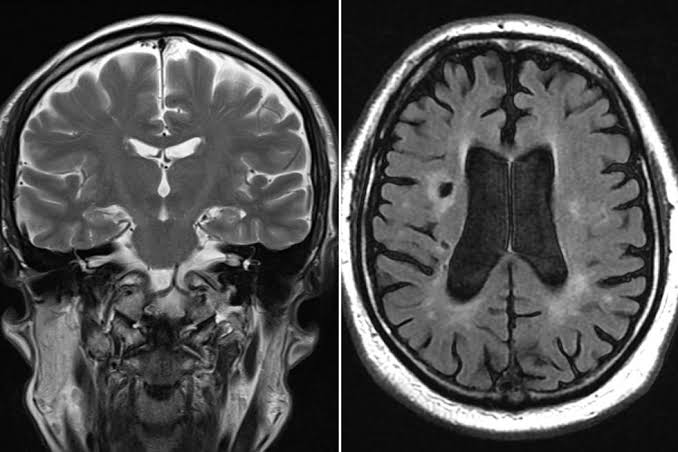
Picture this: a stroke tears through the language centers of your brain overnight. You can no longer form a sentence. You can't understand a stranger asking you for directions. Naming a fork, a chair, even your own child, becomes an impossible task. By every classical assumption about how the mind works, you should also lose the ability to reason your way through a problem — because for centuries, philosophers insisted that words and logic were the same machinery wearing different clothes.
Except that isn't what happened. In a set of language-free logic games devised by neuroscientists at MIT's McGovern Institute for Brain Research, two stroke survivors with severe aphasia — a condition that guts the ability to speak or comprehend language — solved rule-based puzzles just as well as people with no language damage at all. They cracked hidden numerical patterns. They completed geometric sequences. They explained their answers with sketches and hand gestures, because words were off the table entirely. And when the same research team pointed an MRI scanner at the brains of healthy volunteers doing identical reasoning tasks, the brain's language region stayed almost completely dark.
The findings, published this week in the Proceedings of the National Academy of Sciences, land a serious blow to one of the oldest ideas in cognitive science: that we think in language, that the sentences running through your head are the vehicle of reasoning itself. MIT's data says the opposite is true. Somewhere in the brain, there is a second, silent operating system built purely for logic — and it runs whether or not the language system is switched on at all.
TWO PATIENTS, ZERO WORDS, PERFECT LOGIC
The research was led by Evelina Fedorenko, an MIT associate professor of brain and cognitive sciences, together with postdoctoral researcher Hope Kean, in collaboration with University College London neuroscientist Rosemary Varley, who specializes in acquired language disorders. The team recruited two patients who had suffered strokes that devastated the language-processing regions of their brains, leaving them with severe aphasia — unable to reliably understand or produce spoken or written language.
Testing reasoning in people who can't process language sounds like a contradiction in terms, so the team built games with no words in them whatsoever. In one task, participants were shown two lists of numbers and had to figure out the hidden rule that transformed one list into the other — reversing the digits, say, or stripping out anything above a certain value — and then apply that same rule to a brand-new list. In a second task, they were shown a grid of geometric shapes with one square left empty, Sudoku-style, and had to pick the correct missing pattern from a set of options.
Both aphasic patients performed as well on these puzzles as a control group with no language impairment whatsoever. When asked to explain the rule they had discovered, they could not say it out loud — but they could point, sketch, or gesture their way to a correct explanation, communicating a complex abstract idea with nothing but their hands. "It really upends a theory that says that symbolic rule induction is not possible without linguistic capacities," said Kean, a postdoc in Fedorenko's lab and a former K. Lisa Yang Integrative Computational Neuroscience Center fellow.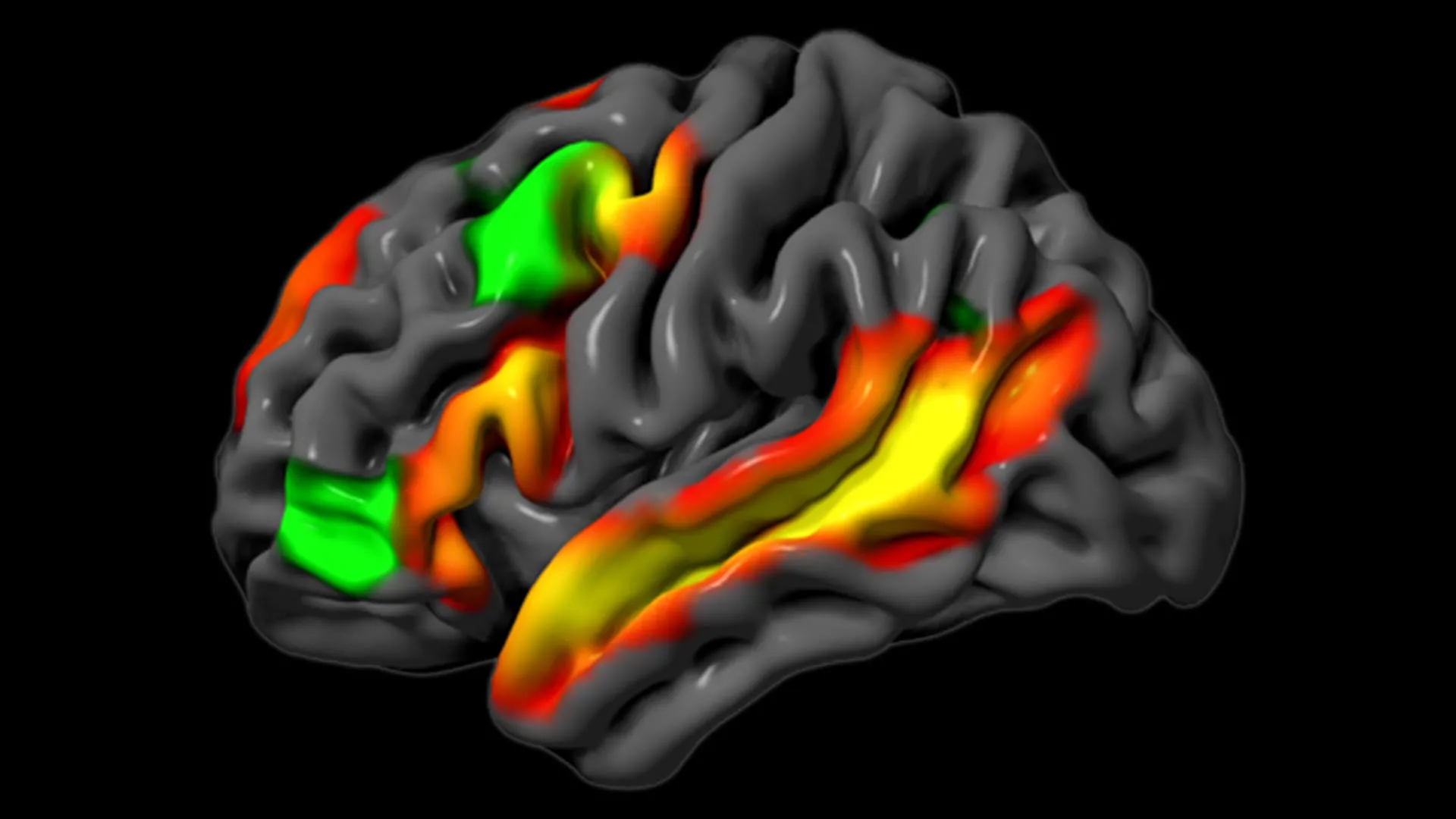
INSIDE THE SCANNER: WATCHING THOUGHT HAPPEN IN REAL TIME
Working with stroke patients answers only half the question. The other half required watching typical, healthy brains in the act of reasoning — and for that, the team turned to functional MRI. Volunteers with no language impairment were scanned while solving the same kinds of number and pattern puzzles used with the aphasic patients, plus a further test of "syllogistic" reasoning — classic logic-textbook statements like "If the ball is red, then it is big. The ball is red. Is the ball big?"
Before running the reasoning tasks, researchers first mapped each volunteer's language network directly inside the scanner, so they knew exactly which brain regions handled that specific person's sentence comprehension and word retrieval. They also mapped a separate system known as the "multiple demand network," a brain-wide circuit long suspected by cognitive scientists to handle general, all-purpose problem-solving of every kind.
The results were unambiguous. While participants worked through the logic puzzles — whether they were inferring a hidden rule (what scientists call inductive reasoning) or judging whether a conclusion followed logically from a stated premise (deductive reasoning) — their language network stayed quiet. It simply was not recruited, no matter how difficult researchers made the puzzle. The multiple demand network, meanwhile, lit up reliably during the rule-guessing tasks, but oddly failed to switch on for the syllogism problems — an unexpected wrinkle Kean says she is now chasing down in follow-up research.
A 3,000-YEAR-OLD ARGUMENT, MAYBE FINALLY SETTLED
Philosophers, linguists, and cognitive scientists have argued about the relationship between language and thought for thousands of years. The dominant "language of thought" camp holds that the sentences running through your head aren't merely describing your reasoning — they ARE your reasoning, the literal medium logic runs on. It's an intuitive theory. Most people report a constant inner monologue while working through a hard problem, and Kean concedes that abstract logic really does resemble grammar on paper. "Abstract thinking has properties that look a lot like language," she says. "You can decompose a thought into subcomponents, like little atoms of logical propositions, and you can combine them in a hierarchical manner to make more complex structured rules, very akin to language."
But Fedorenko and Kean suspected that resemblance was only surface-deep — that people use language to communicate reasoning to others, and to themselves, the way you might scribble on a whiteboard, without the reasoning itself being built out of words at all. Logical reasoning, Kean points out, demands a kind of precision that everyday language often lacks, and requires the ability to juggle information in non-sequential ways, whereas spoken language unfolds one word at a time, strictly moving forward.
This is not the first crack Fedorenko's lab has put in the "we think in language" theory. Earlier work from her group found that other complex mental tasks — sorting objects into categories, reasoning about other people's intentions and social relationships — also proceed without any help from the brain's language machinery. The new PNAS paper adds formal logical reasoning to that list, arguably the toughest possible test case, because logic looks, at first glance, like it's built from exactly the same components as grammar: subjects, predicates, connectives, hierarchical structure.
WHAT THE SCIENTISTS ARE SAYING
"This research adds to a growing body of work establishing that even severely aphasic individuals can preserve their ability for abstract logical thought — a defining feature of our species," Fedorenko said in a statement released alongside the paper. She added a pointed message about how the public tends to treat people who struggle to find their words: "We should continue to educate the public that linguistic difficulties — in aphasia, but also in those with developmental language conditions, such as stuttering, or those who do not speak English natively — are not indicative of how smart or capable someone is."
Kean, who describes the finding as "a new frontier in the geography of thought," says it also reframes how scientists ought to think about artificial intelligence. Large language models such as ChatGPT and Claude are trained entirely on text and produce nothing but text as output, yet they convincingly simulate human-style reasoning. If the human brain keeps language and logic in two functionally separate compartments, Kean argues, the gap between how large language models "think" and how humans actually think may be far larger than their fluent, confident-sounding output suggests — a distinction she believes is worth studying closely as AI developers race to build ever more "reasoning"-capable models.
Clinicians who treat people with aphasia say the study gives long-standing bedside experience a hard neurological backbone. It has been recognized for decades that losing language doesn't mean losing intelligence: people living with aphasia continue to play chess, do sudoku, run their household finances, and make sound decisions about their own medical care. What was missing, until now, was a brain-imaging demonstration of exactly why that is possible — a clean, physical separation between the circuitry that handles words and the circuitry that handles logic.
WHAT THIS MEANS FOR YOU
For the millions of people living with aphasia in the United States alone, and the far larger number of family members and caregivers supporting them after a stroke, this study is a scientific rebuttal to a demeaning and remarkably common assumption: that someone who cannot find their words has also lost their mind. That assumption shapes everything from how doctors talk to patients, to whether a stroke survivor is allowed to keep making their own financial and medical decisions, to how confident a person feels reentering a workplace or a classroom. Fedorenko's team is explicit that this pattern extends beyond stroke survivors to people with developmental language disorders, people who stutter, and non-native speakers navigating a language that isn't their own — groups who are routinely, and wrongly, underestimated because their fluency doesn't match their intelligence.
It also matters if you've ever solved a problem in the shower, felt a decision click into place without "talking it through" in your head first, or noticed that your best ideas sometimes arrive as a flash of understanding rather than a tidy sentence. That kind of silent problem-solving isn't a shortcut, a fluke, or a sign you're "not a verbal thinker." According to this research, it may simply be your brain running the system it was built to reason with all along — with language stepping in afterward, purely to translate the result so you can explain it to someone else, or write it down.
And for the artificial intelligence industry currently racing to build "reasoning" models on top of text-prediction engines, the study is a quiet reminder that the human brain didn't get to logic by memorizing sentences. Evolution built one machine for logic and a separate machine for language, and wired the two together only when there was a need to talk about what the logic machine had found. Any AI system built the opposite way — reasoning entirely through language, because language is the only material it has — may be taking a fundamentally different, and possibly more fragile, route to the same destination.
THE BOTTOM LINE
For thousands of years, thinkers assumed that to think clearly was to talk to yourself clearly — that words came first, and logic followed close behind. MIT's new brain-scan evidence, backed by two stroke survivors who reasoned brilliantly without a single word left to their name, suggests the order runs the other way. Logic runs quietly in its own dedicated circuitry, doing its work in silence, and language shows up afterward to narrate what already happened. It's a small, precise, hard-won finding with an outsized message: the next time your mind goes blank for words, there's a very good chance your reasoning hasn't gone anywhere at all.
Sources: MIT News / McGovern Institute for Brain Research (news.mit.edu), "Separating logic and language," July 8, 2026; PNAS paper "Evidence from formal logical reasoning reveals that the language of thought is not natural language."



