Written By | Torch Media Africa
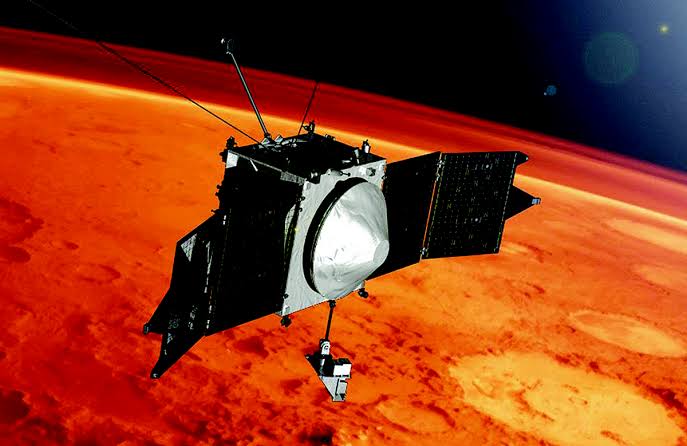
After 11 years unraveling the secrets of Mars, NASA's MAVEN spacecraft vanished mid-orbit — and even the review board investigating its final moments still doesn't know exactly what killed it
DATELINE: PASADENA, CALIF.
Somewhere behind the curve of Mars, on the evening of December 6, 2025, a fourteen-year-old spacecraft the size of a school bus began spinning out of control — and nobody on Earth saw it happen.
By the time NASA's Deep Space Network turned its giant dish antennas back toward the Red Planet, waiting for the signal that always came, always, like clockwork, for over a decade, there was nothing. Just silence, 155 million miles wide.
Seven months, one anomaly review board, and a small mountain of forensic telemetry later, NASA has done something it almost never has to do: it held a funeral for a robot. On June 3, 2026, agency officials and scientists gathered for a public teleconference to formally declare NASA's MAVEN — Mars Atmosphere and Volatile Evolution — mission over. Not paused. Not sleeping. Over.
"We really experienced the loss of a loved one with the end of the mission here," MAVEN project manager Mike Moreau told reporters on the call, in a moment that landed less like a technical briefing and more like a eulogy.
And the strangest part? Investigators still aren't entirely sure what killed it.
The Spacecraft That Refused to Die Young
MAVEN was never supposed to last this long. Launched in November 2013 on a mission designed to run for exactly one year, the spacecraft's job was deceptively simple but scientifically enormous: figure out how Mars, a planet that once had rivers, lakes, and maybe even oceans, turned into the freeze-dried rust-colored husk we see today.
Instead, MAVEN just kept going. And going. Eleven years, one month, and change — more than ten times its planned lifespan — circling Mars roughly 5,000 times, gathering data on the invisible process by which the planet's atmosphere has been quietly bleeding away into space for billions of years.
By any measure, it was one of the most productive planetary science missions NASA has ever flown. Its science team turned out more than 800 peer-reviewed publications over the mission's lifetime, with more still in the pipeline. It didn't just observe Mars losing its atmosphere — it caught the mechanism red-handed.
MAVEN was the first spacecraft at any planet to directly measure a process called atmospheric sputtering, where charged particles slam into the top of an atmosphere with enough force to physically knock gas molecules out into space, like a cosmic game of pool where the cue ball keeps sinking its own side's shots. The mission found that Mars loses roughly ten times more hydrogen when the planet is closest to the sun, driven by the double punch of intensified sunlight and solar wind. It discovered an entirely new type of aurora on Mars. It watched, in real time, as a colossal global dust storm swallowed the planet in 2018 — the same storm that ended the life of NASA's Opportunity rover. And in May 2024, it documented spectacular auroras triggered by an extreme solar storm, the kind of event that, on Earth, would have lit up the sky from Texas to Norway.
Along the way, MAVEN also moonlighted as a communications relay, bouncing signals between Mars rovers and Earth. It's a role that sounds unglamorous next to headline-grabbing science, but the numbers tell a different story: MAVEN handled just over 8% of all relay sessions during its operational life, yet that traffic carried nearly 18% of all the science data ever beamed home from the Martian surface. Pound for pound, it was punching enormously above its weight.
The Night Everything Went Wrong
Understanding how MAVEN died requires understanding a very ordinary, very routine moment in its orbit — the kind that had happened thousands of times before without incident.
Mars orbiters regularly pass behind the planet from Earth's point of view, a maneuver called occultation, where the spacecraft temporarily loses its line of sight to Earth simply because an entire planet is in the way. It's expected. It's boring. Engineers don't lose sleep over it.
On December 6, 2025, MAVEN's telemetry right before it slipped behind Mars showed every subsystem behaving normally — batteries healthy, orientation stable, nothing flashing red. Then it disappeared behind the planet, exactly as scheduled. It never properly came back.
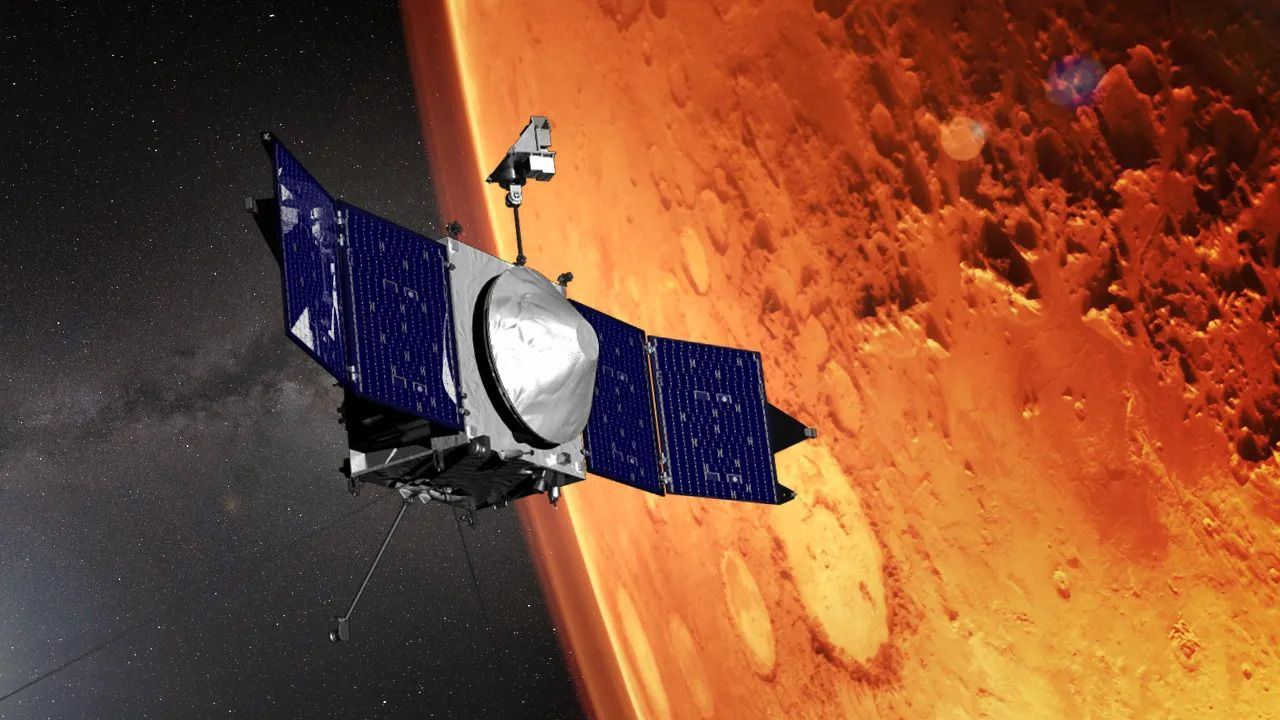
NASA's Deep Space Network, the global system of giant radio dishes that maintains contact with spacecraft across the solar system, listened for MAVEN's signal on the other side and heard nothing where there should have been a clean, familiar transmission. Engineers managed to recover only a brief fragment of telemetry, pieced together from open-loop radio receivers, and what it showed was alarming: the spacecraft was in "safe mode," a defensive posture satellites enter when something goes wrong, and it was rotating at an unusually high rate — a strong sign that something had knocked MAVEN's orbit and orientation out of whack during its pass behind the planet.
That spin turned out to be the real killer. According to the conclusions of NASA's anomaly review board, the uncontrolled rotation likely caused MAVEN's solar panels to lose their lock on the sun. Without steady sunlight hitting the panels, the spacecraft's batteries drained over the following hours. Once the batteries died, so did the communications system that could have told anyone back on Earth what was happening. By the time engineers assembled an anomaly review board in February 2026 to comb through every scrap of available data and weigh possible recovery options, the spacecraft had gone dark for months, with no realistic path back.
The board's ultimate verdict, delivered ahead of the June farewell call: MAVEN was in "an unrecoverable state." It could no longer perform science observations. It could no longer support relay operations. It was, functionally and finally, gone.
What triggered the initial spin in the first place — the actual root cause behind the disruption — remains unresolved. NASA has said the review board expects to release a fuller final report later in 2026, but as of today, the precise chain of events that turned a routine occultation into a mission-ending failure is still, in the driest possible NASA language, "under investigation."
"Best. Mars. Mission. Ever."
If there's a silver lining to a spacecraft dying alone in the dark on the far side of another planet, it's that MAVEN went out having already done virtually everything it was ever asked to do, and then some.
"The MAVEN mission has truly advanced our understanding of the Martian atmosphere and evolution. This dataset has had a tremendous impact on the field," said Shannon Curry, MAVEN's principal investigator and a researcher at the University of Colorado Boulder's Laboratory for Atmospheric and Space Physics, during the farewell call. "Our science team is exceptionally proud of all of these amazing discoveries."
Curry was blunter, and more affectionate, in a separate assessment that's been widely quoted since: "Best. Mars. Mission. Ever."
It's not an empty boast. Even in its final months of operation, before the December anomaly, NASA says the mission team used MAVEN's accumulated data to identify a previously undiscovered atmospheric phenomenon at Mars — a reminder that a data set this rich keeps yielding new science long after the spacecraft itself stops collecting it. Scientists expect to be mining MAVEN's archives for new discoveries for years, possibly decades, to come.
That durability is part of what makes the loss sting. MAVEN wasn't a mission that fizzled out from obsolescence or got shelved for budget reasons — the more common ways NASA missions actually end. It was actively working, actively relevant, actively contributing to two of NASA's flagship priorities on Mars: pure planetary science and the operational backbone for the rovers still crawling around on the surface. Its abrupt, mechanical, poorly-understood death is a different kind of ending than the graceful retirements NASA usually gets to plan years in advance.
Why a Dead Satellite Matters to You
It's easy to read a story about a spacecraft losing its lock on the sun 155 million miles away and file it under "not my problem." But MAVEN's death — and its decade-plus life — actually connects to some very down-to-earth questions.
First, there's the big one: what happened to Mars is a preview, of sorts, of what atmospheric loss looks like over geologic time, and understanding it sharpens scientists' models of how planetary atmospheres behave, including our own. The same solar wind and radiation processes MAVEN studied at Mars interact with Earth's atmosphere too — just far more slowly, thanks to our planet's protective magnetic field, which Mars lost billions of years ago. Every data point about how Mars's atmosphere bled away is also a data point about why Earth's hasn't, and what could change that calculus over deep time.
Second, MAVEN's death is a genuine engineering cautionary tale for the growing fleet of spacecraft NASA and private companies are sending to Mars and beyond. As missions get pushed further past their design lifetimes — something space agencies love to celebrate, since it means more science per taxpayer dollar — components age, safe-mode protocols get triggered by increasingly obscure edge cases, and recovery becomes harder when something does go sideways behind a planet with no one around to help. The unresolved root cause of MAVEN's fatal spin is exactly the kind of failure mode future mission designers will be poring over for years, the same way aviation disasters get dissected to make the next generation of aircraft safer.
Third, for anyone who's ever wondered whether Mars could someday support human explorers, MAVEN's atmospheric data is foundational. Understanding how fast Mars is still losing what little atmosphere it has left, and how solar activity accelerates that loss, matters enormously for anyone planning long-duration human missions that would need to manage radiation exposure and atmospheric resources on the surface.
The End of an Era — And the Start of the Next One
MAVEN's retirement doesn't leave Mars unwatched. NASA and international partners still operate several other active orbiters and rovers at the Red Planet, and additional missions are in various stages of development and launch preparation. But there's something undeniably poignant about a mission engineered to last one year instead running for more than eleven, only to be felled not by old age or an exhausted budget, but by a spinning, silent, unexplained few hours behind a planet 155 million miles from the nearest repair crew.
For the scientists who spent over a decade of their careers tied to this one spacecraft, watching its data trickle in, publishing paper after paper, MAVEN wasn't just hardware. It was a colleague. Moreau's comparison to losing a loved one wasn't hyperbole for the cameras — for a mission team, a spacecraft that runs a decade beyond its expected life becomes something closer to a member of the family than a piece of government equipment.
As NASA's anomaly review board continues piecing together exactly what happened in those crucial hours on December 6, the rest of us are left with something rarer than a tidy explanation: a genuine space mystery, still unsolved, about a machine that quite literally died doing exactly what it loved.



