Written By | Torch Media Africa
Sierra Leone rarely appears in lists of Africa's technology hubs. It has no Lagos-scale startup scene, no Nairobi-style mobile money giant and no submarine cable boom.
Technology Transformation
A small market building big foundations
Sierra Leone rarely appears in lists of Africa's technology hubs. It has no Lagos-scale startup scene, no Nairobi-style mobile money giant and no submarine cable boom. Yet in 2026 the country is quietly assembling something that larger markets often struggle to build: a coordinated approach to digital public infrastructure, anchored in digital identity, in a fraud-control framework for mobile money, and in a national broadband strategy. This article looks at what is being built, how thin the underlying connectivity base remains, and why the sequence of reforms matters.
The starting point is modest. According to data compiled by TS2 Tech from DataReportal sources, Sierra Leone had about 1.8 million internet users in early 2025, roughly 20 percent of the population, against 8.66 million active cellular mobile connections. Around 79 percent of people remained offline, and only 42,000 new internet users were added between January 2024 and January 2025, a 2.4 percent increase. The country has mobile phones in abundance; it has far fewer people who use them to get online.
Digital identity as the keystone
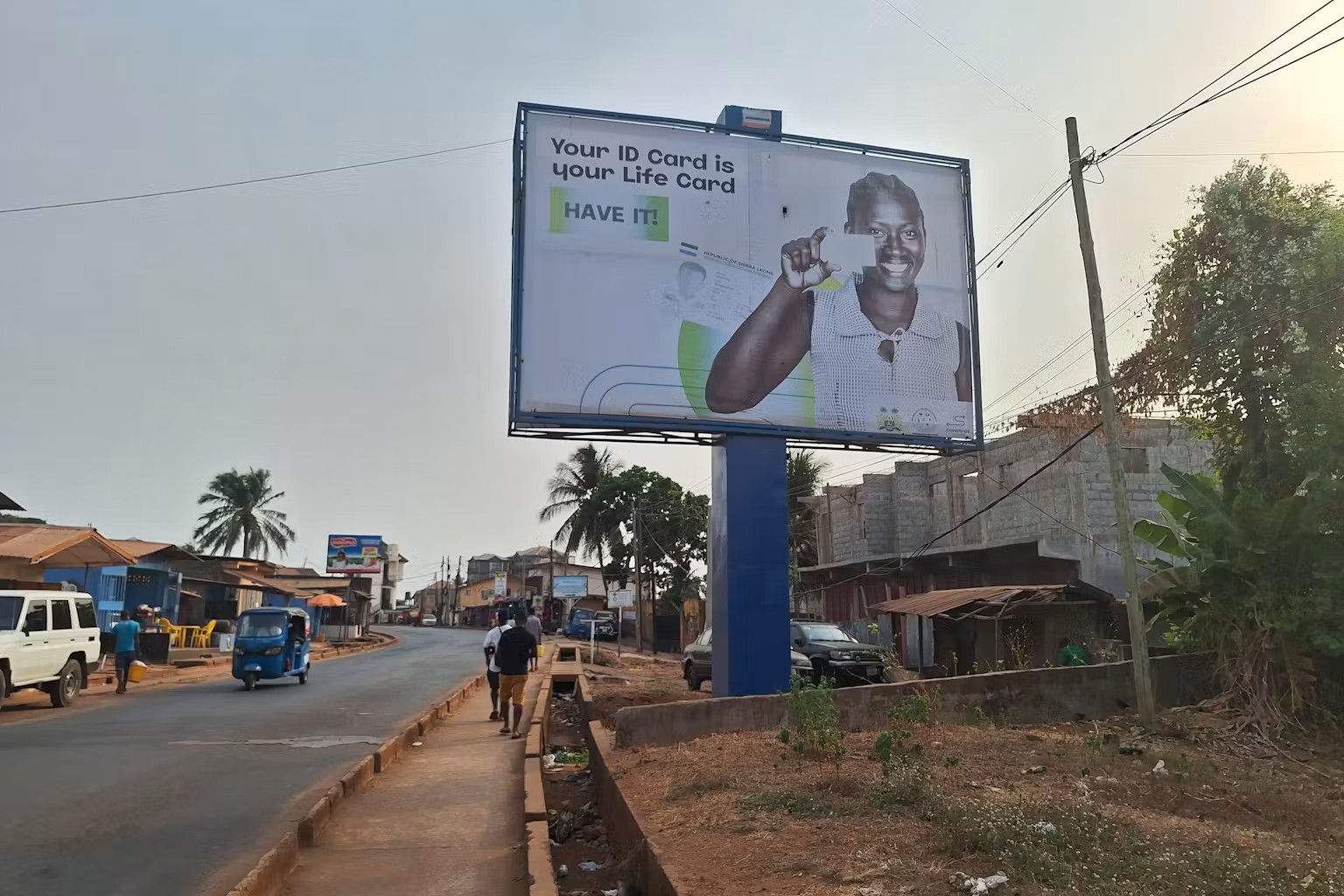
The most strategically important development is the push for a national digital identity. In June 2026 the Ministry of Communication, Technology and Innovation signed a memorandum of understanding with Bhutan National Digital Identity and the SIGN Foundation. A Public-Private Sector Dialogue Forum reported by TechAfrica News on 5 August 2026 brought together government, financial institutions, academia, civil society and development partners around three pillars of digital public infrastructure: trusted digital identity, secure and efficient digital payments, and interoperable data exchange.
The choice of partners is telling. Bhutan's system is built on open-source technology, verifiable credentials and internationally recognised standards for privacy, security and data sovereignty, and Sierra Leone says it wants the same properties. For a country that has repeatedly struggled with fragmented registries, a verifiable credential model allows citizens to prove who they are to a bank, a clinic or a ministry without every institution maintaining its own database. If identity is done well, it lowers the cost of opening an account, issuing a SIM, registering a business or paying a tax, which is why identity is usually the first brick in a digital state.
The ambition also carries risk. Identity systems concentrate sensitive data, and their value depends on public trust, legal safeguards and reliable civil registration. The National Civil Registration Authority was among the institutions involved in related consultations, which suggests officials understand that a digital identity is only as good as the birth, marriage and residency records beneath it.
Fighting fraud to protect mobile money
Mobile money is the main on-ramp to the financial system for most Sierra Leoneans, and it is also where abuse concentrates. On 18 and 19 August 2026 a two-day consultative workshop validated a National Roadmap to Combat Mobile and Digital Fraud. TechAfrica News reported that participants included telecom operators, mobile money providers, civil society and government bodies including the National Communications Authority, the Financial Intelligence Agency, the Bank of Sierra Leone, the National Cybersecurity Coordination Centre and the National Civil Registration Authority. Minister of Communication, Technology and Innovation Salima Monorma Bah has been the political face of the digital agenda.
The roadmap's focus areas are practical: fraud prevention, consumer protection, SIM registration, know-your-customer compliance, reporting mechanisms and public awareness campaigns. Orange Sierra Leone and Orange Money SL joined the effort; the company recently launched a Scam Alert Tool and, in the words of its head of fraud and revenue assurance Tamba Musa, is investing in real-time detection. The link to identity is direct. Reliable SIM and KYC records depend on a trustworthy national identity layer, so the fraud roadmap and the identity programme are two halves of the same project.
The connectivity base: coverage without affordability
None of this works if people cannot afford to get online. About 79 percent of the population lives within 4G coverage, and Orange Sierra Leone reported 100 percent of its cell sites 4G-enabled by 2023. Operators say the sector has attracted more than 500 million dollars in investment, and Orange claims more than 650 sites and over 30,000 jobs. At the Consumer Parliament held in Kenema on 22 May 2026 under the theme Connectivity for Accelerated Growth, industry speakers also pointed to a global fuel price rise of more than 50 percent over the previous three months, a cost that hits tower operators who rely on diesel generators.
Affordability is the deeper problem. TS2 Tech reports that a mobile data plan costs about 15.5 percent of average monthly income, against the United Nations affordability target of 2 percent. Fixed broadband is sparse: Cajutel has deployed fibre in Freetown, Port Loko, Lungi and Kambia, and One Broadband has launched a limited 5G service, but average download speeds were around 17 Mbps in 2023. International capacity depends on the ACE submarine cable, which landed in 2011; wholesale bandwidth prices fell about 60 percent between 2020 and 2024 after Zoodlabs took over cable management in 2021. Only about 1 percent of the most visited websites have a locally cached presence, so much traffic still crosses the Atlantic.
Starlink, which went live in mid-2024, holds roughly a 2 percent share of the internet service market. With hardware from 150 to 299 pounds and a monthly subscription of about 75 pounds, it serves enterprises, NGOs and wealthier households rather than the mass market. The government's National Broadband Strategy 2023 to 2028 and a feasibility study funded by the US Trade and Development Agency for a 1,600 kilometre national fibre backbone connecting 32 cities point to the public-sector response, along with a pilot of five solar-powered 5G sites in Freetown in 2025. Sierra Leone also recorded no government-induced internet shutdowns in the past twelve months, a point in favour of the trust agenda.
Why the sequence matters
Many African countries have launched e-government portals before they had reliable identity, and fintech products before they had coherent fraud rules. Sierra Leone, by necessity as much as design, is taking a different path: identity, payments and data exchange are being discussed as one framework, and fraud control is being agreed with the operators who actually run the networks. A country with limited fiscal space can find this approach attractive because shared infrastructure is cheaper than a collection of disconnected systems.
The danger is that policy outruns delivery. A memorandum of understanding is not a deployed system, and a roadmap is not a reduction in scam losses. Implementation will require money, technical capacity, legal clarity on data protection and a sustained effort to widen internet use beyond the one in five people who are currently online. If costs stay at 15.5 percent of income, even the best identity platform will serve only a minority.
What to watch
Observers should look for four signals: a published timetable and budget for the digital identity rollout; evidence that SIM registration and KYC rules cut fraud measured in reported cases and losses; progress on the 1,600 kilometre fibre backbone and on lowering retail data prices; and any move to extend the five-site solar 5G pilot. Sierra Leone is unlikely to become a regional technology capital soon. But if it sequences identity, payments, fraud controls and affordable access sensibly, it could become a useful case study for other small, low-income markets that need to build digital foundations on a very tight budget.
Note on data: connectivity figures come from compiled secondary sources and may differ from regulator data; several figures date from 2023 to early 2025 and should be read as indicative.



