LOS ANGELES, CA
Marlena Fejzo remembers exactly what it felt like to be dying from pregnancy.
It was 1999, and Fejzo — then a postdoctoral researcher at UCLA — was lying flat on her back in a hospital bed, unable to move, unable to eat, unable to even roll onto her side without triggering violent, uncontrollable vomiting. She was hooked up to a feeding tube. Doctors had tried seven different medications. Nothing worked. By the time anyone took her seriously, it was too late. She lost the baby.
"My symptoms were so severe that I could not eat, drink, or even move without violently vomiting," Fejzo has said of the ordeal. "I was confined to lying completely still and endured weeks of relentless suffering."
More than two decades later, Fejzo is the reason the world finally understands why. This month, a team she leads at the Keck School of Medicine of USC, along with international collaborators, published the largest genetic study ever conducted into hyperemesis gravidarum (HG) — the condition that nearly killed her — in the journal Nature Genetics. The results, drawn from the genomes of nearly half a million women, have identified nine new genes tied to the disease, six of which had never before been linked to it in any way. Combined with Fejzo's earlier discovery of the hormone gene GDF15, scientists now count ten confirmed genetic culprits behind one of pregnancy's cruelest and most dismissed complications.
For millions of women who have been told their vomiting is "just morning sickness," the findings are being hailed as vindication, written in DNA.
A DISEASE HIDING IN PLAIN SIGHT
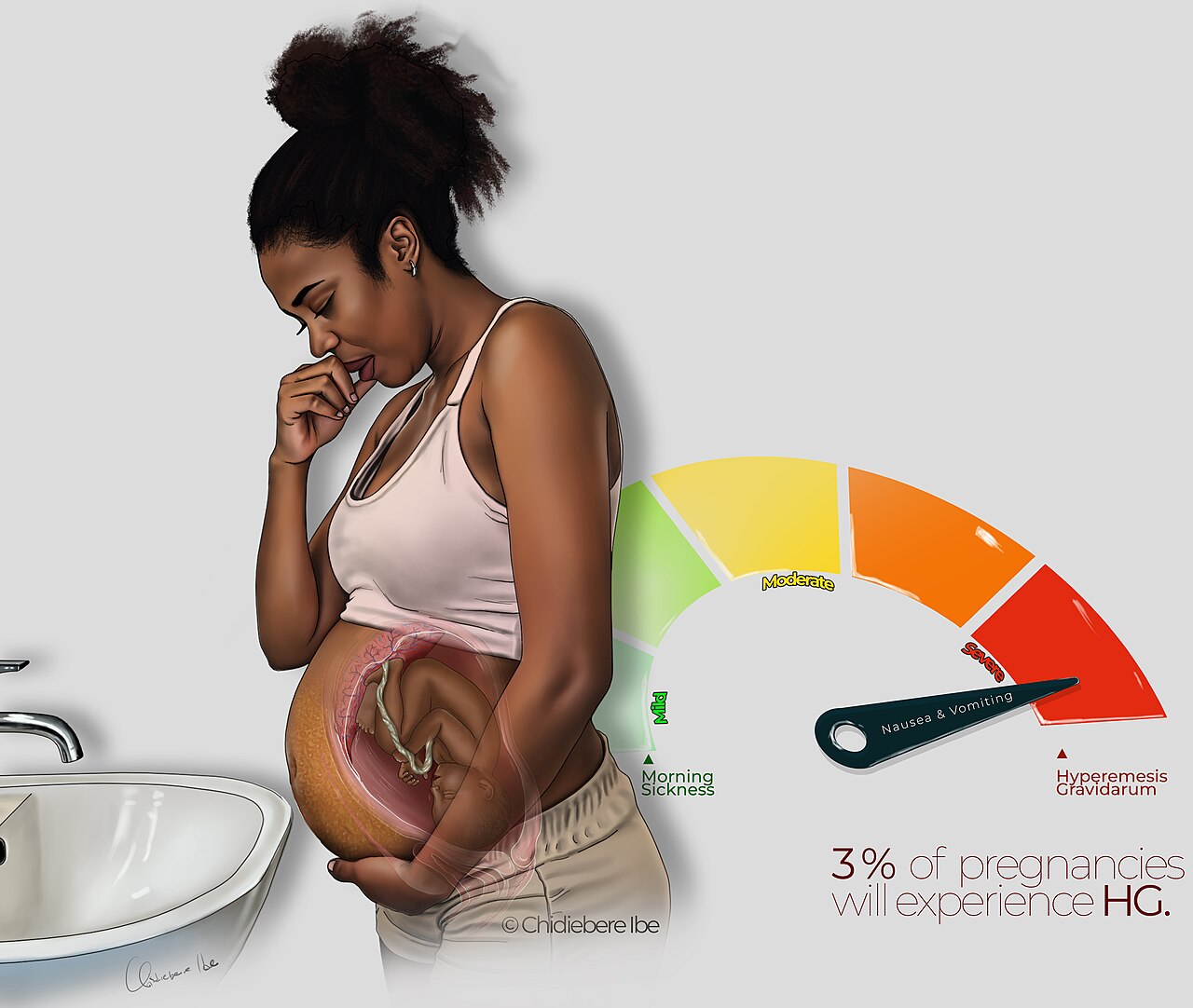
Hyperemesis gravidarum is not ordinary morning sickness. While mild nausea affects the vast majority of pregnant women in the first trimester, HG is a severe, often disabling escalation of it — marked by relentless vomiting, dramatic weight loss, dehydration and, in the worst cases, organ damage, malnutrition, and psychological trauma so severe that some women choose to terminate wanted pregnancies simply to survive. Estimates suggest it strikes somewhere between 2 and 10 percent of pregnancies worldwide, a range wide enough to reveal how inconsistently the condition has historically been recognized and diagnosed.
Its most famous sufferer is Catherine, Princess of Wales, who was hospitalized for HG during multiple pregnancies, thrusting the obscure medical term into tabloid headlines and royal-watching households everywhere. Comedian Amy Schumer later revealed she'd endured the same condition, telling fans partway through a grueling pregnancy, "I have hyperemesis and it blows," after being forced to cancel shows and seek hospital care. For years, the two women's experiences were treated largely as celebrity anecdotes — dramatic, but medically mysterious.
That mystery is what Fejzo has spent her career trying to solve, largely because no one else was.
"People should not still be dying from severe nausea and vomiting of pregnancy," Fejzo has said, "but women are far too often told their severe symptoms are normal or that they are exaggerating, leading to a lack of treatment and poor and sometimes fatal outcomes."
INSIDE THE STUDY: NEARLY HALF A MILLION WOMEN, TEN GENES
The new research represents a scale of investigation that simply didn't exist a decade ago. Fejzo's team conducted a genome-wide association study — a method that scans the entire genetic code of huge populations, looking for tiny variations that show up more often in people with a particular condition — on 10,974 women who had experienced hyperemesis gravidarum and 461,461 women who had not. Crucially, the study spanned multiple ancestries, including European, Asian, African and Latino populations, addressing a long-standing weakness in genetic research that has historically centered overwhelmingly on people of European descent.
The results reconfirmed GDF15 — a gene Fejzo first flagged years earlier — as by far the strongest genetic signal associated with HG. GDF15 encodes a hormone that rises naturally during pregnancy, and mounting evidence suggests it plays a role well beyond the womb: it's the same hormone increasingly implicated in the severe appetite loss and wasting seen in late-stage cancer patients, a phenomenon called cachexia. The leading theory is that women who enter pregnancy with lower baseline exposure to GDF15 — and are therefore less "desensitized" to it — experience a much more violent reaction when the hormone floods their system during pregnancy.
But GDF15 was already known. What makes this study a genuine breakthrough is the other nine genes riding alongside it — six of which had never once appeared in prior HG research. According to the research team, the newly implicated genes cluster around functions that read like a biological explanation of the disease itself: appetite regulation, nausea signaling, metabolism, and brain plasticity. In other words, scientists haven't just found genes correlated with HG — they've started to sketch a biological wiring diagram for why the body reacts to pregnancy hormones with catastrophic nausea in some women and barely a flutter in others.
In other words, this is a disease with a body, not just a bucket of symptoms. Pregnancy sickness has never been "just in someone's head," and now there is hard genetic architecture to prove it.
FROM GENES TO A DRUG THAT ALREADY EXISTS
The most immediately promising part of the discovery isn't just academic. Because GDF15 has already been extensively studied in cancer and metabolic research, scientists have a head start on turning this genetic map into an actual treatment — and Fejzo's team isn't waiting.
Her group has received approval to launch a clinical trial testing metformin, a decades-old, cheap and widely available diabetes medication, as a potential preventive treatment for HG. The theory is elegant: metformin is known to raise GDF15 levels in the body over time. If administered before pregnancy to women with a documented history of hyperemesis gravidarum, the hope is that it could pre-desensitize their systems to the hormone surge that pregnancy triggers — essentially building up a tolerance in advance, so the body doesn't panic when GDF15 spikes for real.
If it works, it would mark the first HG treatment developed specifically because of an understanding of its genetic root cause, rather than simply managing symptoms after the fact — which is currently the standard of care. Today, women with HG are typically offered anti-nausea drugs like ondansetron (commonly known by the brand name Zofran) or doxylamine-pyridoxine combinations such as Diclegis, alongside IV fluids and, in severe cases, feeding tubes. None of these treat the underlying cause. They simply try to keep the patient alive and hydrated until the worst of it passes — if it passes.

WHY THIS MATTERS FOR YOU
If you are pregnant, know someone who is, or plan to be, this research has consequences that reach well beyond a science journal.
For starters, genetic testing could eventually allow doctors to identify — before a woman ever gets pregnant — whether she carries a higher genetic risk for HG, based on her GDF15 baseline and the newly discovered genes. That kind of early warning could let doctors and patients plan ahead: adjusting prenatal care, arranging support systems, or even, for women with a prior severe case, considering a preventive drug regimen like the metformin trial now underway.
It also matters for something less measurable but arguably just as important: being believed. Countless women with severe pregnancy sickness have described being dismissed by doctors, family members, and even partners as anxious, weak, or exaggerating. A concrete genetic basis reframes hyperemesis gravidarum the way, decades ago, genetic and biochemical discoveries reframed conditions like depression or migraines — moving them from the realm of "it's probably in your head" to "here is the biology."
For expectant families making decisions about future pregnancies, particularly those who have already lived through a traumatic HG pregnancy, the promise of a preventive treatment — however early-stage — offers something that has been in short supply: hope, backed by data rather than folk remedies.
THE ROAD AHEAD
Scientists caution that identifying genes is not the same as curing a disease. The nine new genes need to be studied individually to understand exactly how they interact with GDF15 and with each other, and the metformin trial is still in its early stages, meaning any real-world treatment is likely years away from being available to the general public. Researchers will also need to determine whether the genetic risk factors identified in this study apply consistently across all the ancestries included, or whether some populations carry additional risk variants not yet detected.
There is also the broader challenge of translating a genetic breakthrough into everyday obstetric practice. Genetic risk-screening infrastructure for a condition like HG doesn't currently exist in most prenatal care systems, and building it will require investment, education for physicians who may still be unfamiliar with the latest research, and — perhaps most importantly — a cultural shift away from decades of treating severe pregnancy sickness as something women should simply endure.
Still, for a condition that has operated in the shadows of medical research for so long — famous mostly through the hospital visits of a princess and a Hollywood comedian rather than through robust science — the arrival of a nearly half-a-million-person genetic study marks a turning point. It is, in a very real sense, the payoff of one woman's decision to turn a personal tragedy into a decades-long scientific pursuit.
"People should not still be dying from severe nausea and vomiting of pregnancy," Fejzo said. For the first time, science is offering a real reason why they have been — and a real path toward making sure they no longer do.
Published By | Tech Wiz