DAKAR
Senegal is making an unusually explicit bid to become Francophone West Africa's digital anchor. Over the past eighteen months, Dakar has landed one of the world's largest submarine cables, produced the region's first unicorn, launched a national startup fund, and set formal targets to double the digital economy's share of GDP — all while a fledgling offshore oil and gas industry begins generating the fiscal resources to fund the ambition. With a population of only about 18 million, Senegal is a small market by African standards, but a series of 2026 milestones suggest it is punching well above its weight in infrastructure, capital formation and government digitisation.
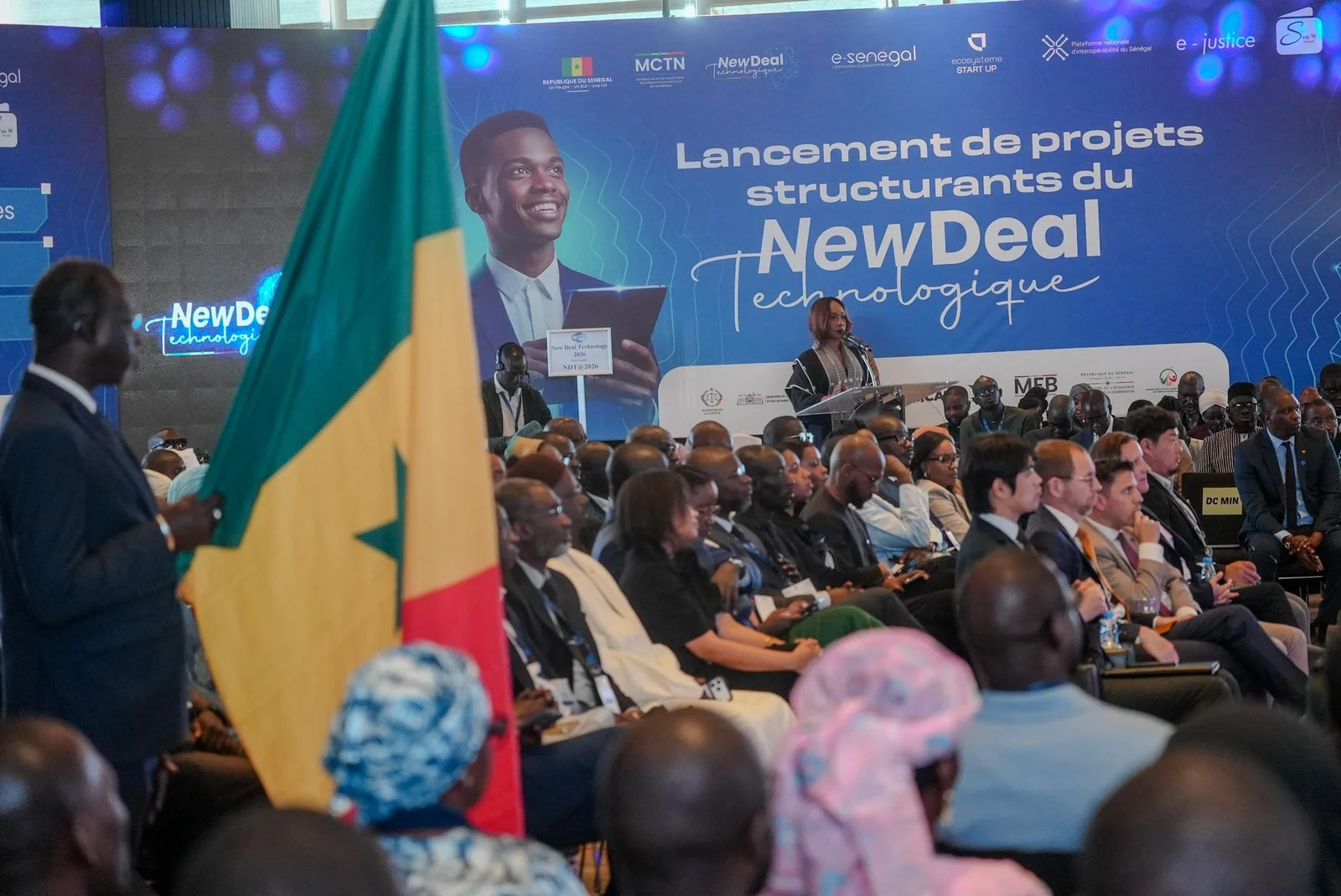
The New Technological Deal
The policy anchor for all of this is the "New Technological Deal," launched by President Bassirou Diomaye Faye in February 2025. The strategy sets explicit, measurable targets: raise the digital economy's contribution to GDP to 10 percent, digitalise at least 90 percent of government services, and position Senegal as an international digital hub by 2034. It is a rare case of an African government attaching numeric benchmarks — rather than broad ambition — to a digital transformation agenda, and 2026 has been the year those targets started generating visible follow-through, from a new government services portal to expanded rural connectivity.
Central to the sovereignty framing is the Universal Connectivity Project, which combines fibre-optic and satellite technology to extend internet access to remote areas, schools and health centres. The government has said more than one million people are expected to gain free connectivity access in 2026 alone, part of a broader effort to ensure that Dakar's world-class international bandwidth actually reaches underserved communities rather than concentrating in the capital.
A Cable Landing That Changes the Region's Math
In December 2025, national operator Sonatel commissioned the 2Africa submarine cable — at 45,000 kilometres and connecting 33 countries across Africa, Europe and Asia, it is the largest connectivity project ever deployed on the continent. With 16 fibre pairs and nominal capacity of 180 terabits per second, roughly ten times that of prior cable generations serving the region, 2Africa's Senegal landing gives Sonatel a claim to be a critical hub for global internet traffic passing through West Africa. Sonatel has said it is also preparing to connect Senegal to a fifth fibre-optic submarine cable, further diversifying the country's international bandwidth routes.
Sonatel has paired that subsea capacity with investment in satellite redundancy. In July 2026, the company completed an upgrade to its Gandoul Teleport, installing 16 Eutelsat OneWeb low-Earth-orbit antennas as part of a hybrid fibre-satellite-4G/5G strategy. The stated rationale is explicitly defensive as well as expansive: reinforcing digital sovereignty, securing and diversifying international connectivity routes, and improving network resilience against technical and geopolitical risk — language that reads as a direct response to the arrival of low-orbit competitors Starlink and Kuiper in the Senegalese market. Sonatel also operates a data centre in Rufisque, recently expanded with a second server room, giving the country domestic hosting capacity to keep more data and digital services on Senegalese soil rather than routed abroad.

Wave, Catalyst DER/FJ, and a Maturing Startup Ecosystem
Senegal's startup story is still substantially the story of one company: Wave, the mobile-money platform that became Francophone Africa's first unicorn after a $200 million Series A round valued it at $1.7 billion. Wave's rise has done more than generate headlines — it has demonstrated to global investors that a francophone West African market underserved by traditional banking can support a venture-scale fintech outcome, a proof point that has helped pull additional capital toward Dakar.
The government has moved to institutionalise that momentum. On June 20, 2026, at the AfricaTech stage of VivaTech in Paris, Aida Mbodji, General Delegate of Senegal's Delegation for Fast-track Entrepreneurship for Women and Youth (DER/FJ), announced the launch of Catalyst DER/FJ, a $50 million fund dedicated to backing innovative local startups. The fund reflects a broader state ambition: Senegal has set a target of formally "labelling" more than 500 tech startups and generating 150,000 direct jobs through its innovation ecosystem. Fintech remains the leading vertical, but logistics platforms supporting trade, health-tech ventures expanding medical access, and edtech initiatives are all cited by local ecosystem trackers as fast-growing segments beyond Wave's core mobile-money category.
By 2025, Senegal ranked 92nd globally in StartupBlink's ecosystem index — modest by the standards of Lagos, Nairobi or Cairo, but notable given Senegal's much smaller population and GDP base. Infrastructure built specifically to support that ecosystem includes the Diamniadio Digital City near Dakar, a purpose-built technology and business park intended to cluster startups, data infrastructure and digital-economy institutions outside the congestion of central Dakar.
Govtech and Digital Identity
On March 24, 2026, Senegal launched "e-Senegal," a one-stop digital portal intended to centralise online administrative procedures under the New Technological Deal umbrella. In its initial phase, the platform prioritises judicial services — criminal record requests, nationality certificates, detention-visit authorisations and civil-service status certificates — with further government services slated to be added as the portal scales toward the 90-percent-digitalisation target.
Digital identity has proven more difficult. Senegal's Ministry of Digital Economy and Telecommunications, working with the UNDP, has been developing a National Digital ID (INN) project and biometric population database since 2022, and in late 2025 a Senegalese government delegation travelled to Lomé to study Togo's digital ID rollout as a model. Progress has not been without setbacks: reporting in early 2026 documented a data breach that disrupted national ID issuance, an episode that underscores the cybersecurity stakes as Senegal digitises identity, tax and judicial records simultaneously. Senegal's government has continued to frame these efforts — alongside cybersecurity investment and electronic-signature systems — as core pillars of digital sovereignty rather than optional modernisation.
Oil Revenue Meets Digital Ambition
Senegal's technology push is unfolding alongside the country's emergence as a hydrocarbons producer. The offshore Sangomar field, operated by Australia's Woodside Energy, produced about 17.9 million barrels of oil in the twelve months to the end of June 2026, after exceeding its first-year target by producing 16.9 million barrels against an initial 11.7 million-barrel goal and generating 595.5 billion CFA francs in revenue. The Greater Tortue Ahmeyim (GTA) liquefied natural gas project, a joint venture with neighbouring Mauritania, has also begun production, with capacity expansion planned in subsequent phases. Oil and gas output helped lift Senegal's economic growth to 6.7 percent in the most recent full year and has narrowed the country's current account deficit by boosting exports.
That hydrocarbons windfall matters for the technology sector because it changes the government's fiscal calculus: state-backed vehicles like Catalyst DER/FJ, the Universal Connectivity Project's rural subsidies, and continued build-out of institutions like Diamniadio Digital City all depend on public capital that resource revenue can help underwrite, even as officials publicly frame industrialisation and digital-economy diversification as the intended use of hydrocarbons proceeds rather than consumption spending.

A Showcase Moment: The 2026 Youth Olympics
Senegal is also using a global sporting event to project its digital ambitions. Ahead of hosting the Dakar 2026 Youth Olympic Games, the government has planned a "Digital Olympic Village" centred on youth engagement, e-sports, coding education and extended-reality (XR) content — a deliberate attempt to link the country's tech-sector messaging to a moment of international visibility, in the same way earlier host nations have used similar events to showcase infrastructure investment.
What to Watch
Three questions will shape whether Senegal's digital ambitions convert into durable economic gains. First, whether Catalyst DER/FJ's $50 million can meaningfully diversify a startup ecosystem still dominated by a single fintech success story. Second, whether digital-identity rollout can recover credibility after the early-2026 data breach, given that biometric ID underpins the government's broader digitalisation of judicial, tax and social-protection services. Third, whether 2Africa's landing capacity and the Gandoul Teleport's satellite redundancy translate into lower connectivity costs and new data-hosting business for ordinary Senegalese firms, rather than remaining primarily an asset for Sonatel's international wholesale traffic. For a country of Senegal's size, the ingredients — a global-scale cable landing, a proven fintech unicorn, new resource revenue, and an explicit numeric digitalisation target — are now largely in place. Execution through 2026 and beyond will determine whether Dakar becomes the digital hub its own strategy names as the goal.
Published By | Tech Wiz