Written By | Torch Media Africa
Egypt has built the largest digital services export industry on the African continent, and it has done so with a model that is unusually legible
Technological Transformation
Egypt has built the largest digital services export industry on the African continent, and it has done so with a model that is unusually legible: take a very large supply of young, multilingual, technically trained graduates; place them inside delivery centres run by multinational firms; and sell their working hours to clients in Europe, the Gulf and North America. The model has worked. The question now on the table in Cairo is whether it can be upgraded before the thing it sells is automated.
The scale of what has been assembled
The headline figure arrived on 8 September 2026, when Minister of Communications and Information Technology Raafat Hindi opened the sixth Tech Invest Egypt conference in Cairo and reported that Egypt's ICT sector had grown 24.3 per cent in the fourth quarter of the 2025/2026 financial year — described as the highest quarterly growth rate on record for the sector. For context, that is roughly five times the pace of the wider Egyptian economy, in a sector that has already been the country's fastest-growing for eight consecutive years at a sustained 14–16 per cent annually.
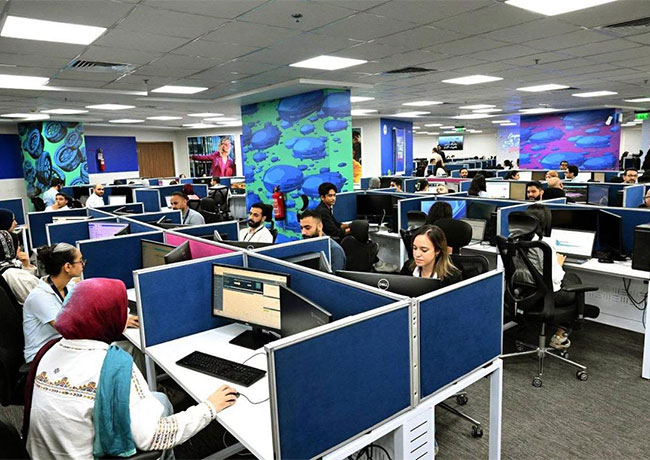
Underneath the growth rate sits a physical industry. Egypt's offshoring ecosystem comprises 252 companies operating across 282 global delivery centres, including 177 multinational firms, employing more than 195,000 specialists. That workforce has more than doubled since 2021, when the figure stood at roughly 90,000. Offshoring services exports reached approximately US$5.2 billion in 2025 — US$5.1 billion by the ministry's more conservative count — with an MCIT target of US$6 billion for 2026 and US$8 billion by 2028.
The individual operator numbers show how concentrated and how deep the commitments are. Teleperformance employs approximately 26,800 people in Egypt, generating 90 per cent of its local revenues from exported services: €280 million in 2025, with €344 million projected for 2026, and plans to add a further 18,000 jobs over three years. Concentrix runs 13 centres with 24,500 employees, derives nearly 99 per cent of local revenue from exports in up to 13 languages, is targeting US$1 billion of local investment over four years, and intends to reach 35,000 staff by 2028. Vodafone Intelligent Solutions employs 9,500 specialists in Egypt — its second-largest global footprint, about a third of its worldwide workforce — generating €200 million in service exports this financial year. Sutherland has grown from 65 employees in 2010 to more than 6,000 today, operating in 16 languages.
Geography as industrial policy
The most deliberate recent shift has been outward from Cairo. In August 2026, Prime Minister Mostafa Madbouly toured technology and business services facilities in Alexandria alongside Minister Hindi, Alexandria Governor Ayman Ateyya and ITIDA CEO Ahmed Elzaher, visiting sites operated by Teleperformance, Concentrix, VOIS and Sutherland. Those four employ close to 15,000 specialists in Alexandria alone. More than 70 per cent of Sutherland's Egyptian workforce is now based there; Teleperformance's four Alexandria centres employ over 4,000.
The reasoning offered was explicitly about resilience rather than cost. Elzaher framed geographic diversification as "no longer an operational choice" but "a driver of competitiveness, scalability, and resilience" — the argument being that a delivery platform concentrated in a single metropolitan area is a single point of failure for clients who buy continuity as much as capability. Madbouly's framing was fiscal and political: extending ICT employment "across all governorates" to create high-value jobs for young people and to "drive foreign currency inflows." In an economy that has spent several years managing a hard currency squeeze, an export sector that bills in euros and dollars is not merely a growth story — it is a balance-of-payments instrument.
The talent pipeline is a state programme
What distinguishes Egypt from most competing destinations is that the supply side is centrally coordinated and publicly funded rather than left to employers. MCIT is targeting 800,000 ICT-trained workers in 2026, a figure it has described as "a coordinated, state-wide effort to rapidly scale digital capabilities" aimed at making Egypt "the most scalable delivery destination for the international IT offshoring industry."
The mechanics run through four institutions: ITIDA, the Information Technology Institute, the National Telecommunication Institute and the Egypt University of Informatics, all under the fully funded Digital Egypt Generations initiative. The ITIDA–NTI summer programme targets 10,000 university students at 120 structured hours each across AI, cybersecurity, software development and digital marketing. ITIDA's "Train to Hire" model maps training outcomes directly onto corporate vacancies in coordination with local and multinational employers, rather than producing graduates and hoping placements follow. The ITIDA–DXC Dandelion programme adds neurodivergent workers to the pool for structured data, quality assurance and detail-intensive functions.
The raw demographic input is the foundation: a population above 110 million and roughly 750,000 university graduates entering the labour market each year. At the November 2025 Global Offshoring Summit, ITIDA signed 55 agreements expected to create more than 75,000 jobs over three years — 39 with companies expanding existing Egyptian operations, 16 with first-time entrants.
The upgrade attempt
Officials are candid that headcount growth alone is not the destination. The stated strategy is to push the sector beyond back-office operations into specialised digital services with generative AI embedded in delivery — and, increasingly, into segments where value is not proportional to hours worked. Egypt is expanding into semiconductor and integrated circuit design, automotive embedded software, and complex research and development, alongside financial and accounting operations, human resources, fleet management and enterprise IT.
The more consequential move is the attempt to build domestic intellectual property. Hindi pointed to the experimental launch of the Egyptian large language model "Karnak," alongside the "Loghat" and "Belmasry" applications, and to Egyptian work in language processing, speech-to-text, translation and healthcare AI. The ministry says it is working to make advanced computing resources available to researchers and developers specifically so they can build solutions with intellectual property that can be commercialised internationally. A competition is being prepared to encourage startups to develop AI solutions with developmental impact, piloted inside a government ministry with the possibility of expansion across other entities.
Supporting infrastructure is being extended in parallel. Egypt Digital Innovation Hubs now operate in more than 20 governorates, providing skills development, incubation, technical and legal advice and investor connections. EGP 13 billion in public investment was allocated to the ICT sector under the 2025/2026 plan, of which EGP 9 billion comes from the state budget. The Personal Data Protection Law and its executive regulations — a standing agenda item at the Tech Invest sessions — matter more than they might appear, because European clients cannot place regulated workloads in a jurisdiction whose data regime they cannot certify.
The structural question nobody in Cairo is avoiding
The tension in Egypt's model is that the same technology being marketed as an upgrade is also the most credible threat to the base business. Generative AI is being integrated into Egyptian delivery operations by Concentrix, Teleperformance and others as a productivity layer. It is simultaneously the technology most capable of absorbing exactly the work — tier-one customer contact, structured data processing, routine back-office transactions — that employs a substantial share of those 195,000 specialists.
This gives the sector a specific vulnerability profile. If AI raises the value of each Egyptian engineer's output, the industry moves up the value chain and revenue per head rises: the ministry's US$8 billion target on a workforce not tripling in size implies precisely this. If instead AI substitutes for the routine tier, the headcount targets and the revenue targets diverge, and an 800,000-person training programme becomes a supply-side bet on demand that may not materialise in the categories being trained for.
There is a second dependency worth naming. Competitiveness in this industry is partly a currency phenomenon. Egypt's cost advantage has been amplified by the pound's depreciation, which makes local salaries cheap in dollar terms without reducing them in local terms. That is a real advantage, but it is not a durable technological one — it can be replicated by any economy that devalues, and it erodes if the pound stabilises and appreciates. Chasing it by remaining cheap is a race Egypt cannot indefinitely win against lower-cost entrants; the defence is the one Hindi described, moving toward capabilities that clients cannot easily source elsewhere.
What to watch
Three markers will show which path the sector is on. The first is revenue per specialist: US$5.2 billion across 195,000 people is roughly US$27,000 per head, and a genuine move up the value chain should lift that ratio faster than headcount grows. The second is whether Karnak and the compute-access programme produce commercialised, exported products rather than demonstrations — the difference between an economy that sells hours and one that sells software. The third is the composition of new agreements: expansion into semiconductor design and embedded systems signals a durable upgrade, while further growth concentrated in multilingual customer experience signals more of the same, faster.
Egypt's achievement is real and quantifiable: an export industry built in under a decade that now generates billions in hard currency and employs a small city's worth of trained professionals in high-quality jobs spread across multiple governorates. Very few economies on the continent have built anything comparable. The next decade will be decided by whether that industry keeps selling capacity or starts selling capability — and the country has, to its credit, named this as the question rather than waiting for the answer to be imposed on it.



