Written By | Torch Media Africa
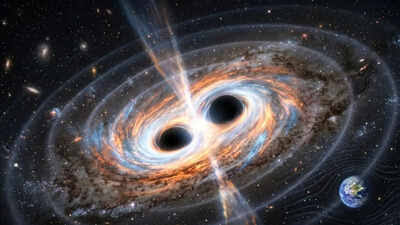
Two German physicists say collapsing stars might not crush themselves into black holes at all — they might give birth to brand-new universes instead
The breakthrough comes from Daniel Jampolski and his advisor Professor Luciano Rezzolla of Goethe University Frankfurt. Their paper, "Formation of Gravastars," published this month in Physical Review D, answers a question that has nagged physicists for over two decades: if gravastars exist, how would one actually form?
Gravastars — short for "gravitationally vacuum stars" — aren't a new idea. Physicists have floated the concept since the early 2000s as a theoretical alternative to black holes, precisely because gravastars sidestep two troublesome features: the singularity (a point of infinite density where physics breaks down) and the event horizon (the point of no return). A gravastar is almost as massive and compact as a black hole, but has neither — it's a black hole impersonator.
The problem, until now, was that nobody had produced a rigorous, dynamic model showing how a real collapsing star could actually become one. Jampolski and Rezzolla's paper — which grew out of Jampolski's master's thesis — represents the first dynamic solution demonstrating exactly how the transformation could unfold in real time.
A Big Bang Where a Black Hole Should Be
So how does a dying star avoid becoming a black hole? The answer lies in one of the strangest ingredients in modern physics: dark energy — the mysterious force driving the accelerating expansion of our own universe.
"The Big Bang of the emerging universe can unfold once the star has already collapsed almost to the point of becoming a black hole," Jampolski explained. As the star's core implodes, the model shows that — under the right conditions — collapsing matter can undergo an internal phase transition, flooding the interior with dark energy. That repulsive push begins shoving back against gravity's inward crush.
The result is a cosmic tug-of-war: gravity hauls matter inward, while dark energy inflates a tiny pocket of spacetime from the inside. If the timing lines up, the outward push can halt gravitational collapse before an event horizon ever closes — freezing the object in a stable standoff between implosion and explosion.
What's left is a layered structure like a Russian nesting doll: an outer shell of compressed matter wrapped around an interior cavity filled with dark energy — effectively the seed of its own self-contained universe, undergoing its own private, miniature Big Bang.
Expert Perspective: Brilliant, But Still Needs Proof
Reaction to gravastar theory has long ranged from "outstandingly brilliant" to "unlikely" — and that split hasn't disappeared with this new paper. The core challenge is observational: as of today, there is no confirmed direct evidence that gravastars exist anywhere in the universe.
Gravastars are frustratingly good at hiding. Because they'd be nearly as massive and compact as black holes, current instruments struggle to tell them apart. When LIGO and Virgo detected gravitational waves from colliding compact objects, the pattern matched black hole predictions almost exactly — but gravastars might produce nearly identical signals.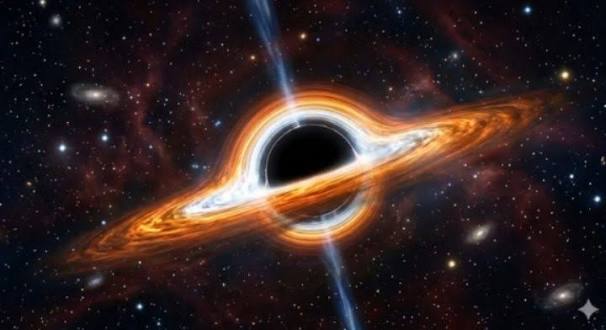
What makes the Jampolski-Rezzolla paper significant isn't proof of existence — it's that it closes a major theoretical gap. Critics had long pointed to the absence of a believable mechanism for how gravastars could form. By rooting the process in Einstein's field equations and tying it to dark energy, the new work gives gravastar advocates something they didn't have before: a believable origin story.
What This Means for You
It probably won't change your life directly — no gravastar is showing up in your neighborhood. But it cuts to one of the most fundamental questions in physics: what is actually happening inside the most extreme objects in the universe?
If gravastars are confirmed, it would mark one of the most significant revisions to our understanding of gravity and cosmology in decades — potentially resolving the "singularity problem" that has nagged physicists since Einstein's own equations first predicted black holes. It would also reframe a popular question: could our own universe's Big Bang have started exactly this way, nested inside the collapsing remnant of some progenitor star in a universe that came before?
For now, the idea remains theoretical — a beautiful piece of mathematics rather than confirmed reality. But theoretical breakthroughs like this are precisely how science narrows the list of possibilities: by forcing skeptics to argue not against a vague hypothesis, but against a fully worked physical mechanism.
The Bottom Line
Somewhere out in the universe, right now, a massive star may be in its final death throes — and according to Jampolski and Rezzolla's model, that star's last act might not be a destructive implosion into a black hole, but a quiet, internal Big Bang, birthing an entirely new universe hidden inside what looks, from our vantage point, like just another dense, dark stellar corpse.
Astrophysicists won't be rewriting textbooks based on one paper, and a confirmed gravastar detection remains over the horizon. But for the first time, there's a rigorous, physics-based story for how it could happen — and that has sent a ripple of genuine excitement through a field that doesn't get surprised very often.
Source: "Formation of Gravastars" — Jampolski & Rezzolla, Physical Review D (June 2026)



