Vancouver / Brussels
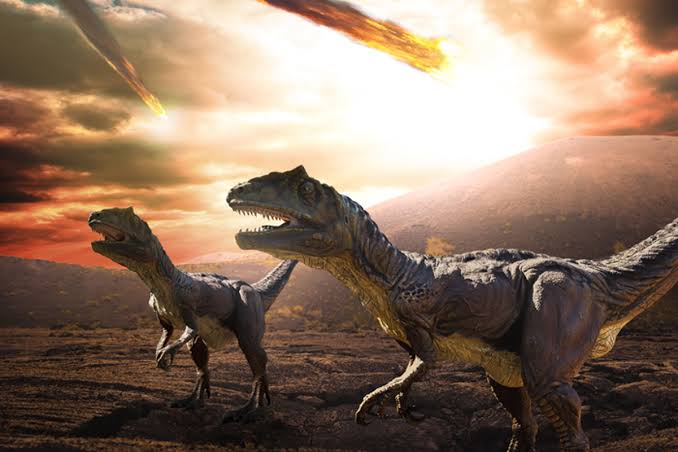
Sixty-six million years ago, a rock roughly the size of Mount Everest's base slammed into the shallow sea off what is now Mexico's Yucatán Peninsula at something like 64,000 kilometers per hour — twenty times the speed of a rifle bullet. It gouged a crater 180 kilometers wide, touched off earthquakes and tsunamis that circled the globe, and threw enough debris into the sky to block the sun for years. When the dust settled, roughly three-quarters of all species on Earth, including every non-avian dinosaur, were gone.
Every kid who's ever loved dinosaurs knows some version of that story. What nobody has been able to say with real confidence, until this week, is what the killer actually was made of.
An international team of researchers based at the University of British Columbia, working with colleagues from Brussels, Paris and Vienna, has finally pinned down the chemical fingerprint of the Chicxulub impactor, and the answer is stranger than the standard textbook telling. Publishing in the journal Science Advances, the team reports that the asteroid wasn't an ordinary rocky body of the kind most frequently found in meteorite collections. It was a CO chondrite — a rare, primitive class of carbonaceous meteorite that makes up only a sliver of a sliver of the rocks that fall to Earth.
"Carbonaceous chondrites of the Ornans class are definitely not like the typical meteors you find in museum collections," said Dr. Philippe Claeys, a geochemistry professor at Vrije Universiteit Brussel who worked on the study as a visiting professor at UBC's Pacific Centre for Isotopic and Geochemical Research. "A CO contains much less volatile elements — like carbon, zinc, water and particularly sulphur — than other classes of meteorites we've discovered so far on Earth."
How Do You Fingerprint Something That Vaporized?
Here's the part that makes this genuinely impressive detective work: nobody has a chunk of the Chicxulub asteroid sitting in a lab. The impact itself was so violent that the object essentially ceased to exist as a rock the instant it struck — vaporized, along with a huge portion of the Yucatán seafloor, in a fireball hotter than the surface of the sun.
"This is challenging work," Claeys said. "Only a minute fraction of the projectile is preserved in the planet's KT clay layer because the entire meteorite vaporized upon impact."
What survives is a thin, dark band of clay found at what geologists call the K-Pg boundary — the line in the rock record, found on every continent, marking the exact moment the Cretaceous period ended and the Paleogene began. That millimeters-thin layer is laced with trace amounts of material from the vaporized asteroid, mixed in with pulverized Earth crust and soot from global wildfires.
The team collected K-Pg boundary clay samples from sites around the world and ran them through high-precision nickel isotope analysis — a technique that measures the ratios of different nickel isotopes with enough sensitivity to distinguish between subtly different families of meteorites, even when the sample itself is a barely-there trace smeared across a geological layer laid down 66 million years ago. Nickel is useful here specifically because asteroids and Earth's crust inherited different nickel isotope signatures from the early solar system, and those signatures survive vaporization and mixing in ways that are still detectable today with the right instruments.
The isotope ratios pointed unambiguously toward one specific, unusual family: CO chondrites, meteorites poor in volatile elements like sulfur, carbon, zinc and water, named for the Ornans meteorite that fell in France in 1868 and first defined the class.

Why 'Rare' Matters: A Killer With A Different Weapon
For years, one of the leading theories about how the Chicxulub impact managed to cause a near-total extinction event centered on sulfur. The idea was straightforward: the Yucatán target rocks were rich in sulfur-bearing minerals, and the asteroid itself was assumed to carry a substantial sulfur payload too. Vaporize enough of both on impact, the thinking went, and you inject enormous quantities of sulfate aerosols into the stratosphere — chemically similar to what happens after a massive volcanic eruption — blocking sunlight, cooling the planet, and collapsing photosynthesis worldwide for years.
The new chemistry complicates that story. CO chondrites are, by definition, unusually poor in sulfur and other volatile elements compared to other meteorite classes. If the Chicxulub impactor really was this rare, sulfur-depleted type of rock, it means the asteroid itself likely wasn't contributing nearly as much sulfur to the atmosphere as the classic model assumed. That lines up with complementary recent research — including a 2024 Nature Communications study that separately found a "reduced contribution of sulfur" to the mass extinction, and a Nature Geoscience study pointing to fine silicate dust, rather than sulfur aerosols, as the dominant driver of the years-long "impact winter."
Put together, the emerging picture is that it wasn't primarily sulfur choking out the sun. It was ultra-fine dust — pulverized rock from both the asteroid and the Earth's own crust, ground down to particles small enough to linger in the upper atmosphere for years — that did most of the climate-wrecking work. That's a meaningful shift in the scientific narrative: the "gun" that killed the dinosaurs may have been loaded with a different kind of ammunition than researchers assumed for decades.
Where Did This Thing Even Come From?
CO chondrites are thought to originate either from the outer reaches of the asteroid belt, in the neighborhood of Jupiter, or potentially from even further out in the solar system, among the icy, rocky debris of the outer planetary region. That's notable because it means the dinosaur-killer likely wasn't a garden-variety near-Earth asteroid of the kind that gets tracked and cataloged by planetary defense programs today, which tend to be dominated by more common, ordinary chondrite and stony compositions. It may have been a comparatively rare visitor, flung inward from much farther away by a gravitational nudge from Jupiter or a collision deep in the asteroid belt, on a one-way trip that happened to intersect Earth's orbit at exactly the wrong moment 66 million years ago.
Carbonaceous chondrites as a whole make up only about 5 percent of meteorites recovered on Earth. CO chondrites are a small fraction even within that already-small group, making Chicxulub's identification as one somewhat like discovering that a specific, once-in-a-hundred-million-years catastrophe was caused by one of the rarest possible culprits, rather than a common one.
Expert Perspective
Claeys and his co-authors are careful to frame this as a chemistry breakthrough rather than a full rewrite of extinction mechanics — the fine-dust-cooling hypothesis was already gaining ground before this study, and this new work provides an independent, complementary line of evidence rather than an isolated bombshell. But the nickel isotope method itself is being highlighted by planetary scientists as a template other researchers can now apply to other impact craters and boundary layers worldwide, potentially letting scientists fingerprint the culprits behind other, less famous mass extinction events in Earth's deep history where the impactor itself left no surviving fragments at all.
That's arguably the quietly bigger story here: for a field that has had to work almost entirely with indirect evidence — crater size, boundary clay chemistry, computer models of atmospheric dust loading — having a reliable technique to identify what kind of object caused an ancient impact, even when literally none of the object survives, is a genuine methodological leap forward, not just a one-off answer about one famous rock.
What This Means For You
You are, obviously, not going to be personally affected by a 66-million-year-old asteroid strike. But this kind of research matters more than pure dinosaur trivia for a few reasons. First, it sharpens scientists' understanding of what actually makes an asteroid impact catastrophic for a planet's climate and biosphere — composition, not just size, appears to matter enormously, which has real implications for how seriously planetary defense agencies should weigh the specific makeup of any future near-Earth object detected on a collision course, not just its diameter.
Second, it's a reminder that the objects capable of reshaping life on Earth aren't necessarily the common, well-cataloged kind that asteroid-tracking telescopes are best tuned to spot. If dangerous impactors can occasionally be rare compositional oddballs from the far outer solar system, that's a data point worth folding into how agencies like NASA and ESA prioritize their sky surveys and characterize the risk posed by objects they do find, beyond simply measuring how big they are and how close their orbit comes to ours.
Finally, there's the simple, durable appeal of finally answering a question this old and this famous. Paleontologists and geologists have spent nearly half a century, since the original Alvarez asteroid-impact hypothesis was proposed in 1980, arguing over exactly what struck Earth and precisely how it killed so much of the planet's life so quickly. Getting an actual chemical fingerprint of the culprit — not a guess, not a model, but a measured isotopic signature pulled from clay laid down the year it happened — is the kind of definitive answer this particular scientific mystery has been waiting on for a generation.
The Bottom Line
The rock that ended the age of dinosaurs has finally given up its chemical secret, and it turns out to have been a rare, sulfur-poor traveler likely flung in from the distant reaches of the solar system rather than an unremarkable chunk of nearby space debris. It's a small, precise answer to one of the biggest questions in the history of life on Earth — and a reminder that sometimes the extinction-level events that reshape a planet come from the strangest, least expected corners of the universe.
Published By | News Editor