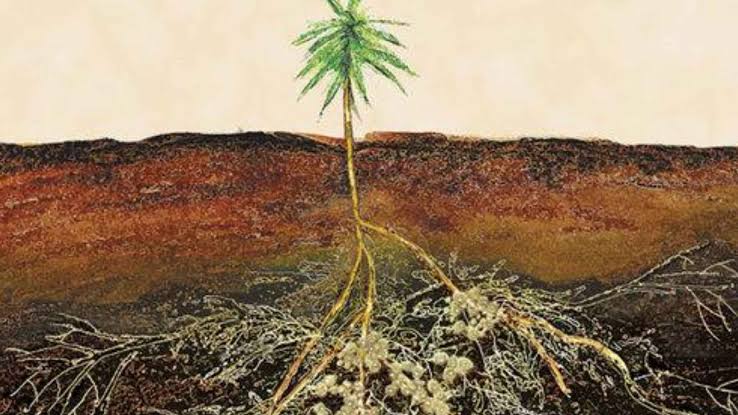
The Discovery: An Underground Network Weighing More Than Every Human on Earth Is Quietly Running the Planet's Climate System
LONDON/GLOBAL
Right now, beneath the ground you're standing on, there is a network so vast that scientists struggle to even describe its size using numbers that make sense to the human brain.
Try this one: if you pulled every thread of it straight and laid the pieces end to end, they would stretch roughly 110 quadrillion kilometers — about 68 quadrillion miles. That is close to one billion times the distance from the Earth to the sun. Or, as one team member put it, long enough to span roughly 10 percent of the width of the entire Milky Way galaxy.
It isn't cable. It isn't pipeline. It's fungus — and until this week, nobody had ever measured how much of it actually exists.
A team of researchers, in a study published in the journal Science and led by Justin Stewart of the Society for the Protection of Underground Networks (SPUN), has produced the first-ever global map of arbuscular mycorrhizal fungi — the microscopic thread-like structures, called hyphae, that live in soil and form partnerships with the roots of the vast majority of plants on Earth. The results, released in mid-June, are already being described by scientists as one of the most significant ecological mapping efforts in a generation.
What Exactly Did They Find?
The research team assembled data from 322 separate studies, pulling in more than 16,000 individual soil core samples collected across nine of the planet's biomes — from the frozen tundra to tropical rainforest to the American grasslands. They fed that data into machine-learning models trained to predict how dense these fungal networks are in soils around the globe, then calibrated their estimates using robotic imaging of more than 300,000 individual hyphae under the microscope.
The headline numbers are almost impossible to picture. Global topsoils, the study estimates, contain approximately 110 quadrillion kilometers of living fungal hyphae. That network has a combined mass of roughly 300 megatons of carbon — somewhere between four and six times the total mass of every human being alive on Earth today. And it isn't just sitting there: this fungal web is estimated to pull about 4 billion tons of carbon dioxide out of the atmosphere and into the soil every single year, making it one of the planet's most important — and most invisible — climate regulators.
To put the density in perspective, Stewart offered a striking image for reporters: there could be up to 10 meters — about 32 feet — of mycorrhizal fungal thread packed into a single teaspoon of healthy soil.
Some regions turned out to be far richer in this hidden infrastructure than others. Grasslands, the study found, hold roughly 40 percent of the entire planet's arbuscular mycorrhizal network, with especially dense concentrations found in places like Florida's Everglades and the wetlands of South Sudan — ecosystems most people would never associate with record-setting biological infrastructure.
Why Have We Never Measured This Before?
The honest answer is that mapping something this small, this widespread, and this deeply buried is brutally difficult. Unlike forests, which can be measured from satellites, or ocean plankton, which can be sampled by ship, mycorrhizal networks live entirely underground, in threads often thinner than a human hair, mixed into soil that varies wildly from one square meter to the next.
That's exactly why the SPUN-led team turned to machine learning. By training statistical models on the patterns found in those 16,000 soil cores — accounting for local climate, soil chemistry, vegetation type, and land use — the researchers could extrapolate reasonable estimates for places on Earth that have never had a single fungal soil sample taken. It's the ecological equivalent of using scattered weather stations to build a complete global temperature map.
The result is what SPUN is calling "A Hidden Infrastructure" — a public global mapping project intended to help conservationists, farmers, and policymakers actually see, for the first time, an ecological system that has been operating in total obscurity for as long as land plants have existed, roughly 450 million years.
The Uncomfortable Discovery: Farming Is Quietly Destroying It
Buried inside the celebratory headlines about the scale of this discovery is a warning that should worry anyone who cares about soil health, food security, or climate change.
The study found that when natural grassland is converted into cropland — the kind of large-scale industrial agriculture that produces much of the world's grain, soy, and corn — the density of arbuscular mycorrhizal fungal networks drops by an average of 47 percent compared to the same land left in its natural grassland state. At a global scale, the researchers concluded, modern agriculture is systematically thinning out one of the planet's most important carbon-capture systems, acre by acre, harvest by harvest.
That matters because these fungal networks don't just store carbon — they actively help plants absorb water and nutrients, resist drought, and fend off some pathogens, in exchange for sugars the plant produces through photosynthesis. It's a partnership that has quietly underpinned life on land for hundreds of millions of years. Damage the fungal side of that partnership, and you don't just lose an interesting organism — you potentially weaken the resilience of the entire food system built on top of it.
Expert Perspective
Researchers involved with the mapping project have been careful to frame this not as an alarmist story but as a call to pay attention to something that has simply never been on humanity's radar. As Stewart and colleagues have noted in describing the "Hidden Infrastructure" project, the goal is to give conservationists and land managers an actual, data-backed map — rather than a vague sense — of where these networks are thickest, where they're most at risk, and where protecting or restoring them could deliver the biggest climate and agricultural payoff per acre.
Outside commentators covering the study have compared its significance to early global forest-cover mapping efforts: before those maps existed, deforestation was something people knew was happening in a general sense; once the maps existed, it became possible to target conservation dollars and policy at the specific places doing the most damage or holding the most value. Scientists are hoping this new fungal map does the same thing for what happens beneath the soil surface.
What This Means for You
You don't need to own a farm or study biology for this to matter to your life. This research touches nearly everyone through three direct channels.
Food: A huge share of the crops that end up on your dinner table — wheat, soybeans, most fruits and vegetables — depend on these same mycorrhizal partnerships to extract nutrients and water from soil efficiently. A 47 percent decline in network density on converted farmland isn't just an ecological statistic; over time, it can translate into soil that needs more synthetic fertilizer, holds water less effectively during droughts, and produces lower long-term yields without heavy chemical inputs.
Climate: With roughly 4 billion tons of CO2 being cycled into soil by these fungi every year, this network functions as a carbon sink on a scale that rivals major forest systems. Any policy conversation about "natural climate solutions" — a phrase that usually conjures images of tree planting — arguably needs to include soil fungi as a legitimate, quantifiable lever, not an afterthought.
Everyday decisions: For home gardeners and even backyard composters, the study reinforces something regenerative-agriculture advocates have argued for years — tilling soil aggressively and relying purely on synthetic fertilizer can physically sever these fungal threads, while reduced tillage, cover cropping, and diverse plantings tend to preserve them.
The Bigger Picture
This discovery arrives at a moment when climate policy circles are increasingly focused on so-called "natural climate solutions" — using ecosystems themselves, rather than purely mechanical carbon capture, to slow the buildup of greenhouse gases. Forests and wetlands have dominated that conversation for years. This study is a strong argument that soil fungi deserve a seat at that table too, given a carbon storage contribution that, by these estimates, rivals entire biomes most people can actually see.
It also lands amid a broader wave of "invisible infrastructure" science making headlines in 2026 — from newly mapped ocean microbial systems to satellite tracking of previously unmonitored methane sources. Taken together, these studies suggest that some of the most consequential systems regulating Earth's climate aren't the ones we can photograph from space, but the ones quietly operating in the dark, whether that's underground, undersea, or inside a single teaspoon of dirt.
Conclusion
For centuries, humans have mapped mountains, oceans, forests, and now even distant planets, while one of the largest living structures on the planet sat completely unmeasured, a few inches beneath our shoes. Now that scientists finally have a number to attach to it — 110 quadrillion kilometers, 300 megatons, a billion round trips to the sun — the challenge shifts from discovery to protection. Whether policymakers, farmers, and conservationists actually use this new map to change how land gets managed may determine whether this invisible infrastructure keeps doing its quiet climate work for the next 450 million years, or slowly erodes under the weight of the very agriculture that depends on it.
Published By | Tech Wiz