CAMBRIDGE, Mass.
For nine years, a small, unassuming red dwarf star sitting 48 light-years from Earth has been taunting astronomers with a single, maddening question: does the rocky world orbiting it actually have air? On July 16, in the pages of the journal Science, a team led by a Harvard astronomer who only recently finished his Ph.D. delivered the answer the exoplanet-hunting world has been chasing for a generation. Yes. LHS 1140 b, a rocky "super-Earth" roughly 5.6 times as massive as our own planet, is holding onto an atmosphere — and it is doing it while parked squarely inside its star's habitable zone, the narrow band of orbital real estate where temperatures allow liquid water to pool on a planet's surface instead of freezing solid or boiling away.
It sounds like a small thing. It is not. For as long as astronomers have been finding rocky planets in the habitable zones of other stars, those planets have, one after another, turned out to be bare, airless cinders — worlds stripped of every trace of atmosphere by the violent tempers of the small, dim stars they orbit. LHS 1140 b is the first one that has broken the pattern. And that single fact has planetary scientists using words they typically reserve for the biggest discoveries of their careers.
The Discovery That Changes Everything
The finding centers on helium — the second-lightest element in the universe and, conveniently for astronomers, one of the easiest gases to spot leaking off a distant world. Because helium atoms are so small and light, they are among the first casualties when a planet's atmosphere gets blasted by high-energy radiation from its star. Watching helium stream off a planet into space is, in effect, watching the smoke rise from a fire — indirect, but unmistakable evidence that there is something substantial underneath being burned away.
Researchers led by Dr. Collin Cherubim of Harvard University, working with an international collaboration of astronomers, spotted exactly that signature: an excess absorption feature consistent with escaping helium during a transit of LHS 1140 b, the tell-tale sign of a hydrodynamic atmospheric outflow driven by X-ray and extreme-ultraviolet radiation pouring off the planet's host star. In plain English, the planet has an atmosphere substantial enough that some of it is now being peeled away and blown into space — and scientists caught it in the act.
"An atmosphere is essential for a planet to support life as we know it," Cherubim said of the discovery, a comment that undersells just how long the field has waited to be able to say those words about a habitable-zone rocky world with a straight face.
Meet LHS 1140 b: The Planet That Wouldn't Quit
LHS 1140 b has had one of the more dramatic identity crises in modern exoplanet science. It was first discovered in 2017 by the ground-based MEarth Project, which flagged a rocky world orbiting a red dwarf star roughly 5.6 times the mass of Earth and about 70% larger in radius — comfortably in the "super-Earth" category, and comfortably within its star's habitable zone. For a few years after its discovery, some researchers suspected it might actually be a puffy, Neptune-like mini-gas world rather than a true rocky planet, a classification mix-up that has snagged more than one promising exoplanet before.
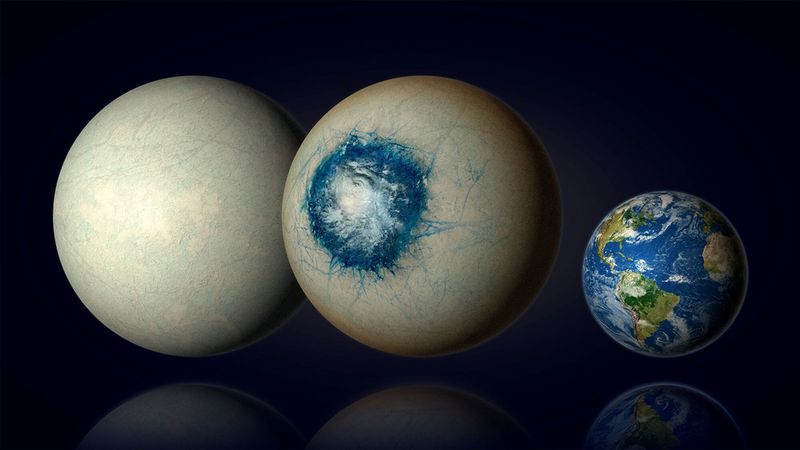
The plot thickened in late 2020, when the Hubble Space Telescope picked up a faint, low-confidence hint of water vapor in the planet's atmosphere — tantalizing, but far too weak a signal to hang a discovery on. The real turning point came in December 2023, when the James Webb Space Telescope trained its infrared eyes on LHS 1140 b and gathered data that, combined with older observations from Hubble, Spitzer and TESS, ruled out a puffy, hydrogen-dominated envelope once and for all. What was left on the table instead was arguably more exciting: the possibility that LHS 1140 b is a genuine ocean world, its surface — or at least a thick, high-molecular-weight atmosphere of nitrogen, water vapor and carbon dioxide — potentially capable of supporting liquid water. Some researchers have floated the idea of a world locked in a permanent "eyeball" configuration, with a perpetual dayside ocean facing its star and an icy nightside frozen in the dark.
The new helium detection does not settle every open question about what, exactly, is happening on the planet's surface. But it does something arguably more foundational: it confirms that whatever is down there is wrapped in a real, substantial atmosphere — not a bare rock, not a scorched cinder, but a world with air worth studying.
How They Found It: Six and a Half Hours in the Chilean Mountains
The breakthrough observation happened in September 2024, though it took nearly two years of analysis to confirm and publish. Cherubim's team pointed the Magellan Clay Telescope, perched high in the Andes at Chile's Las Campanas Observatory, at the LHS 1140 system during a rare 6.5-hour window in which both LHS 1140 b and its smaller sibling planet, LHS 1140 c, transited their star in quick succession. As LHS 1140 b passed in front of its star from Earth's vantage point, starlight filtering through the thin sliver of the planet's atmosphere carried a chemical fingerprint back to the telescope's spectrograph — and buried in that fingerprint was the unmistakable absorption signature of helium being stripped away.
The technique itself — transit spectroscopy — is the same basic method astronomers have used for years to sniff out atmospheres on gas giants and hot, blazing worlds close to their stars. Applying it successfully to a small, rocky, temperate planet is a far harder trick, because the atmospheric signal on a rocky world is minuscule compared to the overwhelming brightness of its star. That LHS 1140 b's home star, LHS 1140, is unusually dim, small and calm for a red dwarf made the observation possible at all.
Why A Quiet Star Matters
Here is the part that has astrobiologists particularly excited: most red dwarf stars, the most common type of star in the galaxy, are notoriously bad neighbors. They flare violently and unpredictably, hurling out blasts of X-ray and ultraviolet radiation and streams of charged particles that can sandblast the atmosphere off any planet orbiting too close — which, because red dwarfs are so dim, is exactly where a planet needs to be to stay warm enough for liquid water. It's a cruel cosmic irony that has haunted the search for habitable worlds around the galaxy's most abundant stars: the habitable zone around a red dwarf is often also the blast radius.
LHS 1140, by the standards of its stellar family, is remarkably well-behaved. It is quieter and less prone to violent flaring than many of its red dwarf peers, and researchers believe that relative calm is precisely why LHS 1140 b has managed to hold onto enough atmosphere to still be leaking helium detectably, rather than having been stripped bare eons ago. In other words: LHS 1140 b may be less a planet that got lucky on composition, and more a planet that got lucky on neighbors.

Expert Perspective
Scientific commentary on the discovery has leaned heavily on how many prior candidates disappointed. Coverage of the result in the scientific press noted that for years, astronomers kept finding rocky planets sitting in the habitable zones of nearby stars, only to discover, one dispiriting result after another, that those planets were bare, airless cinders — worlds like several of the rocky planets in the TRAPPIST-1 system, where JWST observations have repeatedly come back empty-handed on atmospheric signatures. LHS 1140 b, announced this month in Science, is being described as the first one that has broken that streak: a world with a surface temperature that plausibly allows liquid water, orbiting a quiet-enough star to let both the water and the air stick around.
"An atmosphere is essential for a planet to support life as we know it," — Dr. Collin Cherubim, Harvard University, lead author of the study
Independent astronomers not involved in the study have been quick to caution that a detected atmosphere is not the same thing as detected life, or even detected biosignatures — helium leaking into space tells scientists that gas is present and escaping, not what that gas is made of, and certainly not whether anything is swimming in an ocean beneath it. But among planetary scientists, the distinction between "maybe there's an atmosphere" and "confirmed, there's an atmosphere" is enormous, and it is the distinction LHS 1140 b just crossed.
What This Means For You
You will not be booking a flight to LHS 1140 b anytime soon — at 48 light-years away, a radio signal sent today would arrive around the year 2074, and any spacecraft built with current technology would take tens of thousands of years to make the trip. But the discovery matters enormously for anyone curious about whether humanity is alone in the universe, because it reshapes the odds. Every rocky, temperate world that turned out to be airless has quietly dragged down optimism about how common truly habitable planets might be. LHS 1140 b flips that trend, and it does so around a red dwarf — the most common type of star in the Milky Way, meaning that if quiet red dwarfs like LHS 1140 are more common than assumed, the galaxy's inventory of atmosphere-retaining, temperate rocky worlds could be far larger than current estimates suggest.
The discovery is also a preview of what is coming. NASA and international partners are already planning next-generation missions, including the Habitable Worlds Observatory, explicitly designed to characterize atmospheres on rocky planets like this one in far greater detail, hunting for oxygen, ozone, methane and other potential signs of biological activity. LHS 1140 b, sitting relatively close by in cosmic terms and now confirmed to have real atmosphere to study, has instantly become one of the top targets for that kind of follow-up — a proving ground for the tools and techniques that will eventually be pointed at dozens of similar worlds.
Conclusion
Nine years ago, LHS 1140 b was a blip in ground-based survey data, quickly filed away as maybe-a-mini-Neptune. Today it is the first confirmed case of a rocky planet in a star's habitable zone that has managed to keep its atmosphere — a title that, for as long as astronomers have been hunting for potentially habitable worlds, no planet has ever definitively earned. Nobody is claiming LHS 1140 b is inhabited. But for the first time, scientists can say with confidence that one of the basic ingredients for life as we understand it — air — is actually there, 48 light-years away, wrapped around a rocky world orbiting a surprisingly gentle little star. In a search that has produced far more disappointment than triumph, that is being treated, deservedly, as a very big deal.
Published By | Tech Wiz